Jules Matthieu
Micalis Institute, INRA, AgroParisTech, Université Paris-Saclay, 78350 Jouy-en-Josas, France.
Microb Cell. 2017 Dec 11;5(1):56-59. doi: 10.15698/mic2018.01.610.
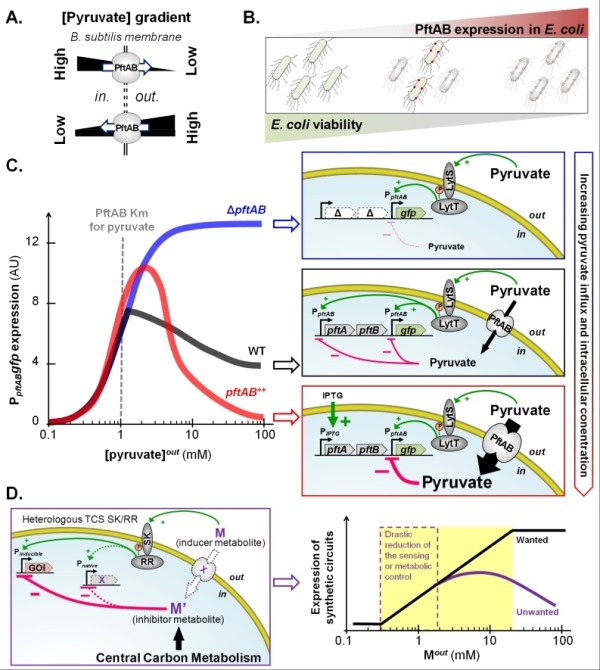
Synthetic Biology (SB) aims at the rational design and engineering of novel biological functions and systems. By facilitating the engineering of living organisms, SB promises to facilitate the development of many new applications for health, biomanufacturing, and the environment. Over the last decade, SB promoted the construction of libraries of components enabling the fine-tuning of genetic circuits expression and the development of novel genome engineering methodologies for many organisms of interest. SB thus opened new perspectives in the field of metabolic engineering, which was until then mainly limited to (over)producing naturally synthesized metabolic compounds. To engineer efficient cell factories, it is key to precisely reroute cellular resources from the central carbon metabolism (CCM) to the synthetic circuitry. This task is however difficult as there is still significant lack of knowledge regarding both the function of several metabolic components and the regulation of the CCM fluxes for many industrially important bacteria. Pyruvate is a pivotal metabolite at the heart of the CCM and a key precursor for the synthesis of several commodity compounds and fine chemicals. Numerous bacterial species can also use it as a carbon source when present in the environment but bacterial, pyruvate-specific uptake systems were to be discovered. This is an issue for metabolic engineering as one can imagine to make use of pyruvate transport systems to replenish synthetic metabolic pathways towards the synthesis of chemicals of interest. Here we describe a recent study (MBio 8(5): e00976-17), which identified and characterized a pyruvate transport system in the Gram-positive (G) bacterium , a well-established biotechnological workhorse for the production of enzymes, fine chemicals and antibiotics. This study also revealed that the activity of the two-component system (TCS) responsible for its induction is retro-inhibited by the level of pyruvate influx. Following up on the open question which is whether this retro-inhibition is a generic mechanism for TCSs, we will discuss the implications in metabolic engineering.
合成生物学(SB)旨在对新型生物功能和系统进行合理设计与工程构建。通过推动对生物体的工程改造,合成生物学有望促进健康、生物制造及环境领域诸多新应用的开发。在过去十年中,合成生物学推动了元件库的构建,这些元件库能够实现对基因回路表达的精细调控,并为许多目标生物体开发新的基因组工程方法。因此,合成生物学在代谢工程领域开辟了新的前景,在此之前,代谢工程主要局限于(过量)生产天然合成的代谢化合物。要构建高效的细胞工厂,关键在于将细胞资源从中心碳代谢(CCM)精确地重新导向合成回路。然而,这项任务颇具难度,因为对于许多具有工业重要性的细菌,目前在几个代谢元件的功能以及CCM通量的调控方面仍存在重大知识缺口。丙酮酸是CCM核心的关键代谢物,也是多种商品化合物和精细化学品合成的关键前体。当环境中存在丙酮酸时,许多细菌物种也能将其用作碳源,但细菌特异性的丙酮酸摄取系统有待发现。这对于代谢工程来说是个问题,因为人们可以设想利用丙酮酸转运系统来补充合成代谢途径,以合成目标化学品。在此,我们描述一项近期研究(《MBio》8(5): e00976 - 17),该研究鉴定并表征了革兰氏阳性(G)细菌中的一种丙酮酸转运系统,这种细菌是生产酶、精细化学品和抗生素的成熟生物技术主力菌株。该研究还表明,负责诱导该转运系统的双组分系统(TCS)的活性会受到丙酮酸流入水平的逆向抑制。针对这一尚未解决的问题,即这种逆向抑制是否是TCS的普遍机制,我们将讨论其在代谢工程中的意义。