Heffernan Alastair, Barber Ella, Cook Nicola A, Gomaa Asmaa I, Harley Yolande X, Jones Christopher R, Lim Aaron G, Mohamed Zameer, Nayagam Shevanthi, Ndow Gibril, Shah Rajiv, Sonderup Mark W, Spearman C Wendy, Waked Imam, Wilkinson Robert J, Taylor-Robinson Simon D
Department of Infectious Disease Epidemiology, Faculty of Medicine, Imperial College London, London, UK.
Division of Infectious Diseases, Faculty of Medicine, Imperial College London, London, UK.
Open Forum Infect Dis. 2017 Nov 17;5(1):ofx252. doi: 10.1093/ofid/ofx252. eCollection 2018 Jan.
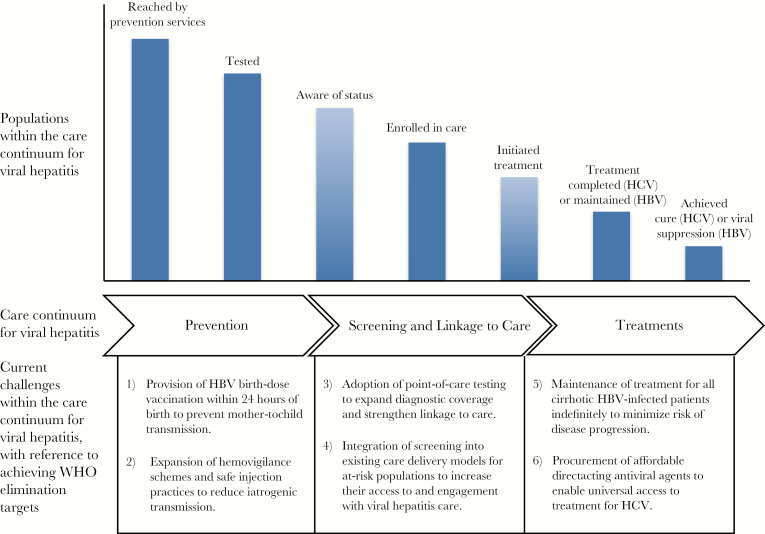
A recent international workshop, organized by the authors, analyzed the obstacles facing the ambitious goal of eliminating viral hepatitis globally. We identified several policy areas critical to reaching elimination targets. These include providing hepatitis B birth-dose vaccination to all infants within 24 hours of birth, preventing the transmission of blood-borne viruses through the expansion of national hemovigilance schemes, implementing the lessons learned from the HIV epidemic regarding safe medical practices to eliminate iatrogenic infection, adopting point-of-care testing to improve coverage of diagnosis, and providing free or affordable hepatitis C treatment to all. We introduce Egypt as a case study for rapid testing and treatment scale-up: this country offers valuable insights to policy makers internationally, not only regarding how hepatitis C interventions can be expeditiously scaled-up, but also as a guide for how to tackle the problems encountered with such ambitious testing and treatment programs.
作者组织的一次近期国际研讨会分析了在全球消除病毒性肝炎这一宏伟目标所面临的障碍。我们确定了几个对实现消除目标至关重要的政策领域。这些领域包括在婴儿出生后24小时内为所有婴儿提供乙肝首剂疫苗接种,通过扩大国家血液监测计划来预防血源性病毒的传播,借鉴艾滋病疫情中关于安全医疗实践的经验教训以消除医源性感染,采用即时检测以提高诊断覆盖率,以及为所有人提供免费或负担得起的丙型肝炎治疗。我们将埃及作为快速检测和治疗扩大规模的案例研究进行介绍:该国不仅为国际政策制定者提供了关于如何迅速扩大丙型肝炎干预措施规模的宝贵见解,还为如何应对此类雄心勃勃的检测和治疗计划中遇到的问题提供了指导。