
广义网络中由用户兴趣主导的信息传播分析与控制
Analysis and control of information diffusion dictated by user interest in generalized networks.
作者信息
Stai Eleni, Karyotis Vasileios, Papavassiliou Symeon
机构信息
School of Electrical and Computer Engineering, National Technical University of Athens (NTUA), 15780 Zografou, Athens, Greece.
出版信息
Comput Soc Netw. 2015;2(1):18. doi: 10.1186/s40649-015-0025-4. Epub 2015 Dec 2.
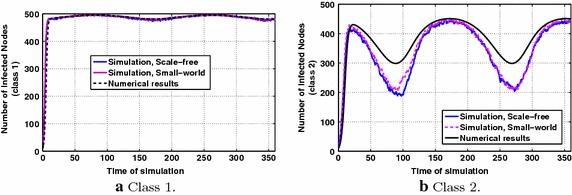
The diffusion of useful information in generalized networks, such as those consisting of wireless physical substrates and social network overlays is very important for theoretical and practical applications. Contrary to previous works, we focus on the impact of user interest and its features (e.g., interest periodicity) on the dynamics and control of diffusion of useful information within such complex wireless-social systems. By considering the impact of temporal and topical variations of users interests, e.g., seasonal periodicity of interest in summer vacation advertisements which spread more effectively during Spring-Summer months, we develop an epidemic-based mathematical framework for modeling and analyzing such information dissemination processes and use three indicative operational scenarios to demonstrate the solutions and results that can be obtained by the corresponding differential equation-based formalism. We then develop an optimal control framework subject to the above information diffusion modeling that allows controlling the trade-off between information propagation efficiency and the associated cost, by considering and leveraging on the impact that user interests have on the diffusion processes. By analysis and extensive simulations, significant outcomes are obtained on the impact of each network layer and the associated interest parameters on the dynamics of useful information diffusion. Furthermore, several behavioral properties of the optimal control of the useful information diffusion with respect to the number of infected/informed nodes and the evolving user interest are shown through analysis and verified via simulations. Specifically, a key finding is that low interest-related diffusion can be aided by utilizing proper optimal controls. Our work in this paper paves the way towards this user-centered information diffusion framework.
在诸如由无线物理底层和社交网络覆盖层组成的广义网络中,有用信息的传播对于理论和实际应用都非常重要。与先前的工作不同,我们关注用户兴趣及其特征(例如兴趣周期性)对这种复杂无线社交系统中有用信息传播动态和控制的影响。通过考虑用户兴趣的时间和主题变化的影响,例如对暑假广告的兴趣的季节性周期性,其在春夏季节传播得更有效,我们开发了一个基于传染病的数学框架来对这种信息传播过程进行建模和分析,并使用三个指示性操作场景来展示通过相应的基于微分方程的形式主义可以获得的解决方案和结果。然后,我们在上述信息传播建模的基础上开发了一个最优控制框架,通过考虑和利用用户兴趣对传播过程的影响,允许控制信息传播效率和相关成本之间的权衡。通过分析和广泛的模拟,我们获得了关于每个网络层和相关兴趣参数对有用信息传播动态影响的重要结果。此外,通过分析展示了有用信息传播的最优控制相对于受感染/被告知节点数量和不断变化的用户兴趣的几个行为特性,并通过模拟进行了验证。具体而言,一个关键发现是,利用适当的最优控制可以帮助低兴趣相关的传播。我们本文的工作为这种以用户为中心的信息传播框架铺平了道路。




 Zotero 插件