Torén L, Hebelka H, Kasperska I, Brisby H, Lagerstrand K
Department of Radiology, Sahlgrenska University Hospital, Gothenburg, Sweden.
Institute of Clinical Sciences, Sahlgrenska Academy, University of Gothenburg, Gothenburg, Sweden.
BMC Musculoskelet Disord. 2018 Jan 22;19(1):25. doi: 10.1186/s12891-018-1930-0.
Axial loading during MRI (alMRI) combined with T2 mapping recently was shown as a promising method to reveal biomechanical intervertebral disc (IVD) characteristics. This feasibility study aims to investigate whether there is a diurnal variation in the IVD T2-value when using alMRI. This is of importance for the planning of when to perform alMRI investigations and for interpretations of alMRI findings in relation to clinical symptoms.
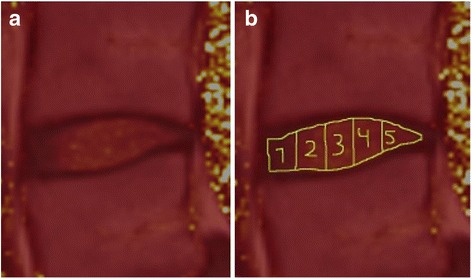
Six healthy volunteers (30 lumbar discs), were examined with alMRI at three different sessions during 1 day. To be representative for a low back pain cohort in terms of age and IVD degeneration the included participants had a wide age range (27-63y) and all Pfirrmann grades represented. The T2-values were measured in five IVD regions of interest (ROI). The ROIs were equally large in sagittal plane with ROI1 representing anterior parts of the IVD, ROI5 posterior IVD parts and ROI2-4 the parts in between.
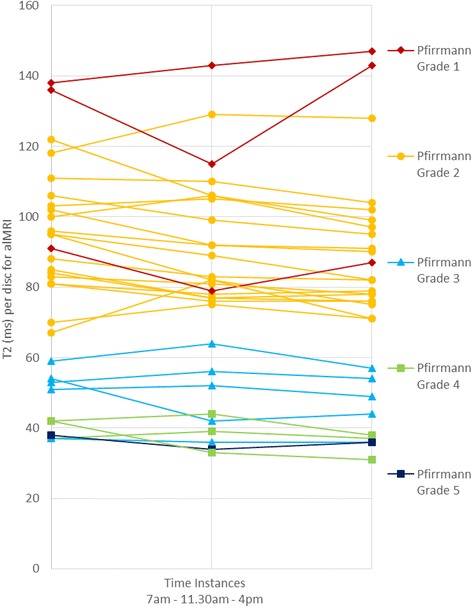
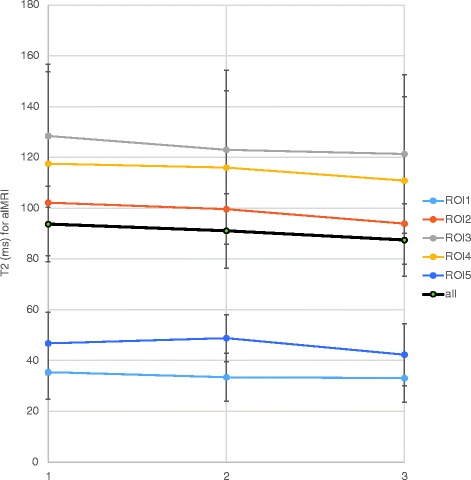
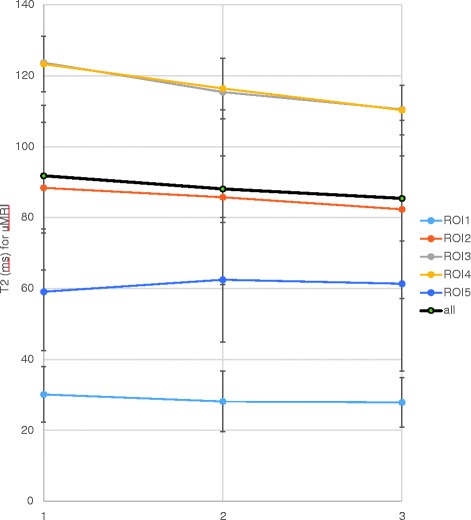
T2-values of the entire IVD varied between 38 and 138 ms at 7 am, 33-143 ms at 11.30 am, and 31-147 ms at 4 pm with large regional IVD variations at all time points. No significant alterations of the T2-values over the day were found, neither for the entire IVD (p = 0.4) nor for the various ROIs (p = 0.2-1.0). Neither when correlated to Pfirrmann grade, any significant diurnal T2-value changes were found.
With alMRI, only minor diurnal T2-value changes were found in the lumbar discs. Nonsignificant and neglectable diurnal changes are advantageous both for research purposes, as well as in the clinical setting, giving comparable and robust data regardless of at what time-point the alMRI is performed.
磁共振成像期间的轴向负荷(alMRI)结合T2映射最近被证明是一种揭示生物力学椎间盘(IVD)特征的有前景的方法。这项可行性研究旨在调查使用alMRI时IVD的T2值是否存在日变化。这对于规划何时进行alMRI检查以及解释与临床症状相关的alMRI结果具有重要意义。
6名健康志愿者(30个腰椎间盘)在一天中的三个不同时段接受alMRI检查。为了在年龄和IVD退变方面代表腰痛队列,纳入的参与者年龄范围广泛(27 - 63岁),涵盖了所有Pfirrmann分级。在五个IVD感兴趣区域(ROI)测量T2值。ROI在矢状面大小相同,ROI1代表IVD的前部,ROI5代表IVD的后部,ROI2 - 4代表其间部分。
整个IVD的T2值在上午7点时在38至138毫秒之间变化,上午11:30时在33 - 143毫秒之间变化,下午4点时在31 - 147毫秒之间变化,所有时间点IVD区域均存在较大差异。未发现全天T2值有显著变化,无论是整个IVD(p = 0.4)还是各个ROI(p = 0.2 - 1.0)。与Pfirrmann分级相关时,也未发现T2值有任何显著的日变化。
使用alMRI时,腰椎间盘的T2值仅存在微小的日变化。不显著且可忽略的日变化对于研究目的以及临床环境均有利,无论在何时进行alMRI检查,都能提供可比且可靠的数据。