State Key Laboratory of Biogeology and Environmental Geology, China University of Geosciences, Beijing, 100083, China.
School of the Earth Sciences and Resources, China University of Geosciences, Beijing, 100083, China.
Sci Rep. 2018 Jan 22;8(1):1365. doi: 10.1038/s41598-018-19877-y.
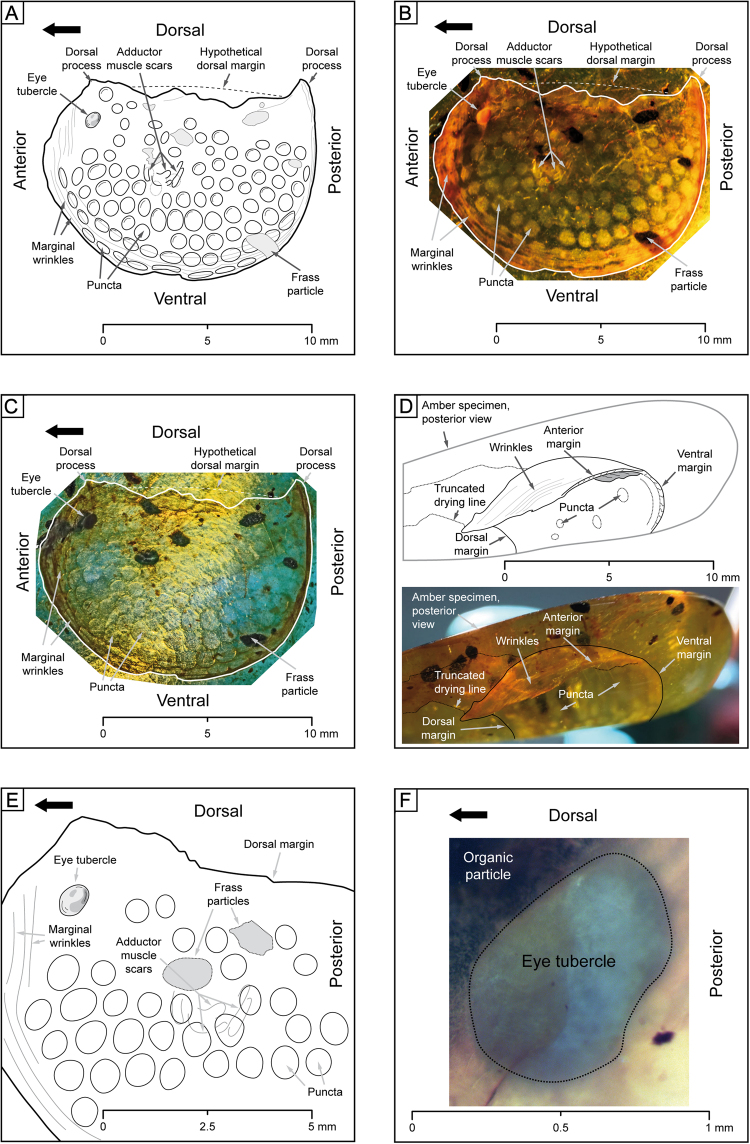
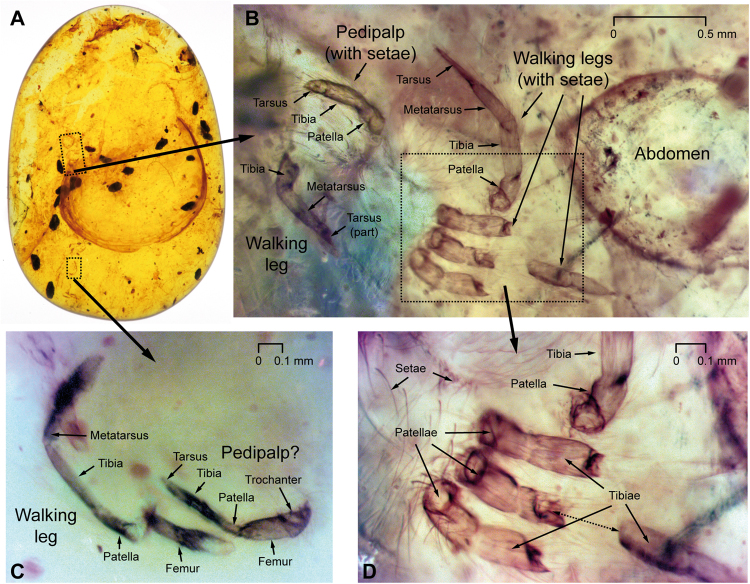
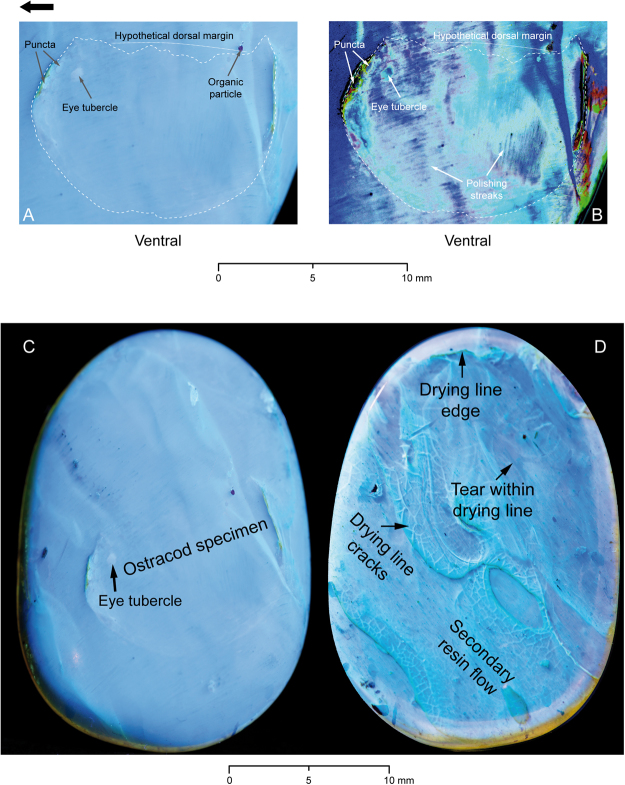
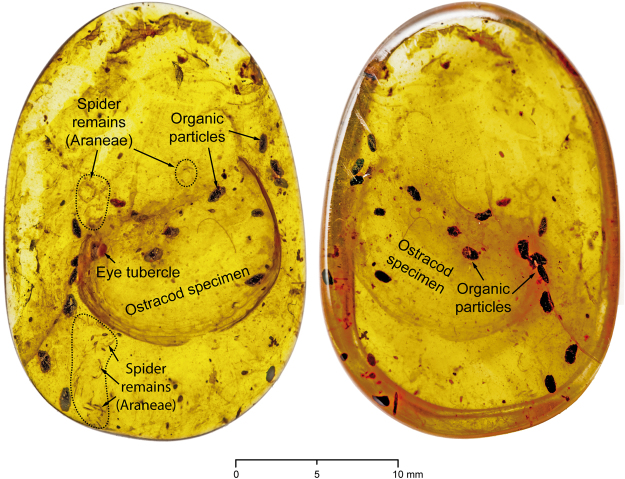
The mid-Cretaceous Burmese amber (99 Ma, Myanmar), widely known for exquisite preservation of theropods, also yields microfossils, which can provide important contextual information on paleoenvironment and amber formation. We report the first Cretaceous ostracod in amber-the gigantic (12.9 mm) right valve of an exclusively marine group (Myodocopa: Myodocopida) preserved in Burmese amber. Ostracods are usually small (0.5-2 mm), with well-calcified carapaces that provide an excellent fossil record extending to at least the Ordovician (485 million years ago), but they are rarely encountered in amber. The new specimen effectively doubles the age of the ostracod amber record, offering the first representative of the Myodocopa, a weakly calcified group with a poor fossil record. Its carapace morphology is atypical and likely plesiomorphic. The preserved valve appears to be either a moulted exuvium or a dead and disarticulated specimen, and subsequent resin flows contain forest floor inclusions with terrestrial arthropods, i.e., fragmentary remains of spiders, and insect frass. These features resolve an enigmatic taphonomic pathway, and support a marginal marine setting for resin production.
缅甸白垩纪中期琥珀(约 9900 万年前)以保存精美的兽脚亚目恐龙而闻名,也产有微体化石,这些化石可以为古环境和琥珀形成提供重要的背景信息。我们报告了首例保存在缅甸琥珀中的白垩纪介形虫——一种仅在海洋中生活的巨型(12.9 毫米)右瓣(Myodocopa: Myodocopida)。介形虫通常体型较小(0.5-2 毫米),外壳钙质化程度高,化石记录非常完整,可追溯到至少奥陶纪(约 4.85 亿年前),但它们在琥珀中很少见。这个新标本将介形虫琥珀记录的年龄有效地延长了一倍,提供了 Myodocopa 的首个代表,Myodocopa 是一个钙质化程度较弱、化石记录较差的群体。其外壳形态是非典型的,可能是原始的。保存下来的瓣壳似乎是蜕皮的外骨骼或死亡和解体的标本,随后的树脂流中包含有陆生节肢动物的森林地面杂物,即蜘蛛的碎片和昆虫粪便。这些特征解决了一个神秘的埋藏学途径,并支持树脂产生的边缘海洋环境。