Kling Catherine E, Perkins James D, Carithers Robert L, Donovan Dennis M, Sibulesky Lena
Division of Transplant Surgery, Department of Surgery, University of Washington, Seattle, WA 98195, United States.
Division of Gastroenterology and Hepatology, Department of Medicine, University of Washington, Seattle, WA 98195, United States.
World J Hepatol. 2017 Dec 28;9(36):1315-1321. doi: 10.4254/wjh.v9.i36.1315.
To examine temporal changes in the indications for liver transplantation (LT) and characteristics of patients transplanted for alcoholic liver disease (ALD).
We performed a retrospective cohort analysis of trends in the indication for LT using the United Network for Organ Sharing (UNOS) database between 2002 and 2015. Patients were grouped by etiology of the liver disease and characteristics were compared using χ and -tests. Time series analysis was used identifying any year with a significant change in the number of transplants per year for ALD, and before and after eras were modeled using a general linear model. Subgroup analysis of recipients with ALD was performed by age group, gender, UNOS region and etiology (alcoholic cirrhosis, alcoholic hepatitis and hepatitis C - alcoholic cirrhosis dual listing).
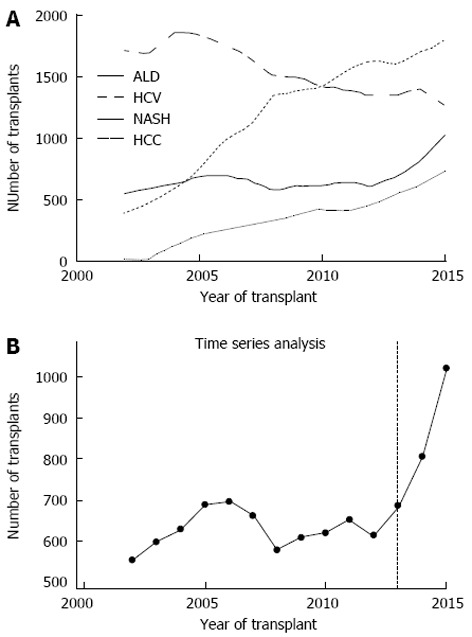
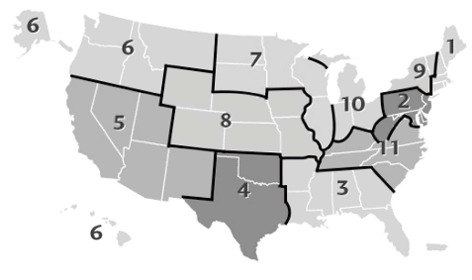
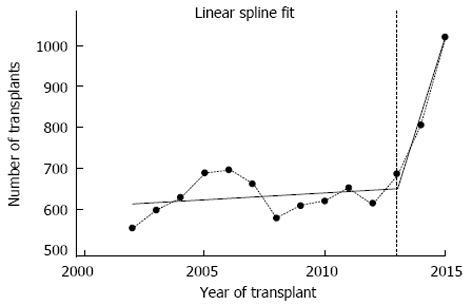
Of 74216 liver transplant recipients, ALD ( = 9400, 12.7%) was the third leading indication for transplant after hepatitis C and hepatocellular carcinoma. Transplants for ALD, increased from 12.8% (553) in 2002 to 16.5% (1020) in 2015. Time series analysis indicated a significant increase in the number of transplants per year for ALD in 2013 ( = 0.03). There were a stable number of transplants per year between 2002 and 2012 (linear coefficient 3, 95%CI: -4.6, 11.2) an increase of 177 per year between 2013 and 2015 (95%CI: 119, 234). This increase was significant for all age groups except those 71-83 years old, was observed for both genders, and was incompletely explained by a decrease in transplants for hepatitis C and ALD dual listing. All UNOS regions except region 9 saw an increase in the mean number of transplants per year when comparing eras, and this increase was significant in regions 2, 3, 4, 5, 6, 8, 10 and 11.
There has been a dramatic increase in the number of transplants for ALD starting in 2013.
研究肝移植(LT)适应证的时间变化以及酒精性肝病(ALD)患者的移植特征。
我们使用器官共享联合网络(UNOS)数据库对2002年至2015年间LT适应证的趋势进行了回顾性队列分析。根据肝病病因对患者进行分组,并使用χ²检验和t检验比较特征。采用时间序列分析确定ALD每年移植数量有显著变化的年份,并使用一般线性模型对前后时期进行建模。对ALD受者按年龄组、性别、UNOS地区和病因(酒精性肝硬化、酒精性肝炎和丙型肝炎-酒精性肝硬化双重列名)进行亚组分析。
在74216例肝移植受者中,ALD(n = 9400,12.7%)是继丙型肝炎和肝细胞癌之后的第三大移植适应证。ALD移植从2002年的12.8%(553例)增加到2015年的16.5%(1020例)。时间序列分析表明,2013年ALD每年的移植数量显著增加(P = 0.03)。2002年至2012年间每年的移植数量稳定(线性系数3,95%CI:-4.6,11.2),2013年至2015年间每年增加177例(95%CI:119,234)。除71 - 83岁年龄组外,所有年龄组的这一增加均显著,男女均有观察到,且丙型肝炎和ALD双重列名移植的减少并不能完全解释这一增加。比较各时期时,除9区外,所有UNOS地区每年的平均移植数量均有所增加,且在2区、3区、4区、5区、6区、8区、10区和11区这一增加显著。
自2013年起,ALD移植数量急剧增加。