Hussain Rehana Z, Miller-Little William A, Doelger Richard, Cutter Gary R, Loof Nicolas, Cravens Petra D, Stüve Olaf
Department of Neurology and Neurotherapeutics (R.Z.H., W.A.M.-L., R.D., P.D.C., O.S.), University of Texas Southwestern Medical Center, Dallas; Department of Biostatistics (G.C.), University of Alabama at Birmingham; The Moody Foundation Flow Cytometry Facility (N.L.), Children's Research Institute, University of Texas Southwestern Medical Center, Dallas; Neurology Section (O.S.), VA North Texas Health Care System, Medical Service, Dallas, TX; and Department of Neurology (O.S.), Klinikum rechts der Isar, Technische Universität München, Germany.
Neurol Neuroimmunol Neuroinflamm. 2018 Jan 17;5(2):e437. doi: 10.1212/NXI.0000000000000437. eCollection 2018 Mar.
To determine the capacity, effectiveness, efficiency, and reliability of select tissue dissociation methods to isolate mononuclear cells from the CNS of mice with experimental autoimmune encephalomyelitis (EAE).
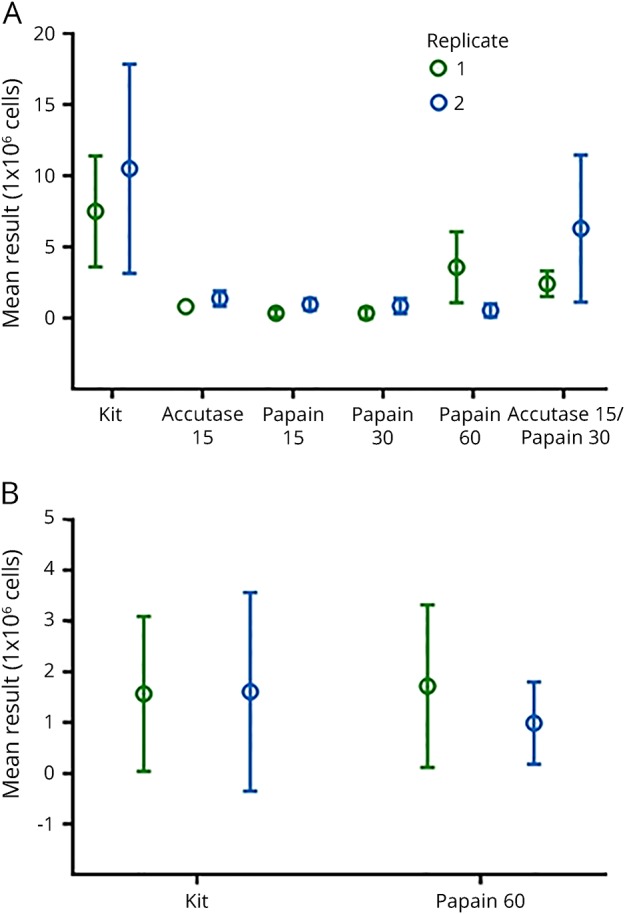
As part of an assay qualification, we tested the isolation method Percoll PLUS vs a commercially available enzymatic Neural Tissue Dissociation Kit (Kit), and the enzymes accutase and papain in C57BL/6 mice with active EAE. In a stepwise approach, we applied the following 4 criteria to each dissociation method: (1) mononuclear cell viability post-processing was required to be ≥80% per brain or spinal cord sample, (2) absolute live mononuclear cell numbers was required to be ≥5 × 10 per brain or spinal cord sample of mice with clinical EAE, (3) test-retest reliability had to be verified, and (4) the absolute mononuclear cell numbers in brain and spinal cord had to correlate with the EAE disease course.
Enzymatic dissociations allowed for greatly increased cell yield and specifically allowed for downstream assays from individual brains and spinal cords in C57BL/6 mice with EAE. All enzymatic dissociations provided a more efficient and effective method for isolating mononuclear cells from brains and spinal cord. Only the Kit assay provided a significant correlation between absolute mononuclear cell numbers in the spinal cord and EAE disease severity.
Enzymatic dissociation of CNS tissue of C57BL/6 mice with active EAE with the Kit should be the standard method. The identification of optimized CNS dissociation methods in EAE has the potential to identify cellular events that are pertinent to MS pathogenesis.
确定从患有实验性自身免疫性脑脊髓炎(EAE)的小鼠中枢神经系统中分离单核细胞的选定组织解离方法的能力、有效性、效率和可靠性。
作为分析鉴定的一部分,我们在患有活动性EAE的C57BL/6小鼠中测试了Percoll PLUS分离方法与市售酶促神经组织解离试剂盒(试剂盒)以及细胞松弛素和木瓜蛋白酶的分离效果。我们采用逐步方法,对每种解离方法应用以下4条标准:(1)每个脑或脊髓样本处理后的单核细胞活力需≥80%,(2)患有临床EAE的小鼠每个脑或脊髓样本的绝对活单核细胞数需≥5×10,(3)必须验证重测可靠性,(4)脑和脊髓中的绝对单核细胞数必须与EAE病程相关。
酶促解离可显著提高细胞产量,尤其适用于来自患有EAE的C57BL/6小鼠个体脑和脊髓的下游分析。所有酶促解离方法都为从脑和脊髓中分离单核细胞提供了更高效的方法。只有试剂盒分析显示脊髓中绝对单核细胞数与EAE疾病严重程度之间存在显著相关性。
使用试剂盒对患有活动性EAE的C57BL/6小鼠的中枢神经系统组织进行酶促解离应作为标准方法。确定EAE中优化的中枢神经系统解离方法有可能识别与MS发病机制相关的细胞事件。