Department of Medical Epidemiology and Biostatistics, Karolinska Institutet, PO Box 281, Stockholm SE-171 77, Sweden.
Department of Molecular Medicine and Surgery, Karolinska Institutet, Stockholm SE-171 77, Sweden.
Br J Cancer. 2018 Mar 6;118(5):738-743. doi: 10.1038/bjc.2017.456. Epub 2018 Jan 23.
Breast cancer can negatively influence working life, but it is unclear how many working years women with breast cancer can expect to lose.
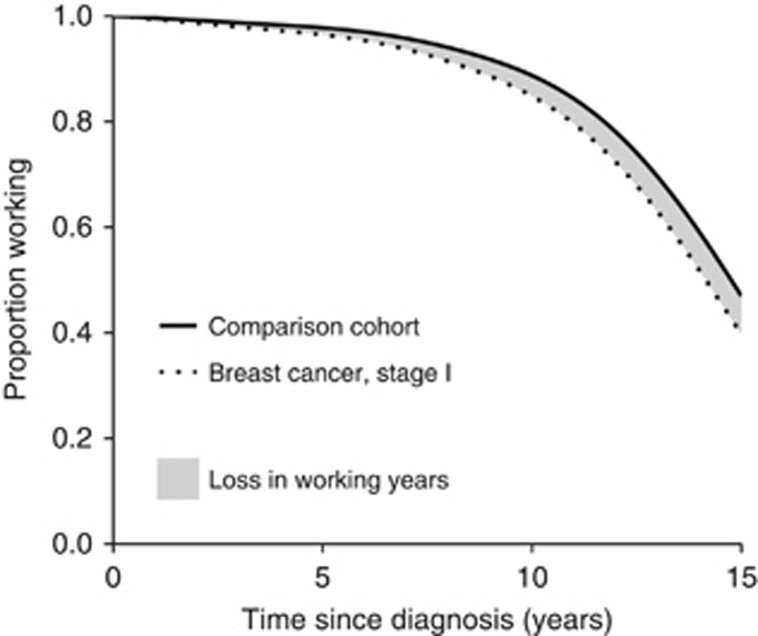
Women diagnosed with breast cancer between 1997 and 2012 were identified in the Breast Cancer Data Base Sweden (N=19 661), together with breast cancer-free comparison women (N=81 303). Using flexible parametric survival modelling, the loss in working years was calculated as the difference in the remaining years in the work force between women with and without breast cancer.
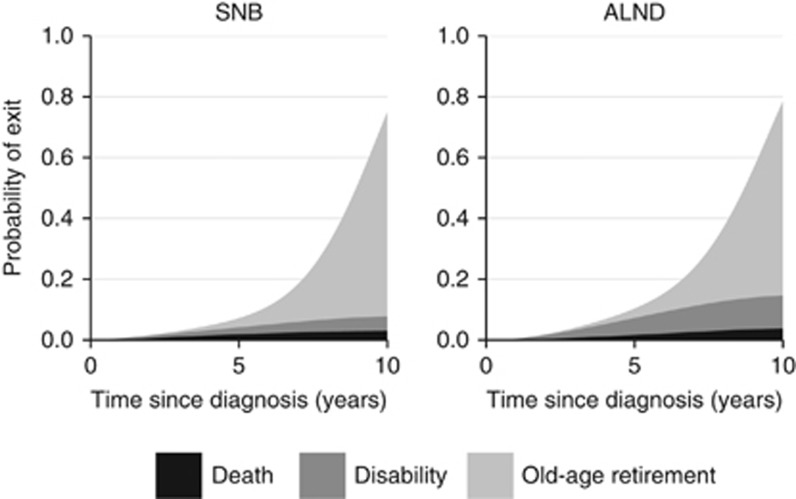
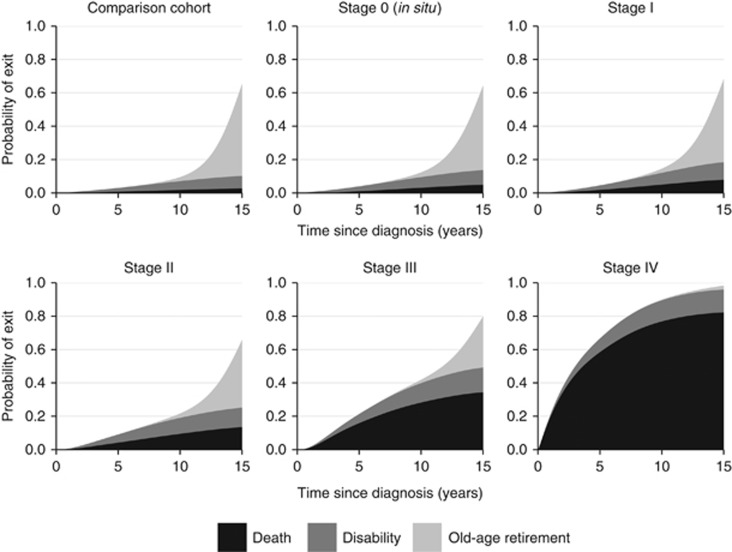
Women aged 50 years at diagnosis with stage I disease lost on average 0.5 years (95% CI, 0.2-0.7) of their remaining working time; the corresponding estimates were 0.9 years (0.5-1.2) in stage II, 2.5 years (1.9-3.1) in stage III and 8.1 years (6.5-9.7) in stage IV. Women with in situ breast cancer did not lose any working years. The strongest treatment determinant was axillary lymph node dissection.
We found a loss in working years not only in late but also in early-stage breast cancer. Although it is reassuring that some groups had no or only a modest work loss, the economic consequences for society are considerable given the large number of women annually diagnosed with breast cancer.
乳腺癌会对女性的工作生活产生负面影响,但目前尚不清楚乳腺癌患者会损失多少年的工作时间。
在瑞典乳腺癌数据库中(N=19661),我们确定了 1997 年至 2012 年间被诊断患有乳腺癌的女性,以及无乳腺癌的对照女性(N=81303)。利用灵活的参数生存模型,通过计算患有乳腺癌的女性和无乳腺癌的女性之间剩余工作年限的差异,得出工作年限的损失。
50 岁时被诊断患有 I 期疾病的女性平均损失 0.5 年(95%CI:0.2-0.7)的剩余工作时间;相应的估计值在 II 期为 0.9 年(0.5-1.2),在 III 期为 2.5 年(1.9-3.1),在 IV 期为 8.1 年(6.5-9.7)。患有原位乳腺癌的女性没有损失任何工作年限。最强的治疗决定因素是腋窝淋巴结清扫术。
我们发现,不仅在晚期乳腺癌,而且在早期乳腺癌中,女性都会损失工作年限。虽然一些群体没有或只有适度的工作损失令人欣慰,但鉴于每年有大量女性被诊断患有乳腺癌,对社会来说,其经济后果是相当大的。