
连接空气污染与先天性心脏病的遗传和表观遗传机制
Genetic and Epigenetic Mechanisms Linking Air Pollution and Congenital Heart Disease.
作者信息
Vecoli Cecilia, Pulignani Silvia, Andreassi Maria Grazia
机构信息
Institute of Clinical Physiology-National Research Council (CNR), Via Moruzzi, 1 56124 Pisa, Italy.
出版信息
J Cardiovasc Dev Dis. 2016 Nov 29;3(4):32. doi: 10.3390/jcdd3040032.
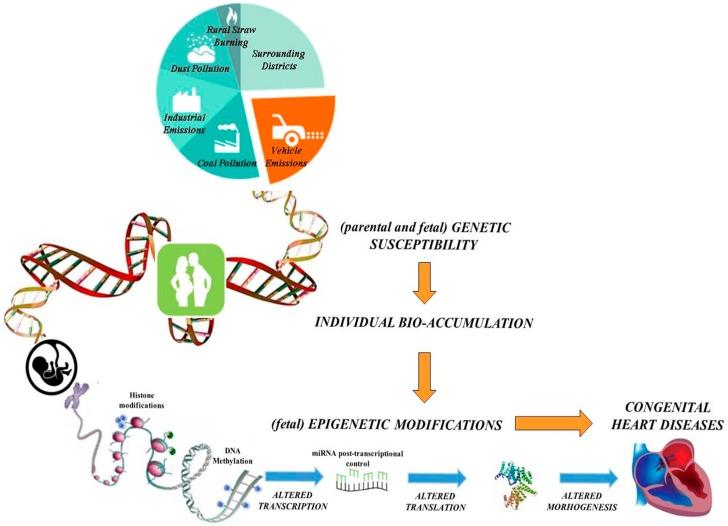
Epidemiological studies strongly suggest that parental air pollutants exposure during the periconceptional period may play a major role in causing fetal/newborn malformations, including a frequent heterogeneity in the methods applied and a difficulty in estimating the clear effect of environmental toxicants. Moreover, only some couples exposed to toxicants during the pre-conception period give birth to a child with congenital anomalies. The reasons for such phenomena remain elusive but they can be explained by the individual, innate ability to metabolize these contaminants that eventually defines the ultimate dose of a biological active toxicant. In this paper, we reviewed the major evidence regarding the role of parental air pollutant exposure on congenital heart disease (CHD) risk as well as the modulating effect on detoxification systems. Finally, major epigenetic alterations induced by adverse environment contaminants have been revised as possible mechanisms altering a correct heart morphogenesis.
流行病学研究有力地表明,围孕期父母接触空气污染物可能在导致胎儿/新生儿畸形方面起主要作用,这包括所应用方法中常见的异质性以及难以估计环境毒物的明确影响。此外,只有一些在孕前接触毒物的夫妇会生下患有先天性异常的孩子。此类现象的原因仍然难以捉摸,但可以用个体代谢这些污染物的先天能力来解释,这种能力最终决定了生物活性毒物的最终剂量。在本文中,我们综述了关于父母接触空气污染物对先天性心脏病(CHD)风险的作用以及对解毒系统的调节作用的主要证据。最后,已对由不良环境污染物引起的主要表观遗传改变进行了修订,将其作为改变正确心脏形态发生的可能机制。
 Zotero 插件