Department of Neurology, Ajou University School of Medicine, Suwon, Republic of Korea.
Department of Biomedical Informatics, Ajou University School of Medicine, Suwon, Republic of Korea.
Sci Rep. 2018 Jan 24;8(1):1556. doi: 10.1038/s41598-018-19998-4.
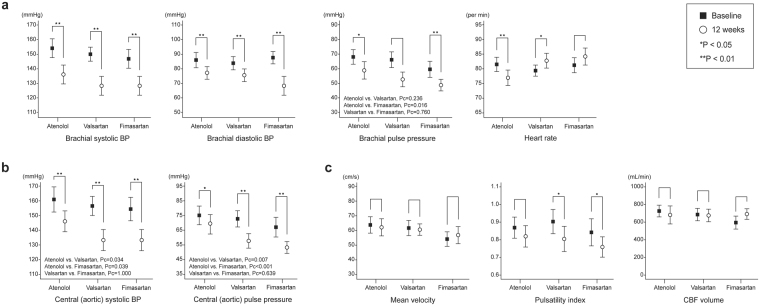
Central and cerebral haemodynamic parameters can vary under similar brachial blood pressure (BP). We aimed to investigate the effects of antihypertensive agents on central and cerebral haemodynamic parameters in hypertensive patients with ischaemic stroke. The Fimasartan, Atenolol, and Valsartan On haemodynamic paRameters (FAVOR) study was conducted in a prospective, double-blinded manner. One hundred five patients were randomly administered atenolol, valsartan, or fimasartan during 12 weeks. We measured brachial, central, cerebral haemodynamic parameters and plasma N-terminal pro-brain natriuretic peptide (NT-proBNP) levels at baseline and after 12-week. Baseline haemodynamic parameters were balanced among the three groups. Even with similar brachial BP reduction, significantly lower central systolic BP (atenolol; 146.5 ± 18.8 vs. valsartan; 133.5 ± 20.7 vs. fimasartan; 133.6 ± 19.8 mmHg, p = 0.017) and augmentation index values (89.8 ± 13.2 vs. 80.6 ± 9.2 vs. 79.2 ± 11.6%; p = 0.001) were seen in the angiotensin receptor blockers (ARBs) groups. The pulsatility index on transcranial Doppler was significantly reduced in valsartan (p = 0.002) and fimasartan group (p = 0.008). Plasma NT-proBNP level was also significantly decreased in ARB groups, especially for the fimasartan group (37.8 ± 50.6 vs. 29.2 ± 36.9 vs.19.2 ± 27.8 pg/mL; p = 0.006). These findings suggest that short-term ARB administration would be favourable for ischaemic stroke patients with hypertension, permitting effective reduction of central pressure and dampening of cerebral pulsatility.
中心和大脑血液动力学参数在相似的臂部血压(BP)下可能会发生变化。我们旨在研究抗高血压药物对患有缺血性中风的高血压患者的中心和大脑血液动力学参数的影响。Fimasartan、Atenolol 和 Valsartan On haemodynamic paRameters(FAVOR)研究以前瞻性、双盲方式进行。105 名患者在 12 周内随机接受阿替洛尔、缬沙坦或 fimasartan 治疗。我们在基线和 12 周后测量了臂部、中心、大脑血液动力学参数和血浆 N 末端脑钠肽前体(NT-proBNP)水平。三组之间的基线血液动力学参数平衡。即使臂部 BP 降低相似,血管紧张素受体阻滞剂(ARBs)组的中心收缩压(阿替洛尔:146.5±18.8 比缬沙坦:133.5±20.7 比 fimasartan:133.6±19.8mmHg,p=0.017)和增强指数值(89.8±13.2 比 80.6±9.2 比 79.2±11.6%;p=0.001)明显更低。经颅多普勒的搏动指数在缬沙坦(p=0.002)和 fimasartan 组(p=0.008)中明显降低。ARB 组的血浆 NT-proBNP 水平也明显降低,尤其是 fimasartan 组(37.8±50.6 比 29.2±36.9 比 19.2±27.8pg/mL;p=0.006)。这些发现表明,短期 ARB 给药对患有高血压的缺血性中风患者有利,可有效降低中心压力并抑制大脑搏动性。