Department of Genetics & Genome Biology, University of Leicester, Leicester, LE1 7RH, UK.
BMC Microbiol. 2018 Jan 24;18(1):9. doi: 10.1186/s12866-017-1143-y.
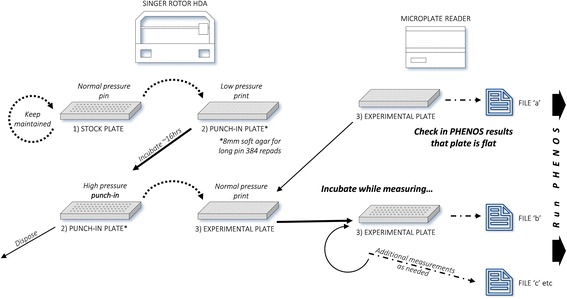
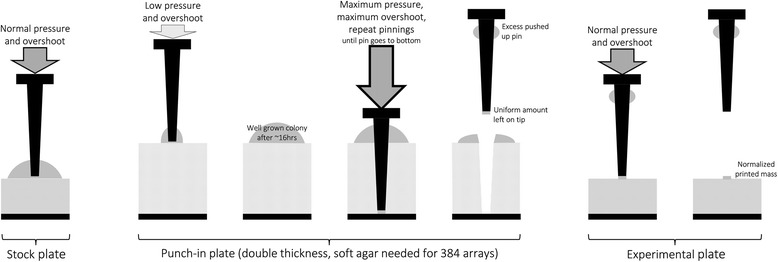
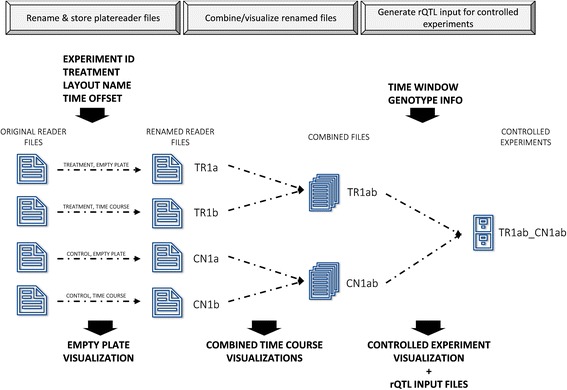
Microbial arrays, with a large number of different strains on a single plate printed with robotic precision, underpin an increasing number of genetic and genomic approaches. These include Synthetic Genetic Array analysis, high-throughput Quantitative Trait Loci (QTL) analysis and 2-hybrid techniques. Measuring the growth of individual colonies within these arrays is an essential part of many of these techniques but is useful for any work with arrays. Measurement is typically done using intermittent imagery fed into complex image analysis software, which is not especially accurate and is challenging to use effectively. We have developed a simple and fast alternative technique that uses a pinning robot and a commonplace microplate reader to continuously measure the thickness of colonies growing on solid agar, complemented by a technique for normalizing the amount of cells initially printed to each spot of the array in the first place. We have developed software to automate the process of combining multiple sets of readings, subtracting agar absorbance, and visualizing colony thickness changes in a number of informative ways.
The "PHENOS" pipeline (PHENotyping On Solid media), optimized for Saccharomyces yeasts, produces highly reproducible growth curves and is particularly sensitive to low-level growth. We have empirically determined a formula to estimate colony cell count from an absorbance measurement, and shown this to be comparable with estimates from measurements in liquid. We have also validated the technique by reproducing the results of an earlier QTL study done with conventional liquid phenotyping, and found PHENOS to be considerably more sensitive.
"PHENOS" is a cost effective and reliable high-throughput technique for quantifying growth of yeast arrays, and is likely to be equally very useful for a range of other types of microbial arrays. A detailed guide to the pipeline and software is provided with the installation files at https://github.com/gact/phenos .
微生物阵列通过机器人精确印刷在单个平板上,拥有大量不同的菌株,为越来越多的遗传和基因组方法提供了基础。这些方法包括合成遗传阵列分析、高通量数量性状位点(QTL)分析和双杂交技术。测量这些阵列中单个菌落的生长是这些技术中的许多技术的重要组成部分,但对于任何使用阵列的工作都是有用的。测量通常使用间歇成像,然后将其输入到复杂的图像分析软件中,这种方法不仅不准确,而且难以有效使用。我们开发了一种简单快速的替代技术,该技术使用固定机器人和常见的微孔板读取器来连续测量固体琼脂上生长的菌落的厚度,同时还开发了一种技术,首先将初始打印到阵列中每个点的细胞量进行标准化。我们开发了软件来自动化组合多组读数、减去琼脂吸光度以及以多种有信息量的方式可视化菌落厚度变化的过程。
针对酿酒酵母进行了优化的“PHENOS”(固体培养基表型)管道生成高度可重复的生长曲线,并且对低水平生长特别敏感。我们已经通过经验确定了一个从吸光度测量中估计菌落细胞数的公式,并证明这与液体测量的估计值相当。我们还通过重现使用传统液体表型学进行的早期 QTL 研究的结果验证了该技术,发现 PHENOS 灵敏度更高。
“PHENOS”是一种经济有效的高通量技术,可用于量化酵母阵列的生长,并且可能同样非常适用于其他类型的微生物阵列。在 https://github.com/gact/phenos 上的安装文件中提供了该管道和软件的详细指南。