Coggan Andrew R, Broadstreet Seth R, Mikhalkova Deana, Bole Indra, Leibowitz Joshua L, Kadkhodayan Ana, Park Soo, Thomas Deepak P, Thies Dakkota, Peterson Linda R
Departments of Kinesiology, Indiana University Purdue University Indianapolis, Indianapolis, Indiana.
Cellular and Integrative Physiology, Indiana University Purdue University Indianapolis, Indianapolis, Indiana.
Physiol Rep. 2018 Jan;6(2). doi: 10.14814/phy2.13575.
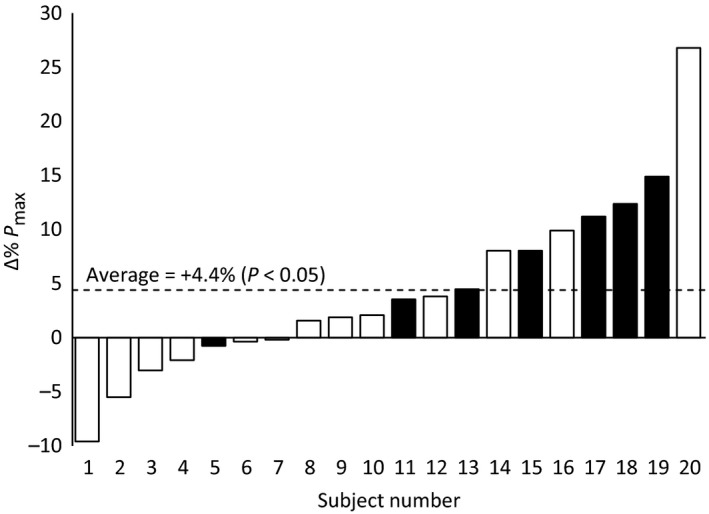
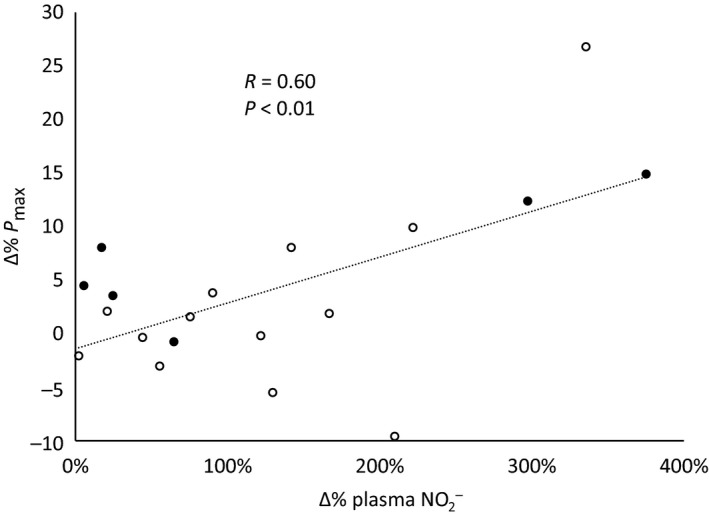
Maximal neuromuscular power is an important determinant of athletic performance and also quality of life, independence, and perhaps even mortality in patient populations. We have shown that dietary nitrate (NO ), a source of nitric oxide (NO), improves muscle power in some, but not all, subjects. The present investigation was designed to identify factors contributing to this interindividual variability. Healthy men (n = 13) and women (n = 7) 22-79 year of age and weighing 52.1-114.9 kg were studied using a randomized, double-blind, placebo-controlled, crossover design. Subjects were tested 2 h after ingesting beetroot juice (BRJ) either containing or devoid of 12.3 ± 0.8 mmol of NO . Plasma NO and nitrite (NO ) were measured as indicators of NO bioavailability and maximal knee extensor speed (V ), power (P ), and fatigability were determined via isokinetic dynamometry. On average, dietary NO increased (P < 0.05) P by 4.4 ± 8.1%. Individual changes, however, ranged from -9.6 to +26.8%. This interindividual variability was not significantly correlated with age, body mass (inverse of NO dose per kg), body mass index (surrogate for body composition) or placebo trial V or fatigue index (in vivo indicators of muscle fiber type distribution). In contrast, the relative increase in Pmax was significantly correlated (r = 0.60; P < 0.01) with the relative increase in plasma NO concentration. In multivariable analysis female sex also tended (P = 0.08) to be associated with a greater increase in Pmax. We conclude that the magnitude of the dietary NO -induced increase in muscle power is dependent upon the magnitude of the resulting increase in plasma NO and possibly female sex.
最大神经肌肉力量是运动表现的重要决定因素,也是患者群体生活质量、独立性甚至死亡率的重要决定因素。我们已经表明,膳食硝酸盐(NO₃⁻)作为一氧化氮(NO)的来源,可改善部分而非全部受试者的肌肉力量。本研究旨在确定导致这种个体间差异的因素。采用随机、双盲、安慰剂对照、交叉设计,对年龄在22 - 79岁、体重在52.1 - 114.9千克的13名健康男性和7名健康女性进行了研究。受试者在摄入含或不含12.3±0.8毫摩尔NO₃⁻的甜菜根汁(BRJ)2小时后接受测试。测量血浆NO和亚硝酸盐(NO₂⁻)作为NO生物利用度的指标,并通过等速测力法测定最大伸膝速度(V)、力量(P)和疲劳性。平均而言,膳食NO₃⁻使P增加了4.4±8.1%(P < 0.05)。然而,个体变化范围为 - 9.6%至 + 26.8%。这种个体间差异与年龄、体重(每千克NO剂量的倒数)、体重指数(身体成分的替代指标)或安慰剂试验中的V或疲劳指数(肌肉纤维类型分布的体内指标)均无显著相关性。相比之下,Pmax的相对增加与血浆NO浓度的相对增加显著相关(r = 0.60;P < 0.01)。在多变量分析中,女性也倾向于(P = 0.08)与Pmax的更大增加相关。我们得出结论,膳食NO₃⁻诱导的肌肉力量增加幅度取决于血浆NO的相应增加幅度,可能还与女性性别有关。