Luria S, Horowitz M
J Virol. 1986 Mar;57(3):998-1003. doi: 10.1128/JVI.57.3.998-1003.1986.
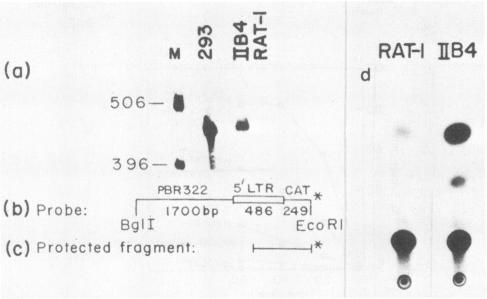
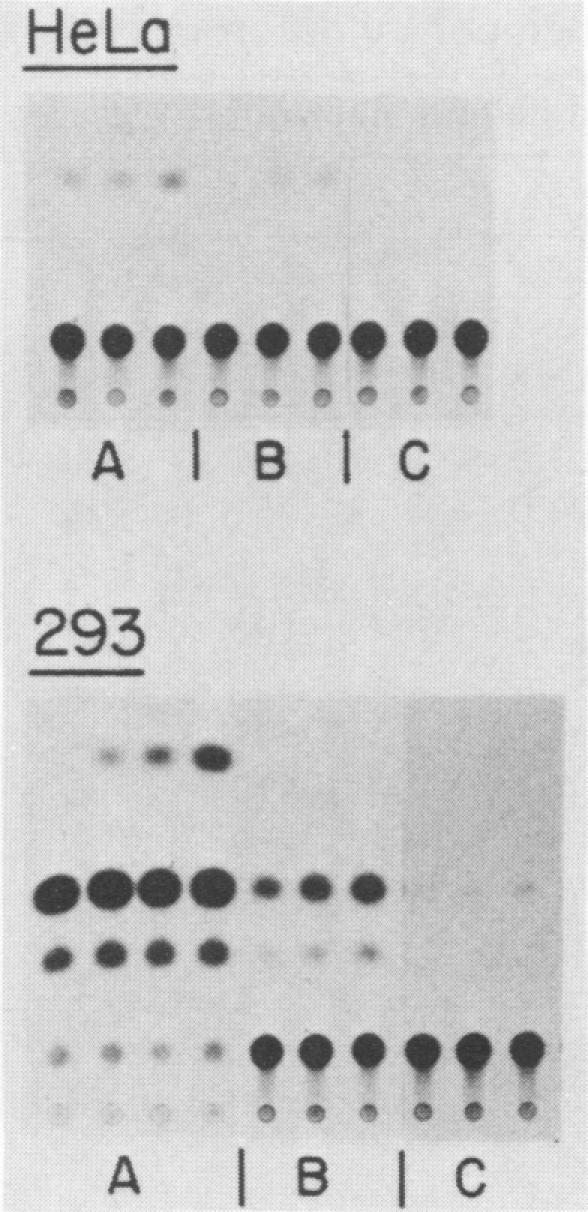
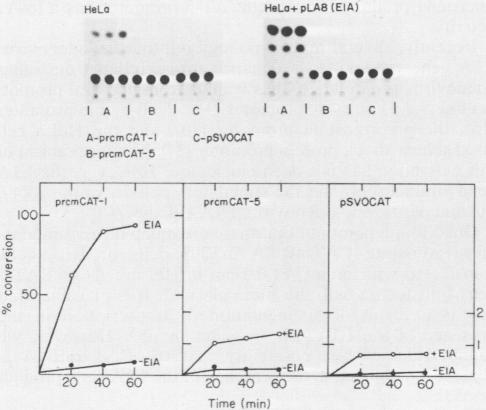
It has been shown recently that the c-mos oncogene becomes activated in myeloma XRPC-24 via insertion of an intracisternal A particle (IAP) long terminal repeat (LTR). The inserted LTR serves as a promoter from which transcription of the 3' rearranged c-mos initiates. The insertion is in a head-to-head orientation such that the transcriptional orientations of the IAP and the 3' rearranged c-mos are opposite. It has already been shown that this IAP LTR has two promoters, one transcribing the IAP genome and the other transcribing the rearranged c-mos. Since the IAP genomes are actively transcribed in mouse myelomas but not in normal cells, it was interesting to test whether transcriptional activation of the IAP occurs in the presence of active oncogene products, especially nuclear ones. The 5' LTR of the IAP inserted in myeloma XRPC-24 was chosen as a convenient model to test the effect of viral and cellular oncogene products. These included simian virus 40 (SV40) large-T antigen, the adenovirus early 1A (E1A) gene product, the myc gene product, and p53. The LTR was coupled to the bacterial gene coding for chloramphenicol acetyltransferase (CAT) in two orientations, and the levels of CAT directed by the LTR promoters were assayed in either the presence or the absence of the oncogene products. The levels of CAT directed by the 5' LTR promoter transcribing the IAP were significantly elevated in the presence of SV40 large-T antigen, the adenovirus E1A and myc gene products, and p53. The promoter transcribing the rearranged c-mos was transactivated by SV40 large-T antigen and the adenovirus E1A gene product. The results indicate that oncogene products may have an important role in turning on promoters of other genes. The IAP LTR may serve as a useful model for studying the effect of various gene products on promoters which are known to be activated in the malignant state.
最近有研究表明,c-mos癌基因通过插入一个脑内A颗粒(IAP)长末端重复序列(LTR)在骨髓瘤XRPC-24中被激活。插入的LTR充当启动子,3'重排的c-mos由此启动转录。插入呈头对头方向,使得IAP和3'重排的c-mos的转录方向相反。已经表明,这个IAP LTR有两个启动子,一个转录IAP基因组,另一个转录重排的c-mos。由于IAP基因组在小鼠骨髓瘤中被积极转录,但在正常细胞中不转录,因此测试IAP的转录激活是否在有活性癌基因产物尤其是核癌基因产物存在的情况下发生是很有趣的。插入骨髓瘤XRPC-24中的IAP的5' LTR被选作测试病毒和细胞癌基因产物作用的便利模型。这些产物包括猴病毒40(SV40)大T抗原、腺病毒早期1A(E1A)基因产物、myc基因产物和p53。LTR以两种方向与编码氯霉素乙酰转移酶(CAT)的细菌基因相连,并且在有或没有癌基因产物的情况下测定由LTR启动子指导的CAT水平。在存在SV40大T抗原、腺病毒E1A和myc基因产物以及p53的情况下,转录IAP的5' LTR启动子指导的CAT水平显著升高。转录重排的c-mos的启动子被SV40大T抗原和腺病毒E1A基因产物反式激活。结果表明癌基因产物可能在开启其他基因的启动子方面起重要作用。IAP LTR可能作为一个有用的模型来研究各种基因产物对已知在恶性状态下被激活的启动子的影响。