USS Center of Cell Therapy "G. Lanzani", USC Ematologia, ASST Papa Giovanni XXIII Bergamo, 24124 Bergamo, Italy.
Int J Mol Sci. 2018 Jan 25;19(2):358. doi: 10.3390/ijms19020358.
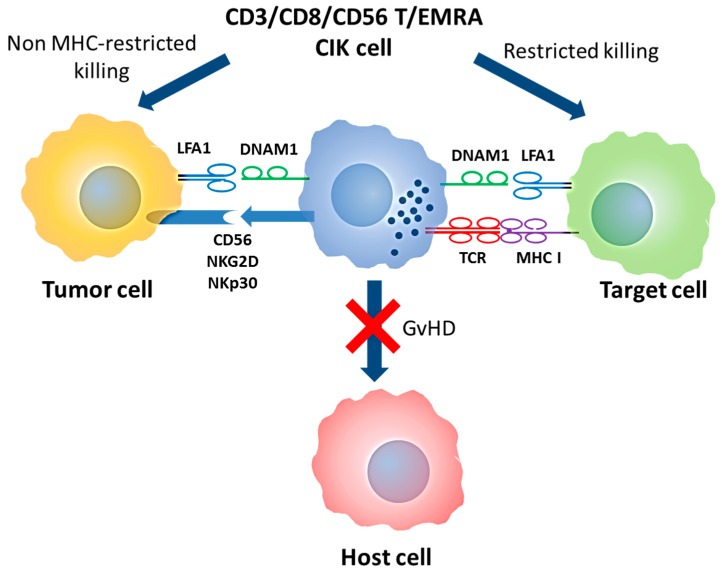
Cytokine-induced killer (CIK) cells are T lymphocytes that have acquired, in vitro, following extensive manipulation by Interferon gamma (IFN-γ), OKT3 and Interleukin 2 (IL-2) addition, the expression of several Natural Killer (NK) cell-surface markers. CIK cells have a dual "nature", due to the presence of functional TCR as well as NK molecules, even if the antitumoral activity can be traced back only to the NK-like structures (DNAM-1, NKG2D, NKp30 and CD56). In addition to antineoplastic activity in vitro and in several in-vivo models, CIK cells show very limited, if any, GvHD toxicity as well as a strong intratumoral homing. For all such reasons, CIK cells have been proposed and tested in many clinical trials in cancer patients both in autologous and allogeneic combinations, up to haploidentical mismatching. Indeed, genetic modification of CIK cells as well as the possibility of combining them with specific monoclonal antibodies will further expand the possibility of their clinical utilization.
细胞因子诱导的杀伤(CIK)细胞是 T 淋巴细胞,在体外经过干扰素γ(IFN-γ)、OKT3 和白细胞介素 2(IL-2)的广泛处理后,表达了几种自然杀伤(NK)细胞表面标志物。CIK 细胞具有双重“性质”,因为存在功能性 TCR 以及 NK 分子,尽管抗肿瘤活性只能追溯到 NK 样结构(DNAM-1、NKG2D、NKp30 和 CD56)。除了在体外和几种体内模型中具有抗肿瘤活性外,CIK 细胞显示出非常有限的,如果有的话,GVHD 毒性以及强烈的肿瘤内归巢。基于所有这些原因,CIK 细胞已在癌症患者的许多临床试验中被提出并进行了测试,包括自体和同种异体组合,甚至达到单倍体错配。事实上,CIK 细胞的基因修饰以及将它们与特定的单克隆抗体结合的可能性将进一步扩大它们临床应用的可能性。