Nannucci Serena, Rinnoci Valentina, Pracucci Giovanni, MacKinnon Andrew D, Pescini Francesca, Adib-Samii Poneh, Bianchi Silvia, Dotti Maria Teresa, Federico Antonio, Inzitari Domenico, Markus Hugh S, Pantoni Leonardo
NEUROFARBA Department, University of Florence, Florence, Italy.
Atkinson Morley Regional Neuroscience Centre, St George's University Hospitals NHS Foundation Trust, London, United Kingdom.
PLoS One. 2018 Jan 25;13(1):e0190878. doi: 10.1371/journal.pone.0190878. eCollection 2018.
The frequency, clinical correlates, and risk factors of cerebral microbleeds (CMB) in Cerebral Autosomal Dominant Arteriopathy with Subcortical Infarcts and Leukoencephalopathy (CADASIL) are still poorly known. We aimed at determining the location and number of CMB and their relationship with clinical manifestations, vascular risk factors, drugs, and other neuroimaging features in CADASIL patients.
We collected clinical data by means of a structured proforma and centrally evaluated CMB on magnetic resonance gradient echo sequences applying the Microbleed Anatomical Rating Scale in CADASIL patients seen in 2 referral centers in Italy and United Kingdom.
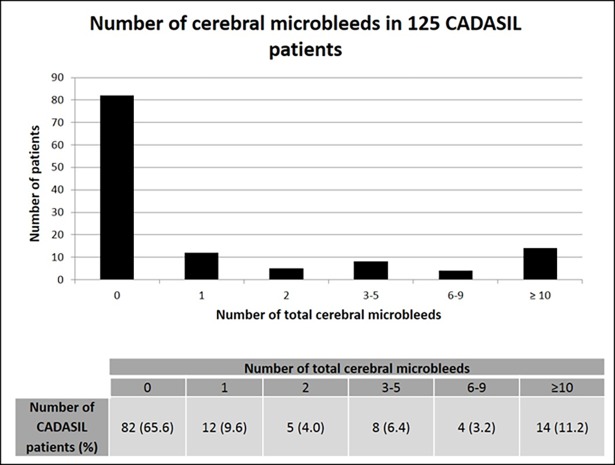
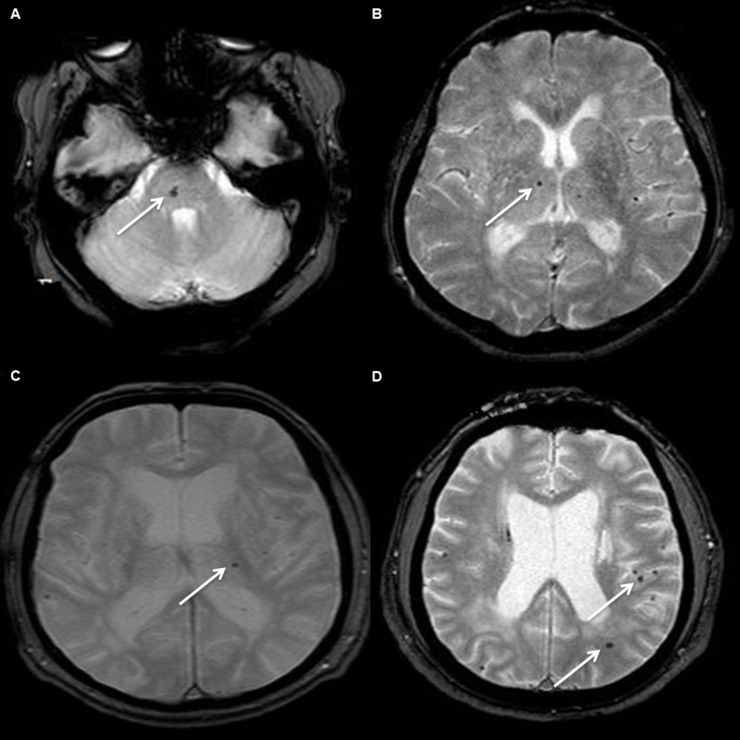
We evaluated 125 patients. CMB were present in 34% of patients and their presence was strongly influenced by the age. Twenty-nine percent of the patients had CMB in deep subcortical location, 22% in a lobar location, and 18% in infratentorial regions. After adjustment for age, factors significantly associated with a higher total number of CMB were hemorrhagic stroke, dementia, urge incontinence, and statins use (this latter not confirmed by multivariate analysis). Infratentorial and deep CMB were associated with dementia and urge incontinence, lobar CMB with hemorrhagic stroke, dementia, and statins use. Unexpectedly, patients with migraine, with or without aura, had a lower total, deep, and lobar number of CMB than patients without migraine.
CMB formation in CADASIL seems to increase with age. History of hemorrhagic stroke, dementia, urge incontinence, and statins use are associated with a higher number of CMB. However, these findings need to be confirmed by longitudinal studies.
脑常染色体显性遗传性动脉病伴皮质下梗死和白质脑病(CADASIL)中脑微出血(CMB)的发生率、临床相关性及危险因素仍鲜为人知。我们旨在确定CADASIL患者CMB的位置和数量及其与临床表现、血管危险因素、药物及其他神经影像学特征的关系。
我们通过结构化表格收集临床数据,并对在意大利和英国两个转诊中心就诊的CADASIL患者,应用微出血解剖评分量表对磁共振梯度回波序列上的CMB进行集中评估。
我们评估了125例患者。34%的患者存在CMB,其出现受年龄的强烈影响。29%的患者CMB位于皮质下深部,22%位于脑叶,18%位于幕下区域。在对年龄进行校正后,与CMB总数较高显著相关的因素有出血性卒中、痴呆、急迫性尿失禁及他汀类药物的使用(后者未得到多变量分析的证实)。幕下和深部CMB与痴呆和急迫性尿失禁相关,脑叶CMB与出血性卒中、痴呆及他汀类药物的使用相关。出乎意料的是,有偏头痛(无论有无先兆)的患者,其CMB的总数、深部及脑叶数量均低于无偏头痛的患者。
CADASIL中CMB的形成似乎随年龄增加。出血性卒中病史、痴呆、急迫性尿失禁及他汀类药物的使用与较多的CMB数量相关。然而,这些发现需要纵向研究来证实。