Department of Nuclear Medicine, Chonnam National University Hwasun Hospital, Jeollanam-do, Republic of Korea.
Department of Biomedical Science and Engineering, Institute of Integrated Technology (IIT), Gwangju Institute of Science and Technology (GIST), Gwangju, Republic of Korea.
Sci Rep. 2018 Jan 26;8(1):1673. doi: 10.1038/s41598-018-19792-2.
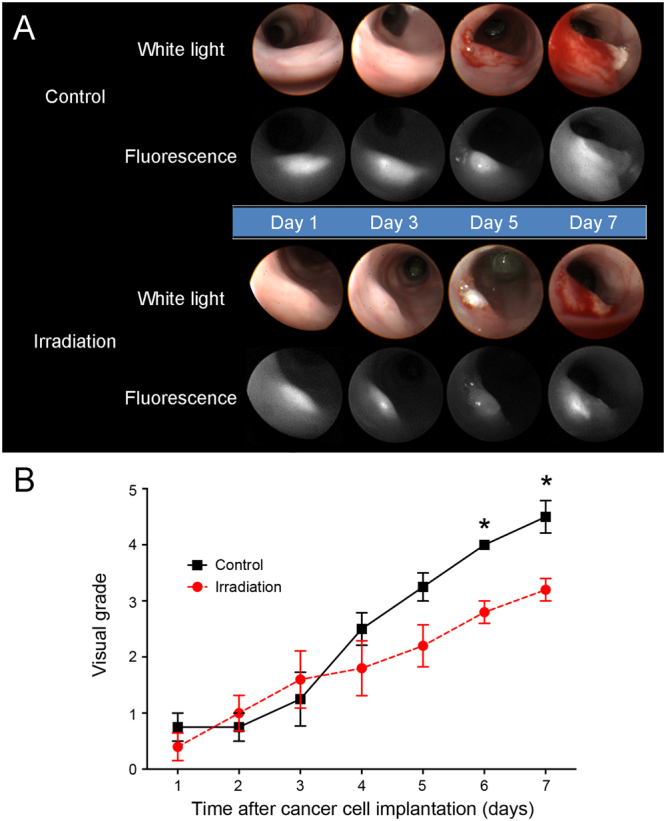
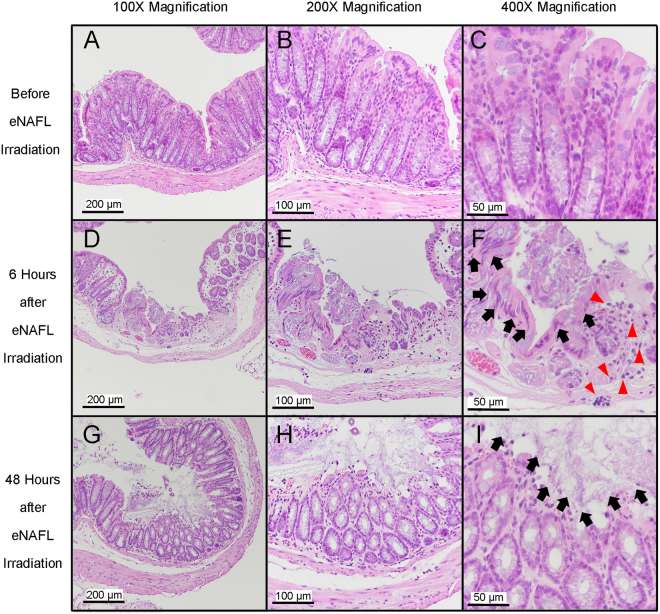
Colorectal cancer is one of the leading causes of cancer-related deaths. Although several therapeutic management strategies are available at the early colon cancer stages, such as endoscopic mucosal or submucosal dissection, associated complications often include bleeding or bowel perforations. As an alternative approach, we investigated endoscopic non-ablative fractional laser (eNAFL) irradiation as a minimally invasive therapeutic modality for the treatment of early-stage colorectal cancer. By implanting SL4-DsRed colon cancer cells into the colons of the C57BL/6 mice, we developed an orthotopic colon tumour mouse model and demonstrated the early-stage tumour growth delay following the eNAFL irradiation. Additionally, we evaluated the temperature changes in the eNAFL-irradiated area using numerical simulations, and induced inflammation using histological analysis. Our results indicate a minimal thermal damage confined to the irradiated spot, sparing the adjacent tissue and alteration in the tumour microenvironment. eNAFL irradiation may be clinically useful as a minimally invasive therapeutic intervention at the early stage of tumourigenesis. In future, an optimal eNAFL therapeutic dose should be determined, in order to increase the efficacy of this approach.
结直肠癌是癌症相关死亡的主要原因之一。尽管在早期结肠癌阶段有几种治疗管理策略,如内镜黏膜或黏膜下切除术,但相关并发症通常包括出血或肠穿孔。作为一种替代方法,我们研究了内镜非消融性分数激光(eNAFL)照射作为治疗早期结直肠癌的微创治疗方式。通过将 SL4-DsRed 结肠癌细胞植入 C57BL/6 小鼠的结肠中,我们建立了一个原位结肠肿瘤小鼠模型,并证明了 eNAFL 照射后早期肿瘤生长延迟。此外,我们使用数值模拟评估了 eNAFL 照射区域的温度变化,并通过组织学分析诱导炎症。我们的结果表明,热损伤最小,仅限于照射部位,保留了相邻组织,改变了肿瘤微环境。eNAFL 照射可能在肿瘤发生的早期作为一种微创治疗干预具有临床应用价值。将来,应确定最佳的 eNAFL 治疗剂量,以提高该方法的疗效。