Psychosocial Department, Emma Children's Hospital, Amsterdam, The Netherlands.
Department of Pediatric Nephrology, Emma Children's Hospital, Amsterdam, The Netherlands.
Qual Life Res. 2018 Jun;27(6):1445-1454. doi: 10.1007/s11136-018-1789-4. Epub 2018 Jan 27.
To assess health-related quality of life (HRQoL) across three renal replacement therapy modalities (preemptive transplant, non-preemptive transplant, and dialysis) in comparison with the healthy norm and other chronic health conditions, and to explore related patient factors.
All prevalent end-stage renal disease (ESRD) patients aged 8-18 years who spent at least 6 months on their current treatment modality in the Netherlands, Belgium, and part of Germany were approached to complete the Pediatric Quality of Life Inventory 4.0 (PedsQL™) questionnaire. We determined the differences between groups on PedsQL™ mean scores, the proportion of children with an impaired HRQoL (≥ 1 SD lower than the healthy norm), the proportion of problems on individual items of the PedsQL™, and the effect of time on current treatment. Linear regression models were used to explore determinants of HRQoL.
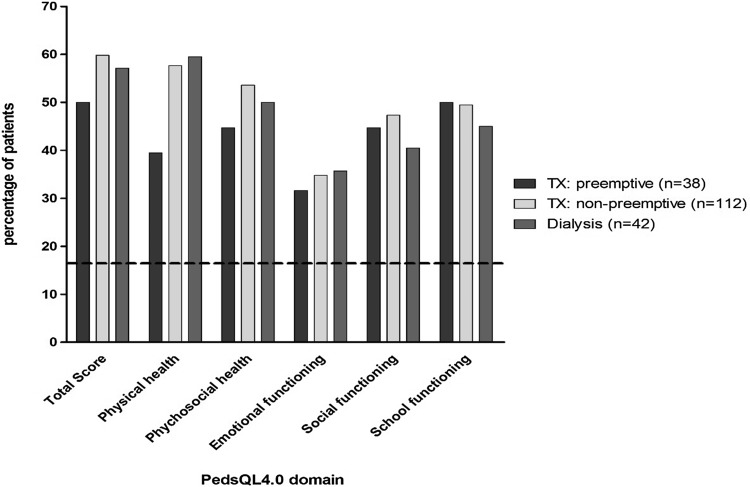
192 out of 278 patients (20% preemptive transplant, 58% non-preemptive transplant, 22% dialysis) filled in the PedsQL™ (response rate 69%). Independent of treatment modality, patients had significantly lower mean scores and consequently higher proportions of impaired HRQoL on almost all domains compared to the healthy norm and other chronic health conditions. Patients with a preemptive transplant only reported higher scores on physical health compared to the other treatment modalities. Having comorbidities was the most important determinant associated with lower HRQoL scores.
Dialysis and renal transplantation both have a severe impact on the HRQoL of children with ESRD. Physicians should be aware of this continuous burden. Furthermore, to develop tailored interventions for children with ESRD, qualitative studies are needed to gain more insight in the determinants of HRQoL in the different treatment modalities.
评估三种肾脏替代疗法(预先移植、非预先移植和透析)的健康相关生活质量(HRQoL),并与健康标准和其他慢性健康状况进行比较,并探讨相关患者因素。
所有在荷兰、比利时和德国部分地区接受当前治疗方案至少 6 个月的年龄在 8-18 岁的普遍终末期肾病(ESRD)患者均被邀请完成儿童生活质量量表 4.0(PedsQL™)问卷。我们比较了各组在 PedsQL™平均得分、HRQoL 受损(低于健康标准 1 个标准差以上)的儿童比例、PedsQL™个别项目的问题比例以及当前治疗时间的差异。线性回归模型用于探讨 HRQoL 的决定因素。
278 名患者中有 192 名(20%预先移植、58%非预先移植、22%透析)填写了 PedsQL™(应答率 69%)。独立于治疗方式,与健康标准和其他慢性健康状况相比,几乎所有领域的患者平均得分均显著较低,因此 HRQoL 受损的比例更高。预先移植的患者仅在生理健康方面的得分高于其他治疗方式。合并症是与较低 HRQoL 得分相关的最重要决定因素。
透析和肾移植都会对 ESRD 儿童的 HRQoL 产生严重影响。医生应该意识到这一持续的负担。此外,为了为 ESRD 儿童制定有针对性的干预措施,需要进行定性研究,以更深入地了解不同治疗方式下 HRQoL 的决定因素。