Schlee Winfried, Hall Deborah A, Canlon Barbara, Cima Rilana F F, de Kleine Emile, Hauck Franz, Huber Alex, Gallus Silvano, Kleinjung Tobias, Kypraios Theodore, Langguth Berthold, Lopez-Escamez José A, Lugo Alessandra, Meyer Martin, Mielczarek Marzena, Norena Arnaud, Pfiffner Flurin, Pryss Rüdiger C, Reichert Manfred, Requena Teresa, Schecklmann Martin, van Dijk Pim, van de Heyning Paul, Weisz Nathan, Cederroth Christopher R
Department of Psychiatry and Psychotherapy of the University of Regensburg at Bezirksklinikum Regensburg, University of Regensburg, Regensburg, Germany.
NIHR Nottingham Hearing Biomedical Research Centre, Nottingham, United Kingdom.
Front Aging Neurosci. 2018 Jan 12;9:447. doi: 10.3389/fnagi.2017.00447. eCollection 2017.
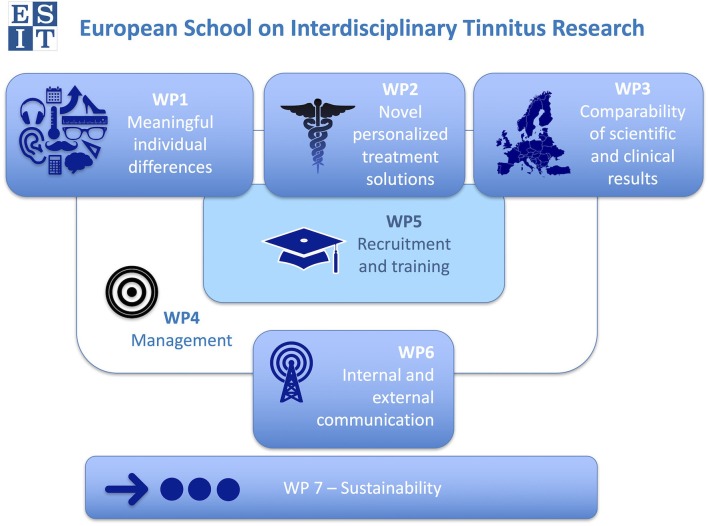
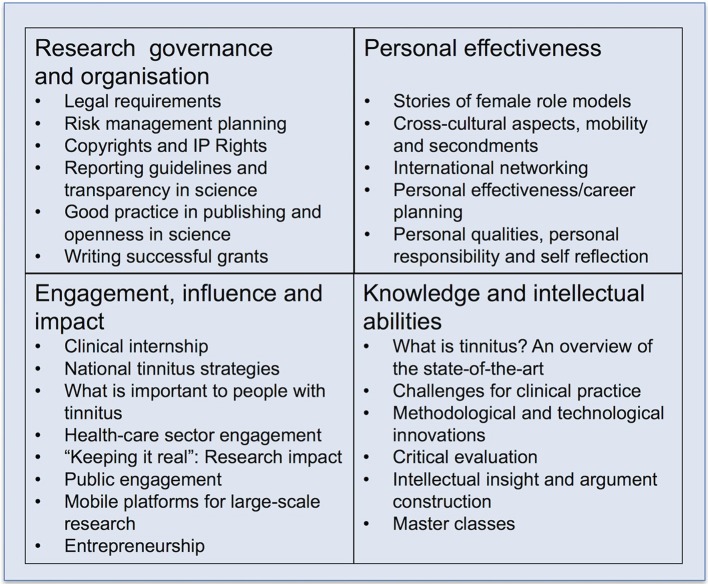
Tinnitus is a common medical condition which interfaces many different disciplines, yet it is not a priority for any individual discipline. A change in its scientific understanding and clinical management requires a shift toward multidisciplinary cooperation, not only in research but also in training. The European School for Interdisciplinary Tinnitus research (ESIT) brings together a unique multidisciplinary consortium of clinical practitioners, academic researchers, commercial partners, patient organizations, and public health experts to conduct innovative research and train the next generation of tinnitus researchers. ESIT supports fundamental science and clinical research projects in order to: (1) advancing new treatment solutions for tinnitus, (2) improving existing treatment paradigms, (3) developing innovative research methods, (4) performing genetic studies on, (5) collecting epidemiological data to create new knowledge about prevalence and risk factors, (6) establishing a pan-European data resource. All research projects involve inter-sectoral partnerships through practical training, quite unlike anything that can be offered by any single university alone. Likewise, the postgraduate training curriculum fosters a deep knowledge about tinnitus whilst nurturing transferable competencies in personal qualities and approaches needed to be an effective researcher, knowledge of the standards, requirements and professionalism to do research, and skills to work with others and to ensure the wider impact of research. ESIT is the seed for future generations of creative, entrepreneurial, and innovative researchers, trained to master the upcoming challenges in the tinnitus field, to implement sustained changes in prevention and clinical management of tinnitus, and to shape doctoral education in tinnitus for the future.
耳鸣是一种常见的医学病症,涉及许多不同学科,但并非任何单一学科的重点关注对象。要改变对其的科学认识和临床管理方式,需要转向多学科合作,不仅在研究方面,而且在培训方面。欧洲跨学科耳鸣研究学院(ESIT)汇聚了临床医生、学术研究人员、商业伙伴、患者组织和公共卫生专家等独特的多学科联盟,开展创新性研究并培养下一代耳鸣研究人员。ESIT支持基础科学和临床研究项目,目的是:(1)推进耳鸣的新治疗方案;(2)改进现有治疗模式;(3)开发创新研究方法;(4)进行基因研究;(5)收集流行病学数据以获取有关患病率和风险因素的新知识;(6)建立泛欧数据资源。所有研究项目都通过实践培训涉及跨部门伙伴关系,这与任何一所大学单独提供的内容截然不同。同样,研究生培训课程在培养成为一名有效研究人员所需的个人品质和方法方面的可转移能力、研究标准、要求和专业精神知识以及与他人合作并确保研究产生更广泛影响的技能的同时,加深对耳鸣的深入了解。ESIT是培养未来一代有创造力、有创业精神和创新能力的研究人员的种子,他们将接受培训,以应对耳鸣领域即将到来的挑战,在耳鸣的预防和临床管理方面实现持续变革,并塑造未来耳鸣领域的博士教育。