Zhang Su-Fang, Zhang Zhen, Kong Xiang-Bo, Wang Hong-Bin, Liu Fu
Key Laboratory of Forest Protection, Research Institute of Forest Ecology, Environment and Protection, Chinese Academy of Forestry, State Forestry Administration, Beijing, China.
Front Physiol. 2018 Jan 10;8:1127. doi: 10.3389/fphys.2017.01127. eCollection 2017.
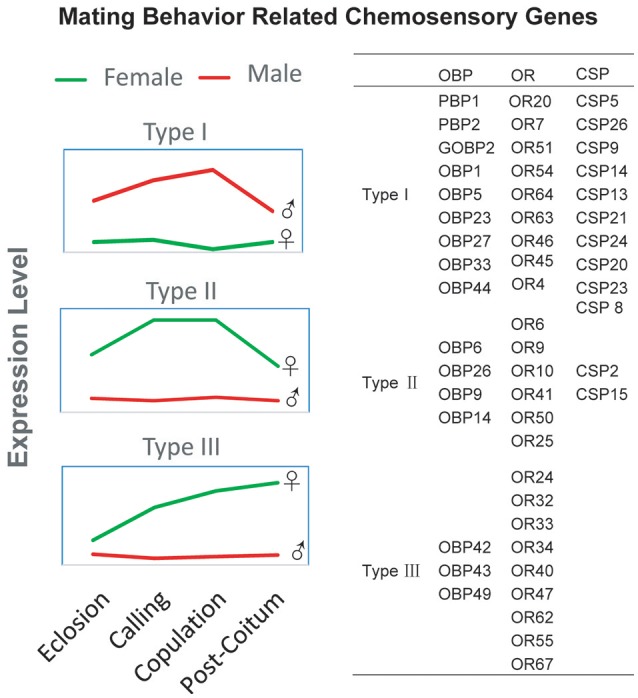
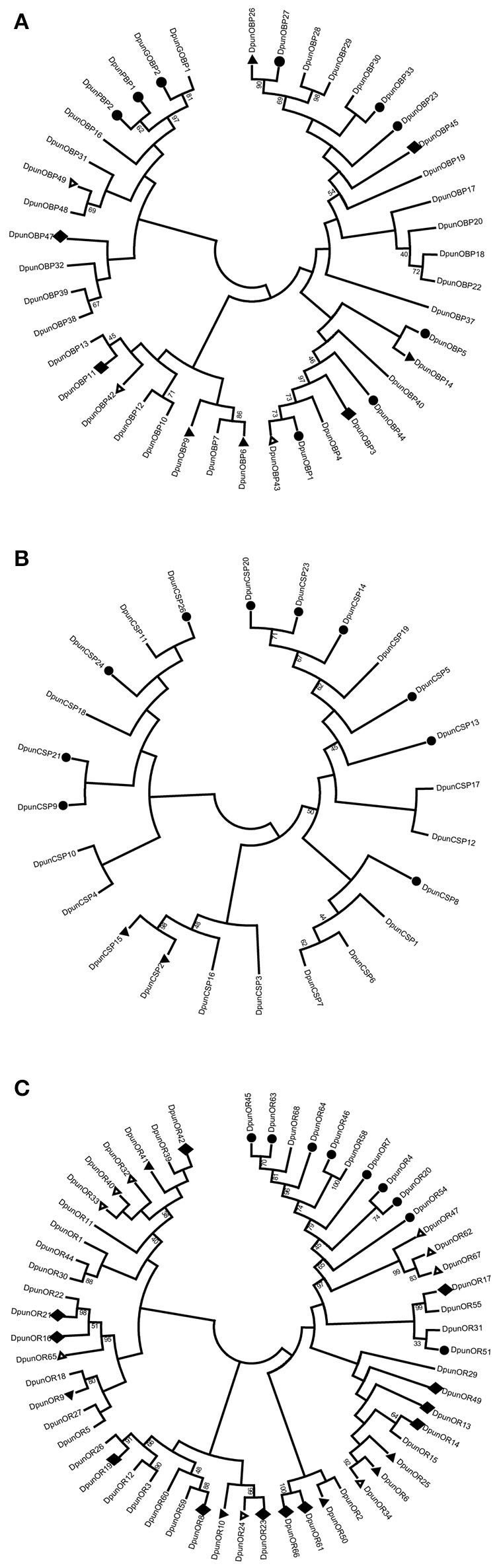
The insect chemosensory system is pivotal for interactions with their environments, and moths have especially sensitive olfaction. Exploration of the connection between the plasticity of olfactory-guided and molecular level pathways in insects is important for understanding the olfactory recognition mechanisms of insects. The pine caterpillar moth, Walker, is a dominant conifer defoliator in China, and mating is the priority for adults of this species, during which sex pheromone recognition and oviposition site location are the main activities; these activities are all closely related to chemosensory genes. Thus, we aimed to identify chemosensory related genes and monitor the spectrum of their dynamic expression during the entire mating process in . In this study, we generated transcriptome data from male and female adult specimens at four mating stages: eclosion, calling, copulation, and post-coitum. These data were analyzed using bioinformatics tools to identify the major olfactory-related gene families and determine their expression patterns during mating. Levels of odorant binding proteins (OBPs), chemosensory proteins (CSPs), and odorant receptors (ORs) were closely correlated with mating behavior. Comparison with ORs from other and Lepidoptera species led to the discovery of a group of ORs specific to . Furthermore, we identified several genes encoding OBPs and ORs that were upregulated after mating in females; these genes may mediate the location of host plants for oviposition via plant-emitted volatiles. This work will facilitate functional research into chemosensory genes, provide information about the relationship between chemosensory genes and important physiological activities, and promote research into the mechanisms underlying insect olfactory recognition.
昆虫化学感应系统对于它们与环境的相互作用至关重要,而蛾类具有特别灵敏的嗅觉。探索昆虫嗅觉引导可塑性与分子水平通路之间的联系,对于理解昆虫的嗅觉识别机制具有重要意义。松毛虫蛾(Walker)是中国针叶林的主要食叶害虫,交配是该物种成虫的首要任务,在此期间,性信息素识别和产卵位点定位是主要活动;这些活动都与化学感应基因密切相关。因此,我们旨在鉴定与化学感应相关的基因,并监测其在松毛虫蛾整个交配过程中的动态表达谱。在本研究中,我们从处于羽化、求偶、交配和交配后四个交配阶段的成年松毛虫蛾雌雄标本中生成了转录组数据。使用生物信息学工具对这些数据进行分析,以鉴定主要的嗅觉相关基因家族,并确定它们在交配过程中的表达模式。气味结合蛋白(OBP)、化学感应蛋白(CSP)和气味受体(OR)的水平与交配行为密切相关。与其他松毛虫蛾及鳞翅目物种的OR进行比较,发现了一组松毛虫蛾特有的OR。此外,我们鉴定出了几个在雌性交配后上调的编码OBP和OR的基因;这些基因可能通过植物释放的挥发物介导产卵寄主植物的定位。这项工作将有助于对松毛虫蛾化学感应基因进行功能研究,提供有关化学感应基因与重要生理活动之间关系的信息,并促进对昆虫嗅觉识别潜在机制的研究。