Voggeser Birgit J, Singh Ranjit K, Göritz Anja S
Department of Psychology, Albert-Ludwigs-Universität Freiburg, Freiburg im Breisgau, Germany.
Front Psychol. 2018 Jan 11;8:2372. doi: 10.3389/fpsyg.2017.02372. eCollection 2017.
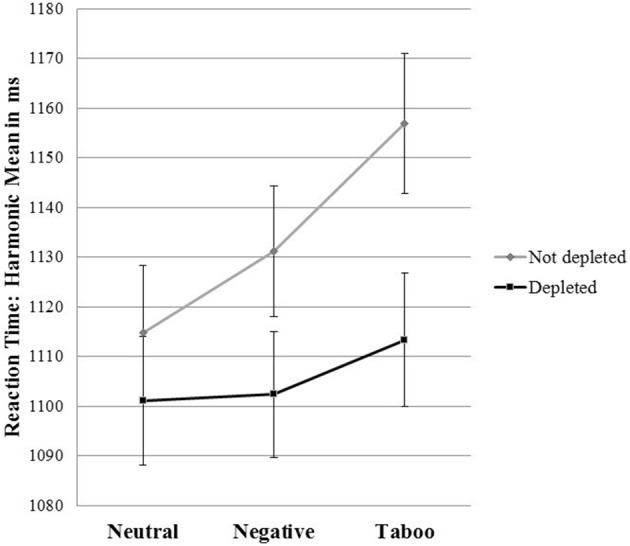
In an online experiment we examined the role of self-control in recognizing social cues in the context of disinhibited online behavior (e.g., flaming and trolling). We temporarily lowered participants' self-control capacity with an ego depletion paradigm (i.e., color Stroop task). Next, we measured participants' sensitivity to social cues with an emotional Stroop task containing neutral, negative, and taboo words. Sensitivity to social cues is represented by the increase in reaction time to negative and especially taboo words compared to neutral words. As expected, undepleted participants were slower to process the color of negative and taboo words. By contrast, depleted participants (i.e., those with lowered self-control capacity) did not react differently to taboo or negative words than they did to neutral words. The experiment illustrates that self-control failure may manifest itself in a failure to recognize social cues. The finding underlines the importance of self-control in understanding disinhibited online behavior: Many instances of disinhibited online behavior may occur not because people are unable to control themselves, but because they do not realize that a situation calls for self-control in the first place.
在一项在线实验中,我们研究了自我控制在识别去抑制性在线行为(如网络暴力和恶意挑衅)背景下的社会线索方面所起的作用。我们采用自我损耗范式(即颜色斯特鲁普任务)暂时降低参与者的自我控制能力。接下来,我们使用包含中性、负面和禁忌词汇的情绪斯特鲁普任务来测量参与者对社会线索的敏感度。对社会线索的敏感度表现为与中性词汇相比,对负面词汇尤其是禁忌词汇的反应时间增加。正如预期的那样,未损耗的参与者处理负面和禁忌词汇颜色的速度较慢。相比之下,损耗的参与者(即自我控制能力降低的那些人)对禁忌或负面词汇的反应与对中性词汇的反应没有差异。该实验表明,自我控制失败可能表现为无法识别社会线索。这一发现强调了自我控制在理解去抑制性在线行为中的重要性:许多去抑制性在线行为的发生可能不是因为人们无法控制自己,而是因为他们一开始就没有意识到某种情况需要自我控制。