Wang Qi-Wei, Zhang Xiao-Tian, Lu Ming, Shen Lin
Medical Oncology, Department of Gastrointestinal Cancer, Liaoning Cancer Hospital and Institute, Shenyang 110042, Liaoning Province, China.
Key Laboratory of Carcinogenesis and Translational Research (Ministry of Education), Department of Gastrointestinal Oncology, Peking University Cancer Hospital and Institute, Beijing 100142, China.
World J Gastrointest Oncol. 2018 Jan 15;10(1):31-39. doi: 10.4251/wjgo.v10.i1.31.
To provide evidence regarding the postoperative treatment of patients with T4bN1-3M0/TxN3bM0 gastric cancer, for which guidelines have not been established.
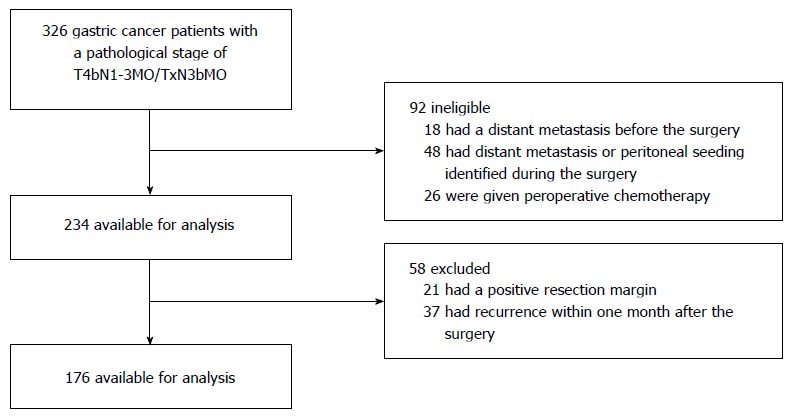
Patients who had undergone curative resection between 1996 and 2014 with a pathological stage of T4bN1-3M0/TxN3bM0 for gastric cancer were retrospectively analyzed; staging was based on the 7th edition of the American Joint Committee on Cancer staging system. The clinicopathological characteristics, administration of adjuvant chemotherapy, and patterns of recurrence were studied. Univariate and multivariate analyses of prognostic factors were conducted. The chemotherapeutic agents mainly included fluorouropyrimidine, platinum and taxanes, used as monotherapy, doublet, or triplet regimens. Patterns of first recurrence were categorized as locoregional recurrence, peritoneal dissemination, or distant metastasis.
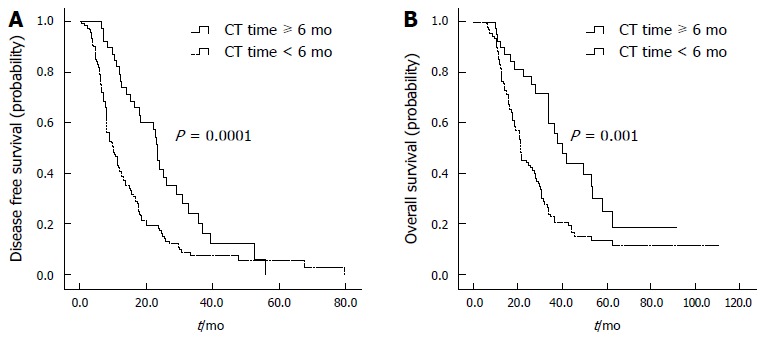
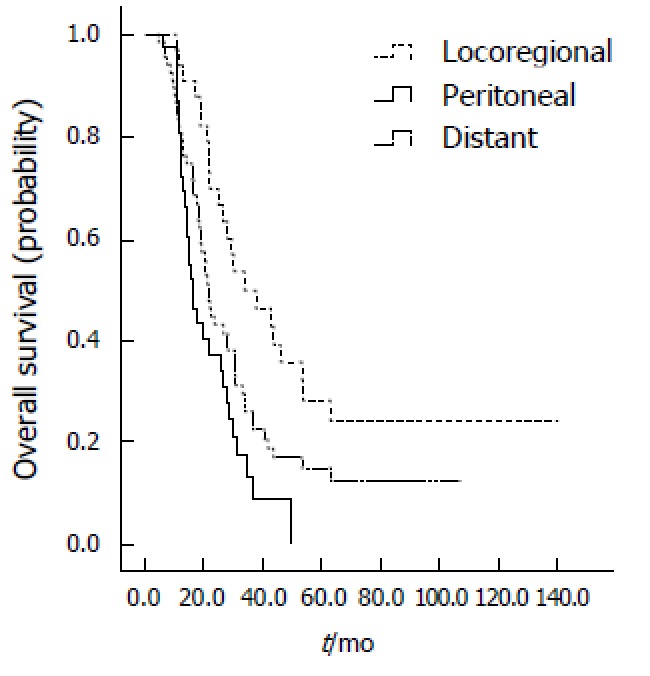
The 5-year overall survival (OS) of the whole group ( = 176) was 16.8%, and the median OS was 25.7 mo (95%CI: 20.9-30.5). Lymphovascular invasion and a node positive rate (NPR) ≥ 0.8 were associated with a poor prognosis ( = 0.01 and = 0.048, respectively). One hundred forty-seven (83.5%) of the 176 patients eventually experienced recurrence; the most common pattern of the first recurrence was distant metastasis. The prognosis was best for patients with locoregional recurrence and worst for those with peritoneal dissemination. Twelve (6.8%) of the 176 patients did not receive adjuvant chemotherapy, while 164 (93.2%) patients received adjuvant chemotherapy. Combined chemotherapy, including doublet and triplet regimens, was associated with a better prognosis than monotherapy, with no significant difference in 5-year OS (17.5% 0%, = 0.613). The triplet regimen showed no significant survival benefit compared with the doublet regimen for 5-year OS (18.5% 17.4%, = 0.661). Thirty-nine (22.1%) patients received adjuvant chemotherapy for longer than six months; the median OS in patients who received adjuvant chemotherapy for longer than six months was 40.2 mo (95%CI: 30.6-48.2), significantly longer than the 21.6 mo (95%CI: 19.1-24.0) in patients who received adjuvant chemotherapy for less than six months ( = 0.001).
Patients with T4bN1-3M0/TxN3bM0 gastric cancer showed a poor prognosis and a high risk of distant metastasis. Adjuvant chemotherapy for longer than six months improved outcomes for them.
为T4bN1 - 3M0/TxN3bM0期胃癌患者的术后治疗提供证据,目前该分期的治疗指南尚未确立。
回顾性分析1996年至2014年间接受根治性切除、病理分期为T4bN1 - 3M0/TxN3bM0的胃癌患者;分期依据美国癌症联合委员会第7版癌症分期系统。研究临床病理特征、辅助化疗的应用及复发模式。对预后因素进行单因素和多因素分析。化疗药物主要包括氟尿嘧啶、铂类和紫杉烷类,采用单药、两药联合或三药联合方案。首次复发模式分为局部区域复发、腹膜播散或远处转移。
全组(n = 176)患者的5年总生存率(OS)为16.8%,中位OS为25.7个月(95%CI:20.9 - 30.5)。淋巴管侵犯和淋巴结阳性率(NPR)≥0.8与预后不良相关(分别为P = 0.01和P = 0.048)。176例患者中有147例(83.5%)最终复发;首次复发最常见的模式是远处转移。局部区域复发患者的预后最佳,腹膜播散患者的预后最差。176例患者中有12例(6.8%)未接受辅助化疗,164例(93.2%)患者接受了辅助化疗。联合化疗,包括两药联合和三药联合方案,与单药治疗相比预后更好,5年OS无显著差异(17.5%对15.0%,P = 0.613)。三药联合方案与两药联合方案相比,5年OS无显著生存获益(18.5%对17.4%,P = 0.661)。39例(22.1%)患者接受辅助化疗超过6个月;接受辅助化疗超过6个月患者的中位OS为40.2个月(95%CI:30.6 - 48.2),显著长于接受辅助化疗少于6个月患者的21.6个月(95%CI:19.1 - 24.0)(P = 0.001)。
T4bN1 - 3M0/TxN3bM0期胃癌患者预后较差,远处转移风险高。辅助化疗超过6个月可改善其预后。