Department of Abdominal Oncology, Cancer Center and State Key Laboratory of Biotherapy, West China Hospital, West China Medical School, Sichuan University, Guoxue Lane No. 37, Chengdu, Sichuan Province, 610041, People's Republic of China.
Chinese Evidence-Based Medicine Centre, West China Hospital, West China Medical School, Sichuan University, Chengdu, People's Republic of China.
BMC Cancer. 2018 Jan 29;18(1):101. doi: 10.1186/s12885-018-3989-2.
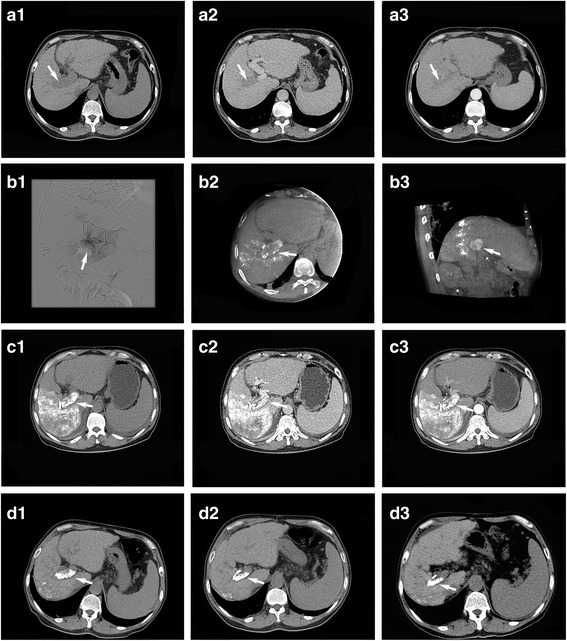
The prognosis of hepatocellular carcinoma with portal vein tumor thrombus remains extremely poor. This pilot study aimed to evaluate the technical feasibility, effectiveness and safety of transcatheter chemoembolization for tumors in the liver parenchyma plus intra-arterial ethanol embolization for portal vein tumor thrombus.
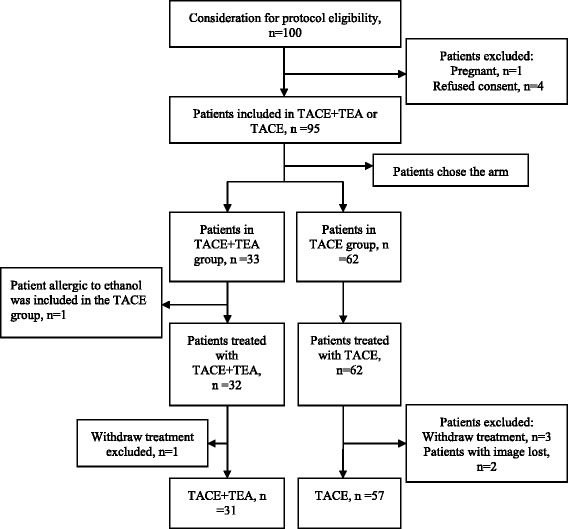
A pilot study was carried out on 31 patients in the treatment group (transcatheter chemoembolization plus intra-arterial ethanol embolization) and 57 patients in the control group (transcatheter chemoembolization alone). Enhanced computed tomography/magnetic resonance images were repeated 4 weeks after the procedure to assess the response. Overall survival and complications were assessed until the patient died or was lost to follow-up.
Median survival was 10.5 months in the treatment group (2.4 ± 1.7 courses) and 3.9 months in the control group (1.9 ± 1 courses) (P = 0.001). Patients in the treatment group had better overall survival (at 3, 6 and 12 months, respectively), compared to patients in the control group (90.3% vs. 59.6%, 64.5% vs. 29.8%, and 41.9% vs. 10.6%; p = 0.001). Furthermore, the rate of portal vein tumor thrombus regression was higher in the treatment group (93.1%) than in the control group (32.1%) (P < 0.001).
Based on the results of this study, transcatheter chemoembolization combined with intra-arterial ethanol embolization may be more effective than transcatheter chemoembolization alone for treating hepatocellular carcinoma with portal vein tumor thrombus. Intra-arterial ethanol embolization for treating portal vein tumor thrombus is safe, feasible and prolongs overall survival.
合并门静脉癌栓的肝细胞癌预后极差。本研究旨在评估经导管肝实质化疗栓塞联合经肝动脉乙醇栓塞治疗门静脉癌栓的技术可行性、有效性和安全性。
对 31 例治疗组(经导管肝实质化疗栓塞+经肝动脉乙醇栓塞)和 57 例对照组(经导管肝实质化疗栓塞)患者进行了一项前瞻性研究。术后 4 周行增强 CT/MRI 评估疗效。直至患者死亡或失访,评估总生存及并发症。
治疗组的中位生存时间为 10.5 个月(2.4±1.7 个疗程),对照组为 3.9 个月(1.9±1 个疗程)(P=0.001)。与对照组相比,治疗组患者的总生存时间更好(3、6、12 个月时分别为 90.3%、64.5%、41.9%,对照组为 59.6%、29.8%、10.6%,P=0.001)。而且,治疗组门静脉癌栓消退率(93.1%)高于对照组(32.1%)(P<0.001)。
本研究结果表明,与单纯经导管肝实质化疗栓塞相比,经导管肝实质化疗栓塞联合经肝动脉乙醇栓塞治疗合并门静脉癌栓的肝细胞癌可能更有效。经肝动脉乙醇栓塞治疗门静脉癌栓安全、可行,可延长总生存时间。