Department of Health Policy and Management, University of Georgia, Athens, GA 30602.
Texas Institute for Discovery Education in Science, College of Natural Sciences, University of Texas at Austin, Austin, TX 78712.
CBE Life Sci Educ. 2018 Spring;17(1). doi: 10.1187/cbe.17-06-0114.
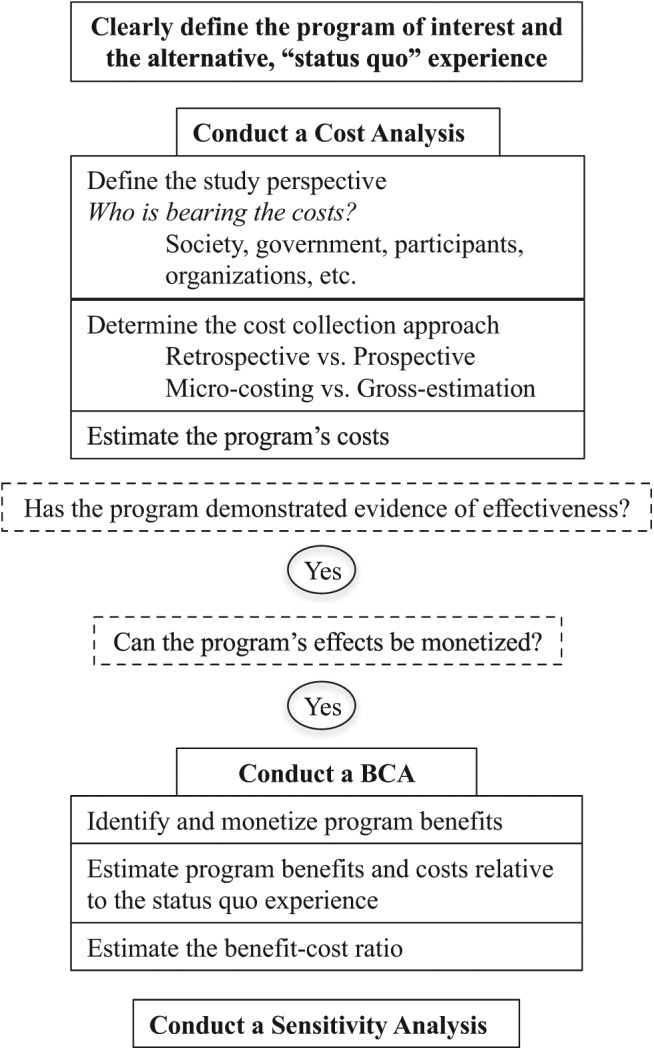
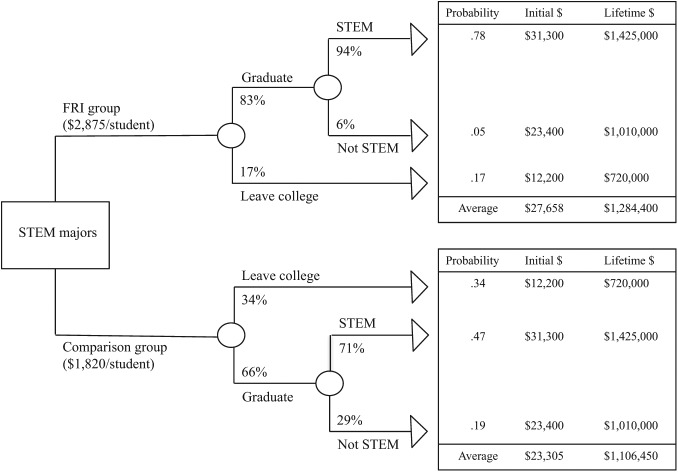
Institutions and administrators regularly have to make difficult choices about how best to invest resources to serve students. Yet economic evaluation, or the systematic analysis of the relationship between costs and outcomes of a program or policy, is relatively uncommon in higher education. This type of evaluation can be an important tool for decision makers considering questions of resource allocation. Our purpose with this essay is to describe methods for conducting one type of economic evaluation, a benefit-cost analysis (BCA), using an example of an existing undergraduate education program, the Freshman Research Initiative (FRI) at the University of Texas Austin. Our aim is twofold: to demonstrate how to apply BCA methodologies to evaluate an education program and to conduct an economic evaluation of FRI in particular. We explain the steps of BCA, including assessment of costs and benefits, estimation of the benefit-cost ratio, and analysis of uncertainty. We conclude that the university's investment in FRI generates a positive return for students in the form of increased future earning potential.
机构和管理人员经常需要做出艰难的选择,以确定如何最好地投资资源来为学生服务。然而,经济评估,即对项目或政策的成本和结果之间关系的系统分析,在高等教育中相对较少见。这种评估可以成为决策者考虑资源分配问题的重要工具。我们撰写本文的目的是描述使用德克萨斯大学奥斯汀分校现有本科教育计划——新生研究计划(FRI)的一个示例来进行一种经济评估方法,即收益成本分析(BCA)。我们的目的有两个:展示如何应用 BCA 方法来评估教育计划,以及特别对 FRI 进行经济评估。我们解释了 BCA 的步骤,包括成本和收益的评估、收益成本比的估计以及不确定性分析。我们的结论是,大学对 FRI 的投资为学生带来了积极的回报,表现为未来收入潜力的增加。