Lopatto David, Rosenwald Anne G, DiAngelo Justin R, Hark Amy T, Skerritt Matthew, Wawersik Matthew, Allen Anna K, Alvarez Consuelo, Anderson Sara, Arrigo Cindy, Arsham Andrew, Barnard Daron, Bazinet Christopher, Bedard James E J, Bose Indrani, Braverman John M, Burg Martin G, Burgess Rebecca C, Croonquist Paula, Du Chunguang, Dubowsky Sondra, Eisler Heather, Escobar Matthew A, Foulk Michael, Furbee Emily, Giarla Thomas, Glaser Rivka L, Goodman Anya L, Gosser Yuying, Haberman Adam, Hauser Charles, Hays Shan, Howell Carina E, Jemc Jennifer, Johnson M Logan, Jones Christopher J, Kadlec Lisa, Kagey Jacob D, Keller Kimberly L, Kennell Jennifer, Key S Catherine Silver, Kleinschmit Adam J, Kleinschmit Melissa, Kokan Nighat P, Kopp Olga Ruiz, Laakso Meg M, Leatherman Judith, Long Lindsey J, Manier Mollie, Martinez-Cruzado Juan C, Matos Luis F, McClellan Amie Jo, McNeil Gerard, Merkhofer Evan, Mingo Vida, Mistry Hemlata, Mitchell Elizabeth, Mortimer Nathan T, Mukhopadhyay Debaditya, Myka Jennifer Leigh, Nagengast Alexis, Overvoorde Paul, Paetkau Don, Paliulis Leocadia, Parrish Susan, Preuss Mary Lai, Price James V, Pullen Nicholas A, Reinke Catherine, Revie Dennis, Robic Srebrenka, Roecklein-Canfield Jennifer A, Rubin Michael R, Sadikot Takrima, Sanford Jamie Siders, Santisteban Maria, Saville Kenneth, Schroeder Stephanie, Shaffer Christopher D, Sharif Karim A, Sklensky Diane E, Small Chiyedza, Smith Mary, Smith Sheryl, Spokony Rebecca, Sreenivasan Aparna, Stamm Joyce, Sterne-Marr Rachel, Teeter Katherine C, Thackeray Justin, Thompson Jeffrey S, Peters Stephanie Toering, Van Stry Melanie, Velazquez-Ulloa Norma, Wolfe Cindy, Youngblom James, Yowler Brian, Zhou Leming, Brennan Janie, Buhler Jeremy, Leung Wilson, Reed Laura K, Elgin Sarah C R
Center for Teaching, Learning and Assessment, Grinnell College, Grinnell, IA 50112, USA.
Biology, Georgetown University, Washington, DC 20057, USA.
J Microbiol Biol Educ. 2020 Feb 28;21(1). doi: 10.1128/jmbe.v21i1.2005. eCollection 2020.
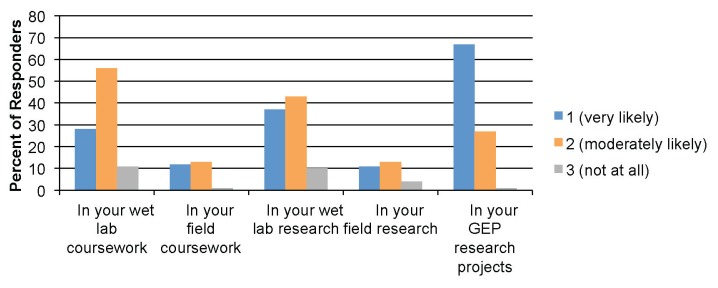
A hallmark of the research experience is encountering difficulty and working through those challenges to achieve success. This ability is essential to being a successful scientist, but replicating such challenges in a teaching setting can be difficult. The Genomics Education Partnership (GEP) is a consortium of faculty who engage their students in a genomics Course-Based Undergraduate Research Experience (CURE). Students participate in genome annotation, generating gene models using multiple lines of experimental evidence. Our observations suggested that the students' learning experience is continuous and recursive, frequently beginning with frustration but eventually leading to success as they come up with defendable gene models. In order to explore our "formative frustration" hypothesis, we gathered data from faculty via a survey, and from students via both a general survey and a set of student focus groups. Upon analyzing these data, we found that all three datasets mentioned frustration and struggle, as well as learning and better understanding of the scientific process. Bioinformatics projects are particularly well suited to the process of iteration and refinement because iterations can be performed quickly and are inexpensive in both time and money. Based on these findings, we suggest that a dynamic of "formative frustration" is an important aspect for a successful CURE.
科研经历的一个标志是遇到困难并克服这些挑战以取得成功。这种能力对于成为一名成功的科学家至关重要,但在教学环境中重现此类挑战可能会很困难。基因组学教育伙伴关系(GEP)是一个由教师组成的联盟,他们让学生参与基于课程的本科基因组学研究体验(CURE)。学生参与基因组注释,利用多条实验证据生成基因模型。我们的观察表明,学生的学习体验是持续且循环的,通常始于挫折,但最终随着他们提出可辩护的基因模型而走向成功。为了探索我们的“形成性挫折”假说,我们通过一项调查从教师那里收集数据,并通过一项普通调查和一组学生焦点小组从学生那里收集数据。在分析这些数据时,我们发现所有三个数据集都提到了挫折与挣扎,以及对科学过程的学习和更好理解。生物信息学项目特别适合迭代和完善的过程,因为迭代可以快速进行,并且在时间和金钱方面成本都很低。基于这些发现,我们认为“形成性挫折”动态是成功的CURE的一个重要方面。