Department of Pharmacology, School of Medicine, International University of Health and Welfare, 4-2 Kozunomori, Narita, Chiba 286-8686, Japan.
Department of Pharmacology, Faculty of Medicine, Kagawa University, Kagawa 761-0793, Japan.
Int J Mol Sci. 2018 Jan 30;19(2):400. doi: 10.3390/ijms19020400.
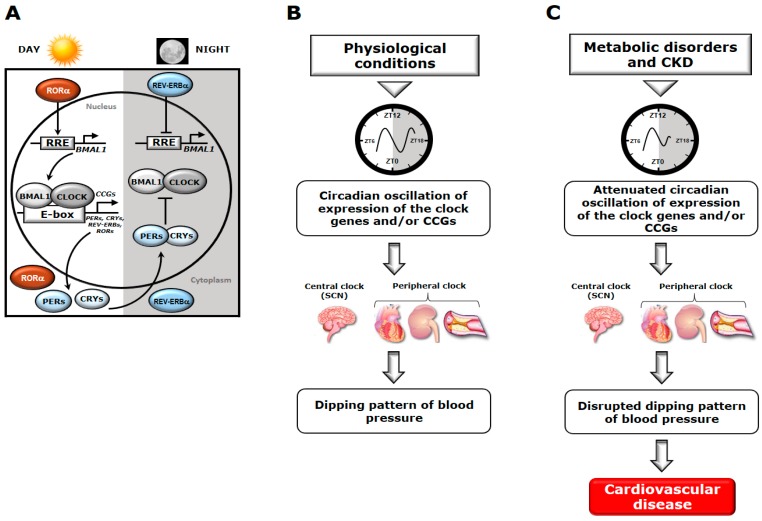
The morning surge in blood pressure (BP) coincides with increased cardiovascular (CV) events. This strongly suggests that an altered circadian rhythm of BP plays a crucial role in the development of CV disease (CVD). A disrupted circadian rhythm of BP, such as the non-dipping type of hypertension (i.e., absence of nocturnal BP decline), is frequently observed in metabolic disorders and chronic kidney disease (CKD). The circadian timing system, controlled by the central clock in the suprachiasmatic nucleus of the hypothalamus and/or by peripheral clocks in the heart, vasculature, and kidneys, modulates the 24 h oscillation of BP. However, little information is available regarding the molecular and cellular mechanisms of an altered circadian timing system-mediated disrupted dipping pattern of BP in metabolic disorders and CKD that can lead to the development of CV events. A more thorough understanding of this pathogenesis could provide novel therapeutic strategies for the management of CVD. This short review will address our and others' recent findings on the molecular mechanisms that may affect the dipping pattern of BP in metabolic dysfunction and kidney disease and its association with CV disorders.
血压(BP)的晨峰与心血管(CV)事件增加相吻合。这强烈表明,BP 的昼夜节律改变在心血管疾病(CVD)的发展中起着关键作用。代谢紊乱和慢性肾脏病(CKD)中经常观察到 BP 的昼夜节律紊乱,例如非杓型高血压(即夜间 BP 下降缺失)。由下丘脑视交叉上核中的中央时钟和/或心脏、血管和肾脏中的外周时钟控制的昼夜节律计时系统调节 BP 的 24 小时波动。然而,关于代谢紊乱和 CKD 中昼夜节律计时系统介导的 BP 昼夜波动模式改变的分子和细胞机制的信息很少,这些机制可能导致 CV 事件的发生。更深入地了解这一发病机制可以为 CVD 的治疗提供新的策略。这篇简短的综述将介绍我们和其他人最近关于可能影响代谢功能障碍和肾脏病中 BP 昼夜波动模式及其与 CV 障碍关联的分子机制的发现。