Cuspidi Cesare, Tadic Marijana, Sala Carla, Gherbesi Elisa, Grassi Guido, Mancia Giuseppe
Department of Medicine and Surgery, University of Milano-Bicocca, 20036 Meda, Italy.
Istituto Auxologico Italiano, 20122 Milano, Italy.
J Clin Med. 2019 Sep 2;8(9):1367. doi: 10.3390/jcm8091367.
We examined the reduced blood pressure (BP) nocturnal fall in patients with obstructive sleep apnea (OSA) by a meta-analysis including studies that provided data on prevalence rates of non-dipping (ND) pattern during 24-h ambulatory blood pressure monitoring (ABPM).
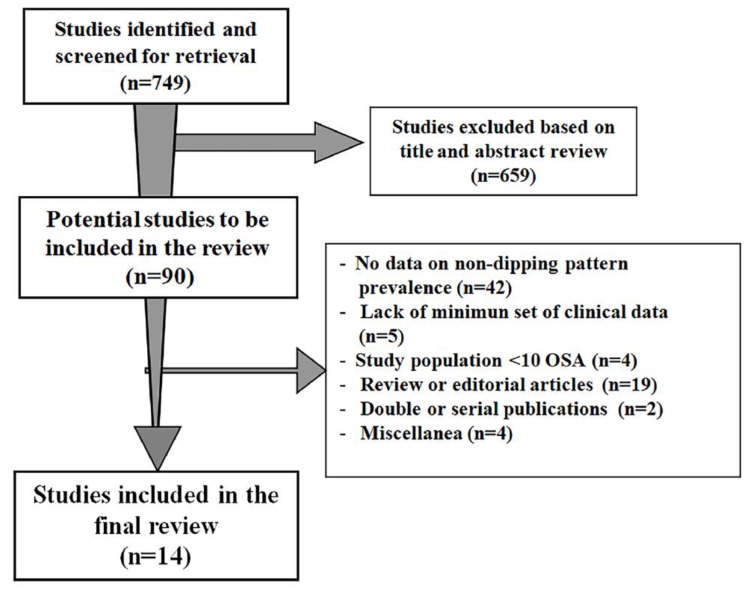
The PubMed, OVID-MEDLINE, and Cochrane CENTRAL literature databases were searched for appropriate articles without temporal restriction up to April 2019 through focused and sensitive search methods. Studies were identified by crossing the search terms as follows: "obstructive sleep apnea", "sleep quality", "non dipping", "reduced nocturnal BP fall", "circadian BP variation", "night-time BP", and "ambulatory blood pressure monitoring".
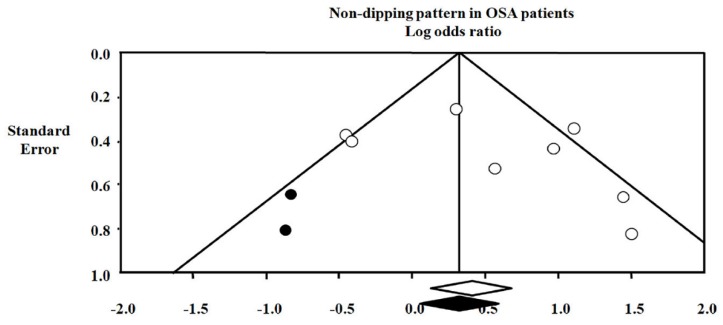
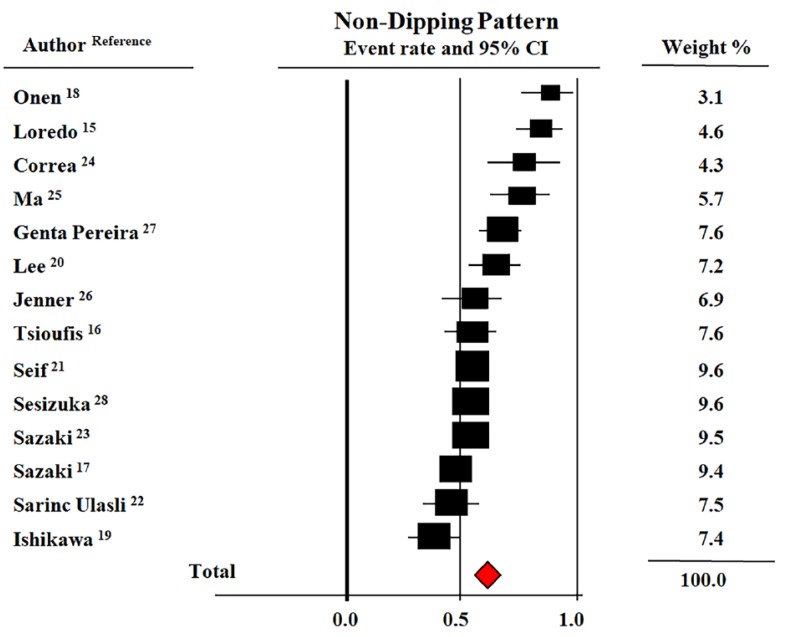
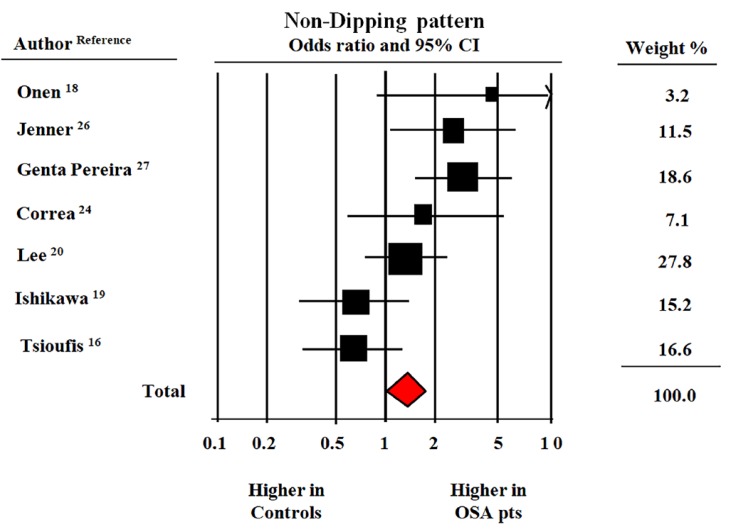
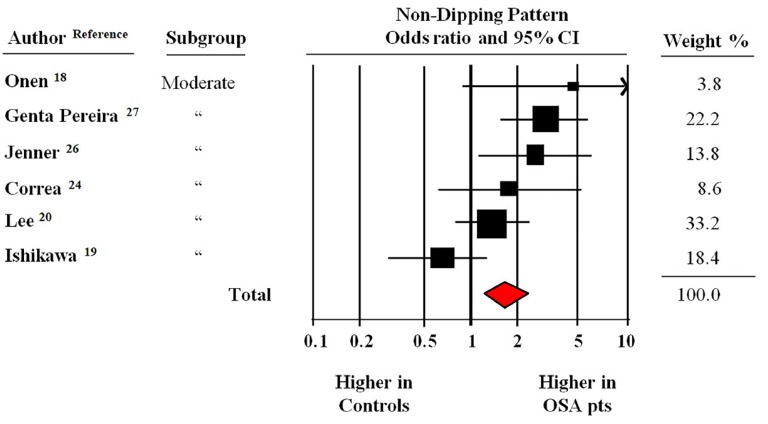
Meta-analysis included 1562 patients with OSA from different clinical settings and 957 non-OSA controls from 14 studies. ND pattern prevalence in patients with OSA widely varied among studies (36.0-90.0%). This was also the case for non-OSA controls (33.0% to 69.0%). Overall, the ND pattern, assessed as an event rate in the pooled OSA population, was 59.1% (confidence interval (CI): 52.0-65.0%). Meta-analysis of the seven studies comparing the prevalence of ND pattern in participants with OSA and controls showed that OSA entails a significantly increased risk of ND (Odds ratio (OR) = 1.47, CI: 1.07-1.89, < 0.01). After the exclusion of patients with mild OSA, OR increased to 1.67 (CI: 1.21-2.28, < 0.001).
The present meta-analysis, extending previous information on the relationship between OSA and impaired BP dipping, based on single studies, suggests that this condition increases by approximately 1.5 times the likelihood of ND, which is a pattern associated with a greater cardiovascular risk than normal BP dipping.
我们通过一项荟萃分析,研究阻塞性睡眠呼吸暂停(OSA)患者夜间血压(BP)下降幅度减小的情况,该分析纳入了提供24小时动态血压监测(ABPM)期间非勺型(ND)模式患病率数据的研究。
通过聚焦且灵敏的检索方法,在PubMed、OVID-MEDLINE和Cochrane CENTRAL文献数据库中检索截至2019年4月无时间限制的相关文章。通过交叉检索词来识别研究,检索词如下:“阻塞性睡眠呼吸暂停”、“睡眠质量”、“非勺型”、“夜间血压下降幅度减小”、“昼夜血压变化”、“夜间血压”以及“动态血压监测”。
荟萃分析纳入了来自不同临床背景的1562例OSA患者以及来自14项研究的957例非OSA对照。OSA患者中ND模式的患病率在不同研究中差异很大(36.0% - 90.0%)。非OSA对照的情况也是如此(33.0%至69.0%)。总体而言,在合并的OSA人群中,作为事件发生率评估的ND模式为59.1%(置信区间(CI):52.0 - 65.0%)。对7项比较OSA参与者和对照中ND模式患病率的研究进行的荟萃分析表明,OSA会使ND风险显著增加(优势比(OR)= 1.47,CI:1.07 - 1.89,P < 0.01)。排除轻度OSA患者后,OR增加至1.67(CI:1.21 - 2.28,P < 0.001)。
本荟萃分析扩展了以往基于单项研究的关于OSA与血压勺型受损之间关系的信息,表明这种情况使ND的可能性增加约1.5倍,ND模式与比正常血压勺型更大的心血管风险相关。