Sadeghian-Rizi Sedighe, Khodarahmi Ghadamali, Sakhteman Amirhossein, Jahanian-Najafabadi Ali, Rostami Mahboubeh, Mirzaei Mahmoud, Hassanzadeh Farshid
Department of Medicinal Chemistry and Pharmaceutical Sciences Research Center, School of Pharmacy and Pharmaceutical Sciences, Isfahan University of Medical Sciences, Isfahan, I.R. Iran.
Department of Medicinal Chemistry, School of Pharmacy, Shiraz University of Medical Sciences, Shiraz, I.R. Iran.
Res Pharm Sci. 2018 Feb;13(1):82-92. doi: 10.4103/1735-5362.220971.
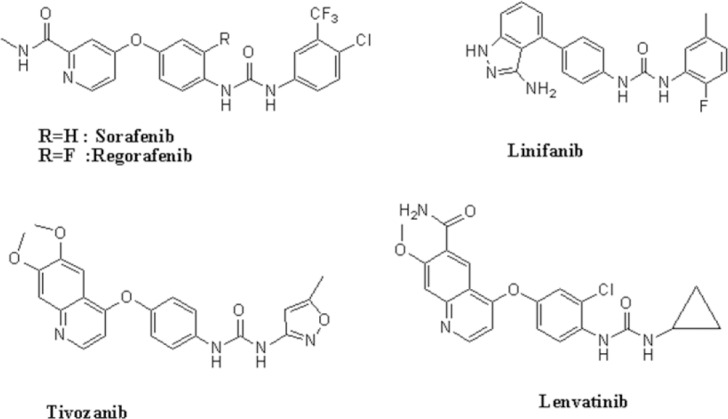
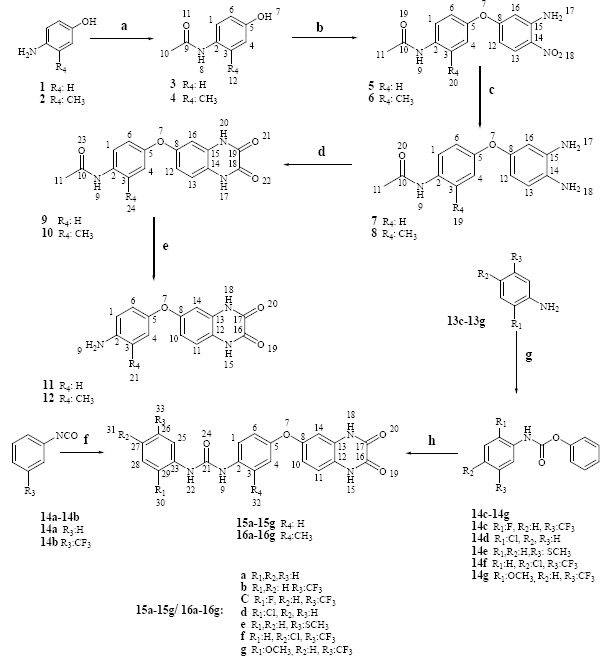
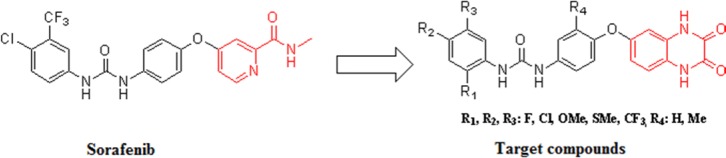
Diaryl urea derivatives have exhibited a broad spectrum of biochemical effects and pharmaceutical applications. Several diaryl urea derivatives such as sorafenib, regorafenib, linifanib, and tivozanib and lenvatinib are in clinical trial or clinical use. Therefore, development of small molecules within the diaryl urea scaffold with the ability of binding to variety of enzymes and receptors in the biological system are an interesting topic for researchers. Sorafenib as a diaryl urea derivative is a well-known anticancer agent. Corresponding to available information about biological activities of quinoxaline moieties, based on sorafenib scaffold, several structures were designed by replacement of pyridyl carboxamide group of sorafenib with quinoxalindione moiety. A total of 14 novel compounds in 7 synthetic steps were synthesized. Briefly, the amino group of p-aminophenol was first protected followed by O-arylation of 4-acetamidophenol with 5-chloro-2-nitroaniline to provide 5-(4-acetamidophenoxy)-2-nitroaniline. Reduction of the nitro group of 5-(4-acetamidophenoxy)-2-nitroaniline and cyclization of diamine N-(4-(3,4-diaminophenoxy) phenyl) acetamides with oxalic acid afforded compound N-(4-((2,3-dioxo-1,2,3,4-tetrahydroquinoxalin-6-yl)oxy)phenyl) acetamides which on deacetylation gave compounds 6-(4-aminophenoxy) quinoxaline-2,3 (1H, 4H)-diones. Then resultant compounds, 6-(4-aminophenoxy) quinoxaline-2,3 (1H, 4H)-diones were reacted by appropriate isocyanates/ carbamates to give the target compounds 1-(4-((2,3-dioxo-1,2,3,4-tetrahydroquinoxalin-6-yl)oxy)phenyl)-3-phenylureas. The structures of compounds confirmed by proton nuclear magnetic resonance (H NMR), mass spectrum and Fourier transform infrared (FT-IR).
二芳基脲衍生物已展现出广泛的生化效应和药物应用。几种二芳基脲衍生物,如索拉非尼、瑞戈非尼、林尼法尼、替沃扎尼和乐伐替尼,正在进行临床试验或已投入临床使用。因此,开发具有与生物系统中多种酶和受体结合能力的二芳基脲骨架小分子,是研究人员感兴趣的课题。索拉非尼作为一种二芳基脲衍生物,是一种著名的抗癌药物。根据有关喹喔啉部分生物活性的现有信息,基于索拉非尼骨架,通过用喹喔啉二酮部分取代索拉非尼的吡啶甲酰胺基团,设计了几种结构。通过7步合成反应,总共合成了14种新化合物。简要来说,对氨基苯酚的氨基首先被保护,随后4 - 乙酰氨基苯酚与5 - 氯 - 2 - 硝基苯胺进行O - 芳基化反应,得到5 - (4 - 乙酰氨基苯氧基)-2 - 硝基苯胺。5 - (4 - 乙酰氨基苯氧基)-2 - 硝基苯胺的硝基还原以及二胺N - (4 - (3,4 - 二氨基苯氧基)苯基)乙酰胺与草酸的环化反应,得到化合物N - (4 - ((2,3 - 二氧代 - 1,2,3,4 - 四氢喹喔啉 - 6 - 基)氧基)苯基)乙酰胺,该化合物脱乙酰化后得到化合物6 - (4 - 氨基苯氧基)喹喔啉 - 2,3(1H, 4H)-二酮。然后,所得化合物6 - (4 - 氨基苯氧基)喹喔啉 - 2,3(1H, 4H)-二酮与适当的异氰酸酯/氨基甲酸酯反应,得到目标化合物1 - (4 - ((2,3 - 二氧代 - 1,2,3,4 - 四氢喹喔啉 - 6 - 基)氧基)苯基)-3 - 苯基脲。化合物的结构通过质子核磁共振(H NMR)、质谱和傅里叶变换红外光谱(FT - IR)得以确认。