Standaert David G, Boyd James T, Odin Per, Robieson Weining Z, Zamudio Jorge, Chatamra Krai
1University of Alabama at Birmingham, Birmingham, AL USA.
2University of Vermont College of Medicine, Burlington, VT USA.
NPJ Parkinsons Dis. 2018 Jan 24;4:4. doi: 10.1038/s41531-017-0040-2. eCollection 2018.
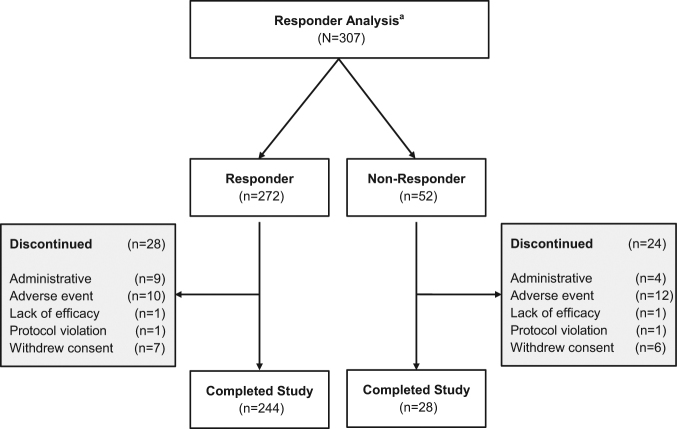
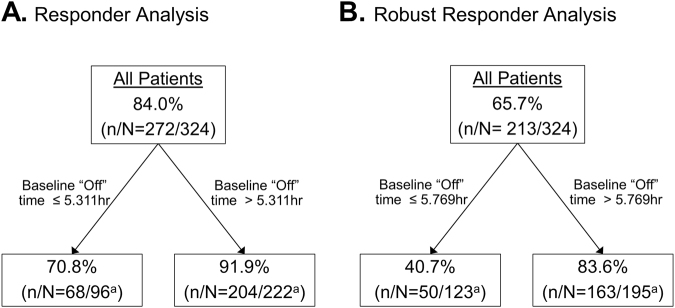
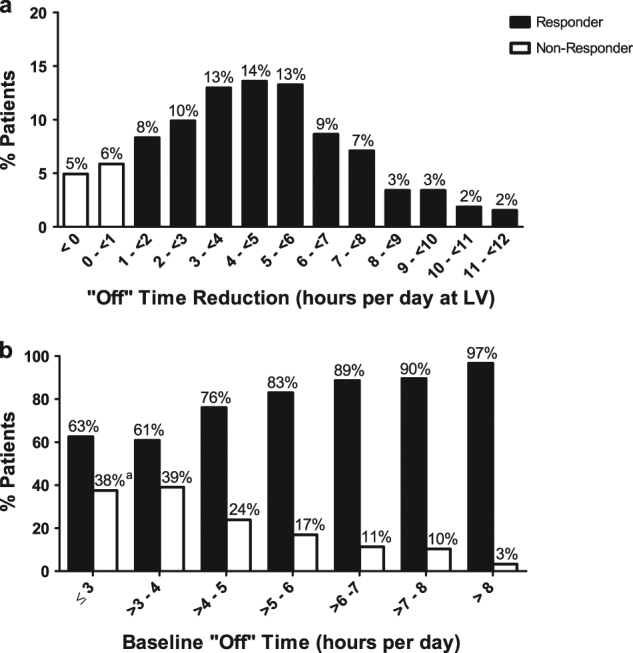
Levodopa-carbidopa intestinal gel (LCIG, carbidopa-levodopa enteral suspension in the United States) is a treatment option for advanced Parkinson's disease (PD) patients with motor fluctuations. The objective of this investigation was to identify the baseline characteristics predictive of treatment response, measured by improvement in motor symptom severity, in advanced PD patients treated with LCIG during a 54-week, open-label phase 3 study. Patients with ≥1 h improvement from baseline in "Off" time were categorized as "Responders"; whereas those with <1 h improvement, any worsening, or no post-baseline assessment were "Non-Responders". A subgroup of Responders with ≥3 h improvement in "Off" time was also examined; this subgroup was identified as "Robust Responders". Baseline demographics and disease characteristics were analyzed and their predictive relationship to change from baseline in normalized "Off" time was assessed. Out of the 324 patients included in the analysis, 272 (84.0%) were categorized as Responders and 52 (16.0%) were Non-Responders. A majority of patients (65.7%) had ≥3 h improvement in "Off" time. In general, baseline characteristics were similar between Non-responders, Responders, and the subgroup of Robust Responders. A conditional tree-structured regression analysis identified baseline "Off" time as the only factor that had significant effect on Responder and Robust Responder status. The safety profile of LCIG was similar between patient groups. Overall, this analysis showed that 84% of LCIG-treated advanced PD patients had ≥1 h improvement in "Off" time and the number-needed-to-treat to observe one patient responder was 1.19 patients. Notably, Responders and Robust Responders to LCIG were observed across the range of baseline demographics and clinical characteristics examined.
左旋多巴-卡比多巴肠凝胶(在美国为卡比多巴-左旋多巴肠内混悬液)是治疗出现运动波动的晚期帕金森病(PD)患者的一种选择。本研究的目的是在一项为期54周的开放标签3期研究中,确定接受左旋多巴-卡比多巴肠凝胶治疗的晚期PD患者中,通过运动症状严重程度改善来衡量的治疗反应的基线特征。“关”期时间较基线改善≥1小时的患者被归类为“反应者”;而改善<1小时、有任何恶化或未进行基线后评估的患者则为“无反应者”。还对“关”期时间改善≥3小时的反应者亚组进行了检查;该亚组被确定为“强反应者”。分析了基线人口统计学和疾病特征,并评估了它们与标准化“关”期时间相对于基线变化的预测关系。在纳入分析的324例患者中,272例(84.0%)被归类为反应者,52例(16.0%)为无反应者。大多数患者(65.7%)的“关”期时间改善≥3小时。总体而言,无反应者、反应者和强反应者亚组之间的基线特征相似。条件树结构回归分析确定基线“关”期时间是对反应者和强反应者状态有显著影响的唯一因素。患者组之间左旋多巴-卡比多巴肠凝胶的安全性概况相似。总体而言,该分析表明,84%接受左旋多巴-卡比多巴肠凝胶治疗的晚期PD患者“关”期时间改善≥1小时,观察到1例患者有反应所需治疗的患者数为1.19例。值得注意的是,在所检查的基线人口统计学和临床特征范围内均观察到了对左旋多巴-卡比多巴肠凝胶有反应者和强反应者。