Silva Diego Augusto Santos, Tremblay Mark Stephen, Souza Maria de Fatima Marinho de, Mooney Meghan, Naghavi Mohsen, Malta Deborah Carvalho
Research Center in Kinanthropometry and Human Performance, Federal University of Santa Catarina, Florianopolis, SC, Brazil.
Children's Hospital of Eastern Ontario Research Institute, Ottawa, ON, Canada.
PLoS One. 2018 Feb 1;13(2):e0190943. doi: 10.1371/journal.pone.0190943. eCollection 2018.
The aims of this study were to estimate all-cause and cause-specific mortality and years of life lost, investigated by disability-adjusted life-years (DALYs), due to colorectal cancer attributable to physical inactivity in Brazil and in the states; to analyze the temporal trend of these estimates over 25 years (1990-2015) compared with global estimates and according to the socioeconomic status of states of Brazil.
Databases from the Global Burden of Disease Study (GBD) for Brazil, Brazilian states and global information were used. It was estimated the total number and the age-standardized rates of deaths and DALYs for colorectal cancer attributable to physical inactivity in the years 1990 and 2015. We used the Socioeconomic Development Index (SDI).
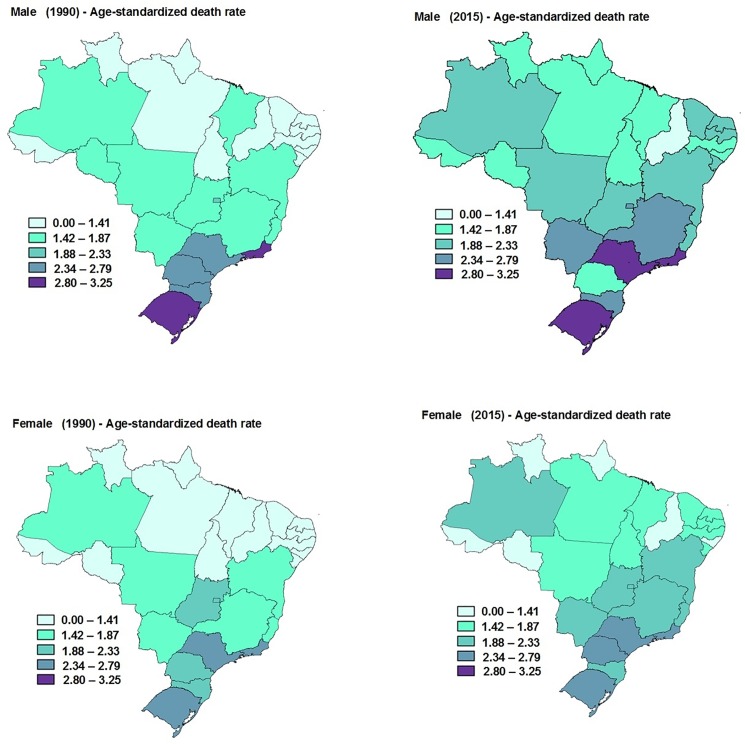
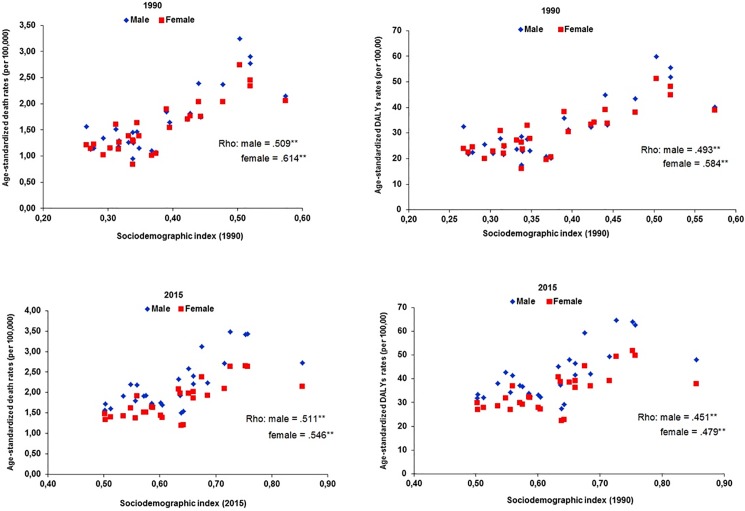
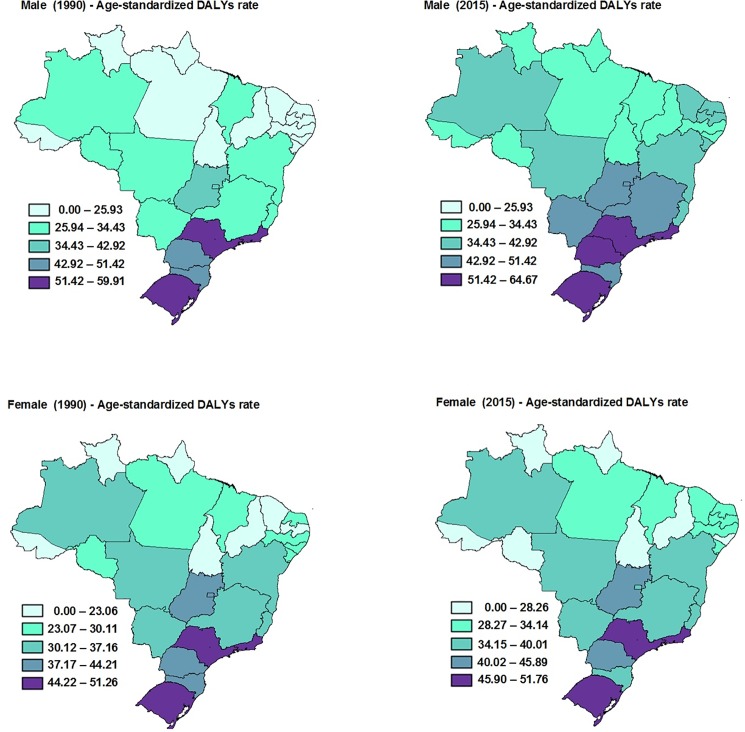
Physical inactivity was responsible for a substantial number of deaths (1990: 1,302; 2015: 119,351) and DALYs (1990: 31,121; 2015: 87,116) due to colorectal cancer in Brazil. From 1990 to 2015, the mortality and DALYs due to colorectal cancer attributable to physical inactivity increased in Brazil (0.6% and 0.6%, respectively) and decreased around the world (-0.8% and -1.1%, respectively). The Brazilian states with better socioeconomic indicators had higher rates of mortality and morbidity by colorectal cancer due to physical inactivity (p<0.01). Physical inactivity was responsible for deaths and DALYs due to colorectal cancer in Brazil.
Over 25 years, the Brazilian population showed more worrisome results than around the world. Actions to combat physical inactivity and greater cancer screening and treatment are urgent in the Brazilian states.
本研究的目的是估计巴西及各州市因缺乏身体活动导致的结直肠癌所致的全因死亡率、特定病因死亡率和生命损失年数,采用伤残调整生命年(DALYs)进行调查;分析这些估计值在25年(1990 - 2015年)间的时间趋势,并与全球估计值进行比较,同时根据巴西各州市的社会经济状况进行分析。
使用了来自全球疾病负担研究(GBD)的巴西、巴西各州市及全球信息的数据库。估计了1990年和2015年因缺乏身体活动导致的结直肠癌死亡总数、年龄标准化死亡率以及伤残调整生命年。我们使用了社会经济发展指数(SDI)。
在巴西,缺乏身体活动导致了大量因结直肠癌所致的死亡(1990年:1302例;2015年:119351例)和伤残调整生命年(1990年:31121;2015年:87116)。从1990年到2015年,巴西因缺乏身体活动导致的结直肠癌死亡率和伤残调整生命年有所上升(分别为0.6%和0.6%),而全球范围内则有所下降(分别为 - 0.8%和 - 1.1%)。社会经济指标较好的巴西州市,因缺乏身体活动导致的结直肠癌死亡率和发病率更高(p<0.01)。缺乏身体活动是巴西结直肠癌所致死亡和伤残调整生命年的原因。
在25年期间,巴西人口的情况比全球更为令人担忧。在巴西各州市,采取行动应对身体活动不足以及加强癌症筛查和治疗迫在眉睫。