Park Soyeon, Yoon Joon-Kee, Jin Lee Su, Kang Seok Yun, Yim Hyunee, An Young-Sil
Department of Nuclear Medicine and Molecular Imaging Department of Hematology-Oncology Department of Pathology, Ajou University School of Medicine, Suwon, Republic of Korea.
Medicine (Baltimore). 2017 Dec;96(50):e8985. doi: 10.1097/MD.0000000000008985.
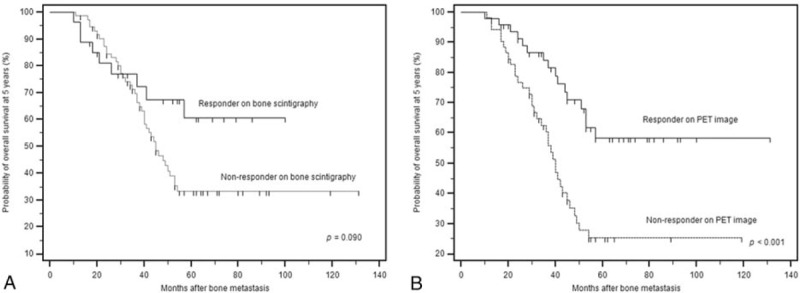
We performed this retrospective clinical study to examine the prognostic power of bone scintigraphy (BS) and F-fluorodeoxyglucose positron emission tomography/computed tomography (FDG PET/CT) in terms of overall survival (OS) of breast cancer with bone-only metastasis.We retrospectively evaluated 100 female invasive ductal breast cancer patients (mean age 48.1 years) with bone-only metastasis. Twenty-five patients had human epidermal growth factor receptor 2 (HER2)-positive tumors, 65 were estrogen receptor (ER) and/or progesterone receptor (PR)-positive, HER2-negative tumors, and 10 were triple negative tumors. The patients were treated properly with various treatments, including chemotherapy, radiotherapy, hormone, and bisphosphonate therapy, based on their clinical status. All patients underwent BS and FDG PET/CT at baseline and 1 year after treatment. The baseline and follow images were visually compared, and the patients were grouped as responders or nonresponders based on their images. OS was compared between the groups.The mean OS after the diagnosis of bone-only metastasis was 57.6 months. Fifty-one patients (51%) died within 5 years after diagnosis of metastasis. No difference in survival was evident between responders and nonresponders based on BS imaging data (P = .090). The response status based on PET imaging data waste only significant independent prognostic factor on multivariate analysis (P = .001). Survival was lower in nonresponders than in responders based on PET imaging (32.7% vs 66.4%; P < .001).Our findings suggest that the response status according to FDG PET imaging can be used to predict OS in breast cancer patients with bone-only metastasis.
我们进行了这项回顾性临床研究,以检验骨闪烁显像(BS)和氟脱氧葡萄糖正电子发射断层扫描/计算机断层扫描(FDG PET/CT)对仅发生骨转移的乳腺癌患者总生存期(OS)的预后预测能力。我们回顾性评估了100例仅发生骨转移的女性浸润性导管癌患者(平均年龄48.1岁)。25例患者为人类表皮生长因子受体2(HER2)阳性肿瘤,65例为雌激素受体(ER)和/或孕激素受体(PR)阳性、HER2阴性肿瘤,10例为三阴性肿瘤。根据患者的临床状况,对其进行了包括化疗、放疗、激素治疗和双膦酸盐治疗在内的多种适当治疗。所有患者在基线时以及治疗后1年均接受了BS和FDG PET/CT检查。对基线图像和随访图像进行了视觉比较,并根据图像将患者分为反应者或无反应者。比较了两组之间的总生存期。仅发生骨转移诊断后的平均总生存期为57.6个月。51例患者(51%)在转移诊断后5年内死亡。根据BS成像数据,反应者和无反应者之间的生存无明显差异(P = 0.090)。基于PET成像数据的反应状态在多变量分析中是唯一显著的独立预后因素(P = 0.001)。根据PET成像,无反应者的生存率低于反应者(32.7%对66.4%;P < 0.001)。我们的研究结果表明,根据FDG PET成像的反应状态可用于预测仅发生骨转移的乳腺癌患者的总生存期。