Geng He-Hong, Wang Qiang, Li Bo, Cui Bin-Bin, Jin Yong-Ping, Fu Rong-Li, Zhang Qing, Wang Jing-Jie, Wang Pei-Xi
Institute of Public Health, School of Nursing, Henan University, Kaifeng Henan Children's Hospital, Zhengzhou Department of Preventive Medicine, School of Public Health, Guangzhou Medical University, Guangzhou School of Basic Medical Science, Henan University, Kaifeng Department of Neurology of Huai-He Hospital, Kaifeng, China.
Medicine (Baltimore). 2017 Dec;96(51):e9068. doi: 10.1097/MD.0000000000009068.
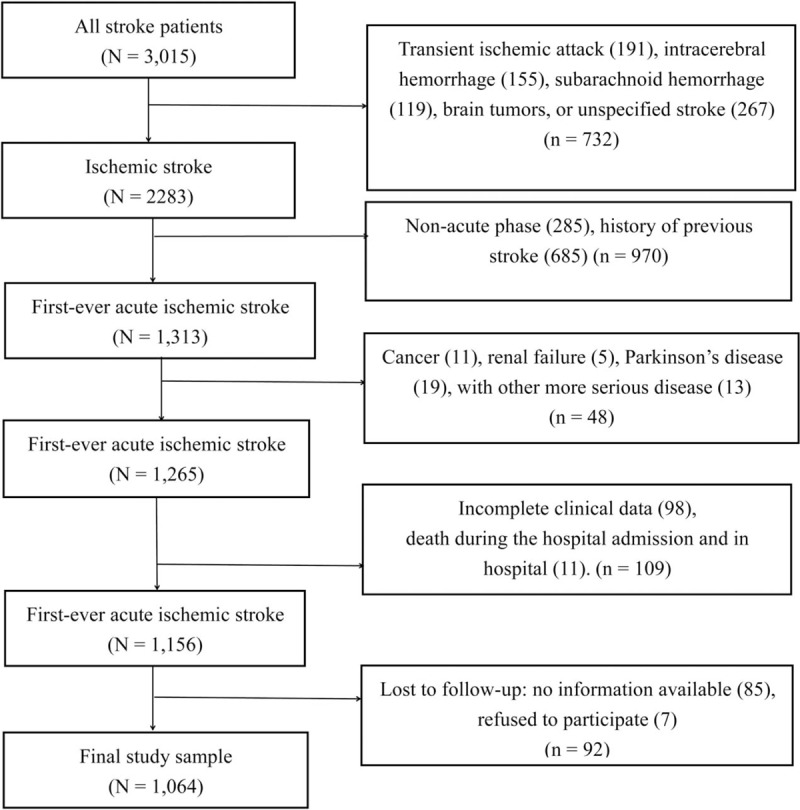
Early neurological deterioration (END) is associated with increased risk of functional disability and mortality. However, data are limited regarding the long-term risk of poor functional outcomes. Thus we explored the association between END and long-term outcomes in patients with acute ischemic stroke.A total of 1064 patients were enrolled with acute ischemic stroke who were consecutively admitted to the 3 stroke units of Huai-He Hospital, Kaifeng, China. END was defined as an increment change of at least one point in motor power or total National Institute of Health Stroke Scale (NIHSS) score deterioration ≥2 points within the first week after admission. We retrospectively assessed the risk factors of END and prospectively explored the relationship between END and the long-term outcomes by multivariable regression models after adjusting the potential confounding factors. Outcomes were evaluated at 18 months based on modified Rankin scale (MRS) scores.Approximately 32% of first-ever ischemic stroke patients experienced END during the acute phase. END was associated with diabetes (odds ratio [OR], 2.218; 95% confidence interval [CI] 1.619-3.037), NIHSS score at admission (OR, 1.052; 95% CI 1.023-1.082), C-reactive protein (CRP) levels (OR, 1.224; 95% CI 1.066-1.406]), and homocysteine (HCY) levels (OR, 1.203; 95% CI 1.061-1.365) after adjusting related factors, such as hypertension, diabetes, NIHSS at admission, and some blood laboratory values, including direct bilirubin, total cholesterol, low-density lipoprotein, glucose, CRP, HCY, and D-dimer levels. During the follow-up period, 52 (4.9%) patients died, 160 (15.0%) recrudesced, and 317 (29.8%) suffered poor outcomes. Multivariate logistic regression analyses revealed that poor outcome was associated with END (OR, 3.366; 95% CI 2.495-4.542), age (OR, 1.028; 95% CI 1.015-1.041), body mass index (OR, 1.096; 95% CI 1.051-1.144), coronary heart disease (OR, 1.637; 95% CI 1.108-2.416), and CRP (OR, 2.474; 95% CI 1.840-3.326).The risk factors of END are multifaceted. Diabetes, NIHSS score at admission, CRP, and HCY are independent predictors of END. In addition, the results of this study indicate that END is an important predictor of poor functional outcome.
早期神经功能恶化(END)与功能残疾和死亡率风险增加相关。然而,关于功能预后不良的长期风险的数据有限。因此,我们探讨了急性缺血性卒中患者中END与长期预后之间的关联。
共有1064例急性缺血性卒中患者连续入住中国开封淮河医院的3个卒中单元。END定义为入院后第一周内运动力量至少增加1分或美国国立卫生研究院卒中量表(NIHSS)总分恶化≥2分。我们回顾性评估了END的危险因素,并在调整潜在混杂因素后,通过多变量回归模型前瞻性探讨了END与长期预后之间的关系。基于改良Rankin量表(MRS)评分在18个月时评估预后。
约32%的首次缺血性卒中患者在急性期经历了END。在调整了高血压、糖尿病、入院时NIHSS评分以及一些血液实验室值(包括直接胆红素、总胆固醇、低密度脂蛋白、血糖、C反应蛋白、同型半胱氨酸和D-二聚体水平)等相关因素后,END与糖尿病(比值比[OR],2.218;95%置信区间[CI] 1.619 - 3.037)、入院时NIHSS评分(OR,1.052;95% CI 1.023 - 1.082)、C反应蛋白(CRP)水平(OR,1.224;95% CI 1.066 - 1.406)以及同型半胱氨酸(HCY)水平(OR,1.203;95% CI 1.061 - 1.365)相关。在随访期间,52例(4.9%)患者死亡,160例(15.0%)复发,317例(29.8%)预后不良。多变量逻辑回归分析显示,预后不良与END(OR,3.366;95% CI 2.495 - 4.542)、年龄(OR,1.028;95% CI 1.015 - 1.041)、体重指数(OR,1.096;95% CI 1.051 - 1.144)、冠心病(OR,1.637;95% CI 1.108 - 2.416)以及CRP(OR,2.474;95% CI 1.840 - 3.326)相关。
END的危险因素是多方面的。糖尿病、入院时NIHSS评分、CRP和HCY是END的独立预测因素。此外,本研究结果表明END是功能预后不良的重要预测因素。