Oliveira Fátima R, Oliveira Victor H, Oliveira Ítalo M, Lima José W, Calderaro Daniela, Gualandro Danielle M, Caramelli Bruno
Heart Institute (InCor), University of Sao Paulo, Brazil. Av. Dr. Enéas Carvalho de Aguiar 44, Sao Paulo, CEP, São Paulo, 05403-000, Brazil.
Hospital de Messejana Dr. Carlos Alberto Studart Gomes SESA, Fortaleza, Ceará, Brazil.
BMC Anesthesiol. 2018 Feb 1;18(1):15. doi: 10.1186/s12871-018-0481-0.
Delirium is a common complication after cardiac surgery in older adult patients. However, risk factors and the influence of delirium on patient outcomes are not well established. We aimed to determine the incidence, predisposing and triggering factors of delirium following cardiac surgery.
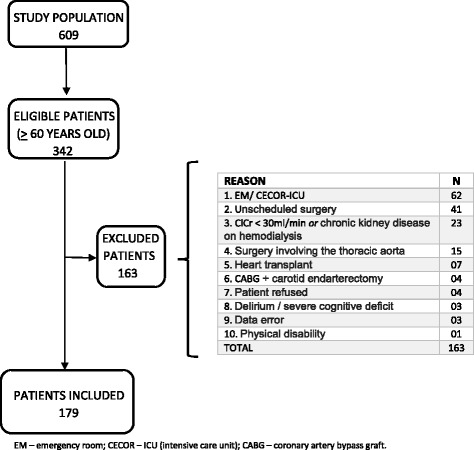
One hundred seventy-three consecutive patients aged ≥60 years were studied. Patients' characteristics and two cognitive function assessment tests were recorded preoperatively. Perioperative variables were blood transfusion, orotracheal intubation time (OIT), renal dysfunction, and hypoxemia. Delirium was assessed using the Confusion Assessment Method for the Intensive Care Unit. The composite outcome consisted of death, infection, and perioperative myocardial infarction until hospital discharge or 30 days after surgery, and for up to 18 months.
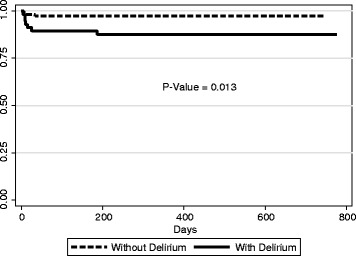
One hundred six patients (61.27%) were men and the age was 69.5 ± 5.8 years. EuroSCORE II index was 4.06 ± 3.86. Hypertension was present in 75.14%, diabetes in 39.88%, and 30.06% were illiterate. Delirium occurred in 59 patients (34.1%). Education level (OR 0.81, 0.71-0.92), hypertension (OR 2.73, 1.16-6.40), and mitral valve disease (OR 2.93, 1.32-6.50) were independent predisposing factors for delirium, and atrial fibrillation after surgery (OR 2.49, 1.20-5.20) represented the potential triggering factor. Delirium (OR 2.35, 1.20-4.58) and OIT ≥ 900 min (OR 2.50; 1.30-4.80) were independently associated with the composite outcome.
In older adult patients submitted to cardiac surgery, delirium is a frequent complication that is associated with worst outcome. Independent risk factors for delirium included education level, hypertension, mitral valve disease, and atrial fibrillation after cardiac surgery.
谵妄是老年患者心脏手术后常见的并发症。然而,谵妄的危险因素及其对患者预后的影响尚未完全明确。我们旨在确定心脏手术后谵妄的发生率、易感因素和诱发因素。
对173例年龄≥60岁的连续患者进行研究。术前记录患者的特征和两项认知功能评估测试结果。围手术期变量包括输血、气管插管时间(OIT)、肾功能不全和低氧血症。使用重症监护病房谵妄评估方法评估谵妄。综合结局包括直至出院或术后30天以及长达18个月的死亡、感染和围手术期心肌梗死。
106例患者(61.27%)为男性,年龄为69.5±5.8岁。欧洲心脏手术风险评估系统II指数为4.06±3.86。75.14%的患者患有高血压,39.88%的患者患有糖尿病,30.06%的患者为文盲。59例患者(34.1%)发生谵妄。教育程度(比值比0.81,0.71 - 0.92)、高血压(比值比2.73,1.16 - 6.40)和二尖瓣疾病(比值比2.93,1.32 - 6.50)是谵妄的独立易感因素,术后房颤(比值比2.49,1.20 - 5.20)是潜在的诱发因素。谵妄(比值比2.35,1.20 - 4.58)和OIT≥900分钟(比值比2.50;1.30 - 4.80)与综合结局独立相关。
在接受心脏手术的老年患者中,谵妄是一种常见并发症,与较差的预后相关。谵妄的独立危险因素包括教育程度、高血压、二尖瓣疾病和心脏手术后房颤。