Forschergruppe Diabetes e.V. am Helmholtz Zentrum München, Ingolstädter Landstr. 1, 85764 Neuherberg, Germany; Institute of Diabetes Research, Helmholtz Zentrum München, and Forschergruppe Diabetes, Klinikum rechts der Isar, Technische Universität München, Ingolstädter Landstr. 1, 85764 Neuherberg, Germany.
Institute of Diabetes Research, Helmholtz Zentrum München, and Forschergruppe Diabetes, Klinikum rechts der Isar, Technische Universität München, Ingolstädter Landstr. 1, 85764 Neuherberg, Germany.
Mol Metab. 2018 Mar;9:168-175. doi: 10.1016/j.molmet.2017.12.015. Epub 2018 Jan 3.
Women with insulin-requiring gestational diabetes mellitus (GDM) are at high risk of developing diabetes within a few years postpartum. We implemented this phase II study to test the hypothesis that vildagliptin, a dipeptidyl peptidase-4 inhibitor, is superior to placebo in terms of reducing the risk of postpartum diabetes.
Women with insulin-requiring GDM were randomized to either placebo or 50 mg vildagliptin twice daily for 24 months followed by a 12-month observation period (EudraCT: 2007-000634-39). Both groups received lifestyle counseling. The primary efficacy outcomes were the diagnosis of diabetes (American Diabetes Association (ADA) criteria) or impaired fasting glucose (IFG)/impaired glucose tolerance (IGT).
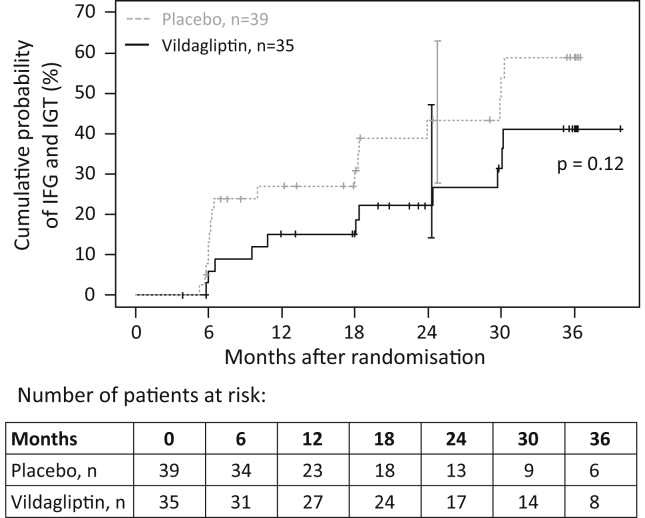
Between 2008 and 2015, 113 patients (58 vildagliptin, 55 placebo) were randomized within 2.2-10.4 (median 8.6) months after delivery. At the interim analysis, nine diabetic events and 28 IFG/IGT events had occurred. Fifty-two women withdrew before completing the treatment phase. Because of the low diabetes rate, the study was terminated. Lifestyle adherence was similar in both groups. At 24 months, the cumulative probability of postpartum diabetes was 3% and 5% (hazard ratio: 1.03; 95% confidence interval: 0.15-7.36) and IFG/IGT was 43% and 22% (hazard ratio: 0.55; 95% confidence interval: 0.26-1.19) in the placebo and vildagliptin groups, respectively. Vildagliptin was well tolerated with no unexpected adverse events.
The study did not show significant superiority of vildagliptin over placebo in terms of reducing the risk of postpartum diabetes. However, treatment was safe and suggested some improvements in glycemic control, insulin resistance, and β-cell function. The study identified critical issues in performing clinical trials in the early postpartum period in women with GDM hampering efficacy assessments. With this knowledge, we have set a basis for which properly powered trials could be performed in women with recent GDM. TRIAL REGISTRATION NUMBER AT CLINICALTRIALS.GOV: NCT01018602.
患有需要胰岛素的妊娠糖尿病(GDM)的女性在产后几年内发生糖尿病的风险很高。我们开展了这项 II 期研究,以检验以下假设,即二肽基肽酶-4 抑制剂维格列汀在降低产后糖尿病风险方面优于安慰剂。
患有需要胰岛素的 GDM 的女性被随机分配至安慰剂或每日两次 50mg 维格列汀组,治疗 24 个月,随后进行 12 个月的观察期(EudraCT:2007-000634-39)。两组均接受生活方式咨询。主要疗效终点为糖尿病(美国糖尿病协会(ADA)标准)或空腹血糖受损(IFG)/糖耐量受损(IGT)的诊断。
2008 年至 2015 年,产后 2.2-10.4 个月(中位数 8.6 个月)内,共有 113 例患者(58 例维格列汀,55 例安慰剂)被随机分配。在中期分析时,发生了 9 例糖尿病事件和 28 例 IFG/IGT 事件。52 例女性在完成治疗阶段前退出。由于糖尿病发生率较低,研究提前终止。两组的生活方式依从性相似。24 个月时,产后糖尿病的累积发生率分别为 3%和 5%(风险比:1.03;95%置信区间:0.15-7.36),IFG/IGT 的发生率分别为 43%和 22%(风险比:0.55;95%置信区间:0.26-1.19)。维格列汀耐受性良好,无意外不良事件。
与安慰剂相比,维格列汀在降低产后糖尿病风险方面未显示出显著优势。然而,治疗是安全的,并提示血糖控制、胰岛素抵抗和β细胞功能有所改善。该研究发现了在 GDM 女性产后早期进行临床试验的一些关键问题,这些问题影响了疗效评估。有了这些知识,我们为最近患有 GDM 的女性开展更有力的试验奠定了基础。临床试验注册编号:NCT01018602。