Cardiovascular Research Program, King Faisal Specialist Hospital and Research Centre, PO Box 3354, Riyadh, 11211, Saudi Arabia.
College of Medicine and Health Sciences, Al-Faisal University, Riyadh, 11211, Saudi Arabia.
Heart Fail Rev. 2018 Mar;23(2):261-272. doi: 10.1007/s10741-018-9676-1.
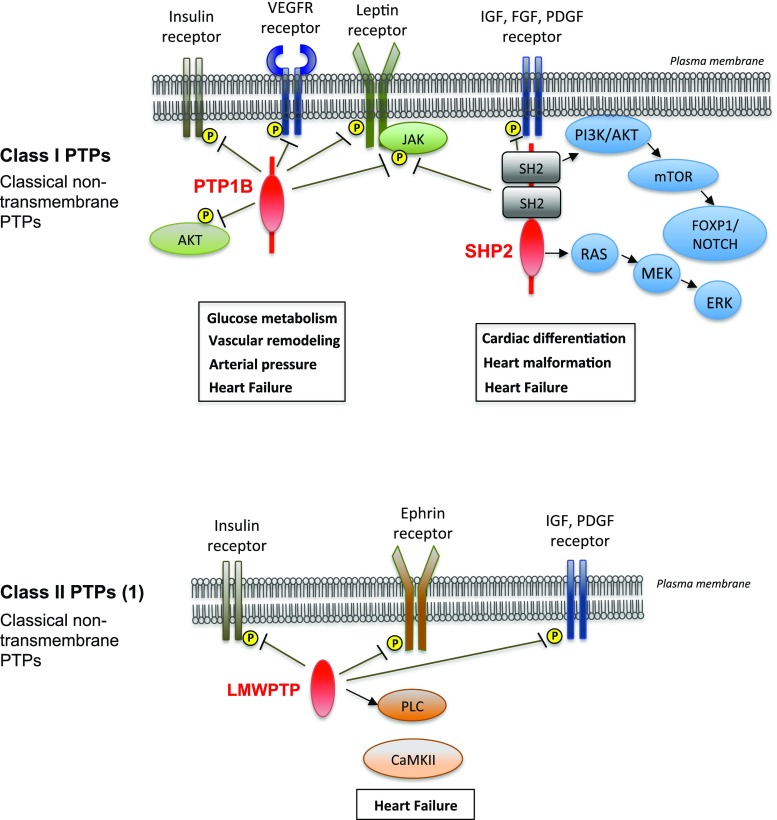
More than any other organ, the heart is particularly sensitive to gene expression deregulation, often leading in the long run to impaired contractile performances and excessive fibrosis deposition progressing to heart failure. Recent investigations provide evidences that the protein phosphatases (PPs), as their counterpart protein kinases, are important regulators of cardiac physiology and development. Two main groups, the protein serine/threonine phosphatases and the protein tyrosine phosphatases (PTPs), constitute the PPs family. Here, we provide an overview of the role of PTP subfamily in the development of the heart and in cardiac pathophysiology. Based on recent in silico studies, we highlight the importance of PTPs as therapeutic targets for the development of new drugs to restore PTPs signaling in the early and late events of heart failure.
与其他器官相比,心脏对基因表达失调特别敏感,这通常会导致长期收缩功能受损和过度纤维化沉积,进而导致心力衰竭。最近的研究表明,蛋白磷酸酶(PPs)与蛋白激酶一样,是心脏生理学和发育的重要调节剂。两大主要组,蛋白丝氨酸/苏氨酸磷酸酶和蛋白酪氨酸磷酸酶(PTPs),构成了 PPs 家族。在这里,我们概述了 PTP 亚家族在心脏发育和心脏病理生理学中的作用。基于最近的计算机研究,我们强调了 PTP 作为治疗靶点的重要性,以开发新的药物来恢复心力衰竭早期和晚期事件中的 PTP 信号。