Booth William T, Schlachter Caleb R, Pote Swanandi, Ussin Nikita, Mank Nicholas J, Klapper Vincent, Offermann Lesa R, Tang Chuanbing, Hurlburt Barry K, Chruszcz Maksymilian
Department of Chemistry and Biochemistry, University of South Carolina, Columbia, South Carolina 29208, United States.
Department of Chemistry, Davidson College, Davidson, North Carolina 28035, United States.
ACS Omega. 2018 Jan 31;3(1):760-768. doi: 10.1021/acsomega.7b01598. Epub 2018 Jan 22.
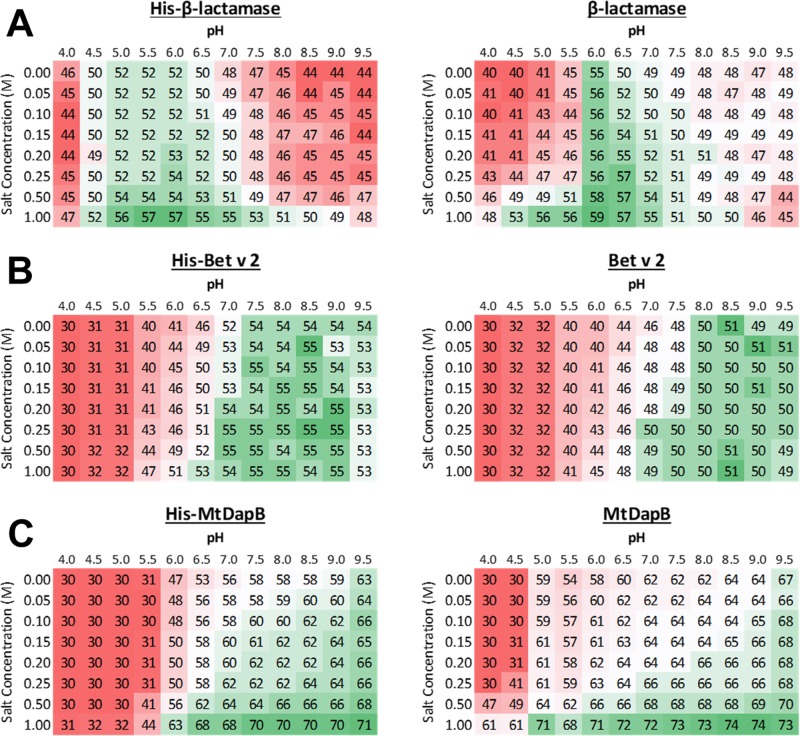
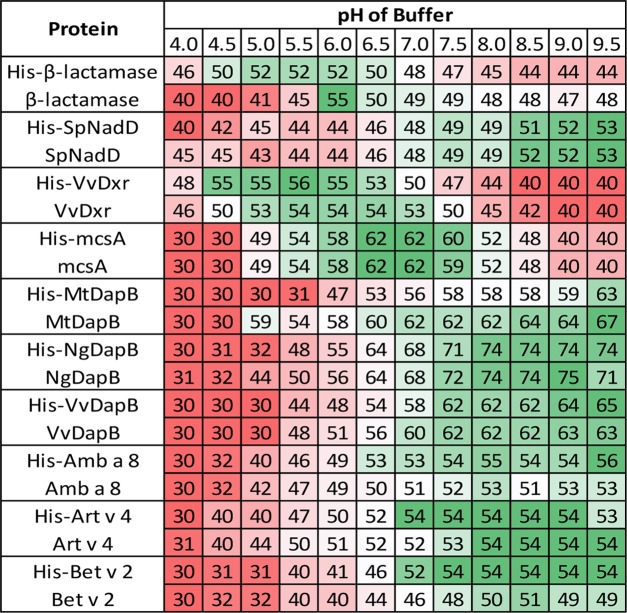
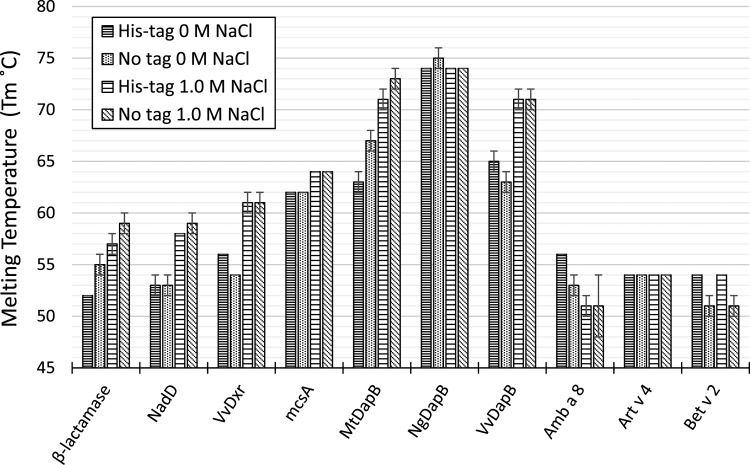
For years, the use of polyhistidine tags (His-tags) has been a staple in the isolation of recombinant proteins in immobilized metal affinity chromatography experiments. Their usage has been widely beneficial in increasing protein purity from crude cell lysates. For some recombinant proteins, a consequence of His-tag addition is that it can affect protein function and stability. Functional proteins are essential in the elucidation of their biological, kinetic, structural, and thermodynamic properties. In this study, we determine the effect of N-terminal His-tags on the thermal stability of select proteins using differential scanning fluorimetry and identify that the removal of the His-tag can have both beneficial and deleterious effects on their stability.
多年来,多组氨酸标签(His标签)的使用一直是固定化金属亲和色谱实验中分离重组蛋白的主要方法。它们的使用在提高粗细胞裂解物中蛋白质纯度方面具有广泛的益处。对于一些重组蛋白来说,添加His标签的一个后果是它会影响蛋白质的功能和稳定性。功能性蛋白质对于阐明其生物学、动力学、结构和热力学性质至关重要。在本研究中,我们使用差示扫描荧光法测定了N端His标签对选定蛋白质热稳定性的影响,并发现去除His标签对其稳定性可能既有有益影响也有有害影响。