Duque Valentina, Pilkauskas Natasha V, Garfinkel Irwin
Population Studies Center and Department of Economics, University of Michigan, Ann Arbor, MI, United States of America.
Gerald R. Ford School of Public Policy, University of Michigan, Ann Arbor, MI, United States of America.
PLoS One. 2018 Feb 5;13(2):e0192370. doi: 10.1371/journal.pone.0192370. eCollection 2018.
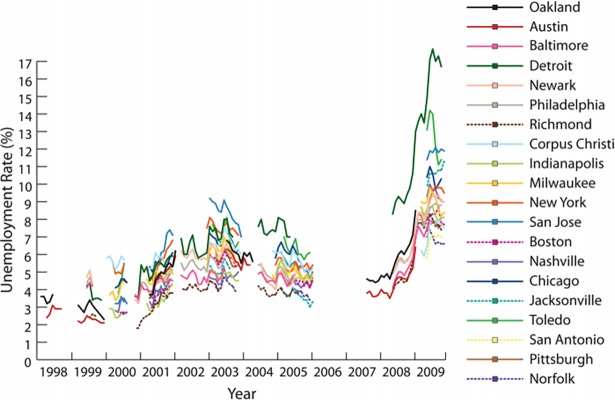
This paper examines the association between the Great Recession and real assets among families with young children. Real assets such as homes and cars are key indicators of economic well-being that may be especially valuable to low-income families. Using longitudinal data from the Fragile Families and Child Wellbeing Study (N = 4,898), we investigate the association between the city unemployment rate and home and car ownership and how the relationship varies by family structure (married, cohabiting, and single parents) and by race/ethnicity (White, Black, and Hispanic mothers). Using mother fixed-effects models, we find that a one percentage point increase in the unemployment rate is associated with a -0.5 percentage point decline in the probability of home ownership and a -0.7 percentage point decline in the probability of car ownership. We also find that the recession was associated with lower levels of home ownership for cohabiting families and for Hispanic families, as well as lower car ownership among single mothers and among Black mothers, whereas no change was observed among married families or White households. Considering that homes and cars are the most important assets among middle and low-income households in the U.S., these results suggest that the rise in the unemployment rate during the Great Recession may have increased household asset inequality across family structures and race/ethnicities, limiting economic mobility, and exacerbating the cycle of poverty.
本文考察了大衰退与有幼儿家庭的实物资产之间的关联。房屋和汽车等实物资产是经济福祉的关键指标,对低收入家庭可能格外重要。利用脆弱家庭与儿童福祉研究的纵向数据(N = 4898),我们研究了城市失业率与房屋及汽车拥有情况之间的关联,以及这种关系如何因家庭结构(已婚、同居和单亲家庭)和种族/族裔(白人、黑人及西班牙裔母亲)而异。使用母亲固定效应模型,我们发现失业率每上升一个百分点,房屋拥有概率下降0.5个百分点,汽车拥有概率下降0.7个百分点。我们还发现,衰退与同居家庭及西班牙裔家庭较低的房屋拥有水平相关,与单亲母亲及黑人母亲较低的汽车拥有水平相关,而在已婚家庭或白人家庭中未观察到变化。鉴于房屋和汽车是美国中低收入家庭最重要的资产,这些结果表明,大衰退期间失业率的上升可能加剧了家庭资产在家庭结构和种族/族裔间的不平等,限制了经济流动性,并加剧了贫困循环。