Center for Population and Health, Georgetown University, Washington, District of Columbia, United States of America.
Office of Population Research, Princeton University, Princeton, New Jersey, United States of America.
PLoS One. 2019 Apr 4;14(4):e0214947. doi: 10.1371/journal.pone.0214947. eCollection 2019.
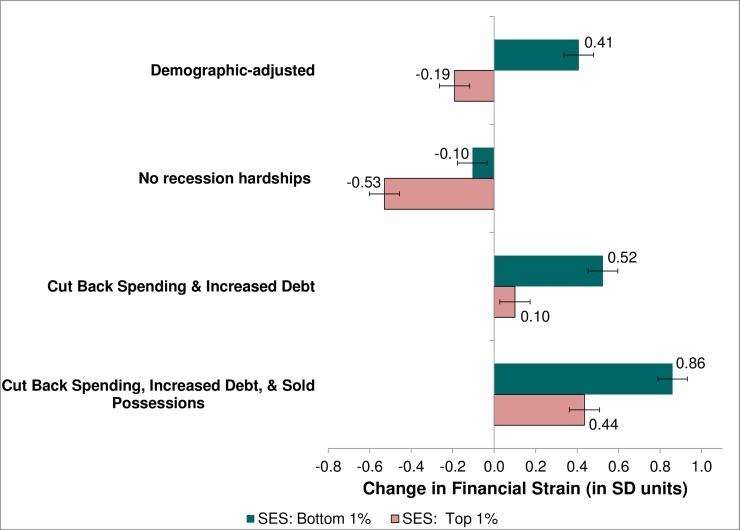
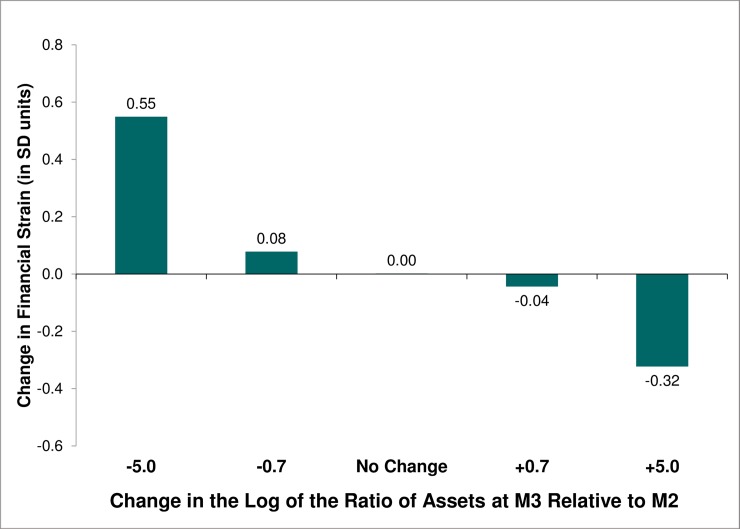
We demonstrate widening socioeconomic disparities in perceived economic distress among Americans, characterized by increasing distress at the bottom and improved perceptions at the top of the socioeconomic ladder. We then assess the extent to which hardships related to the Great Recession account for the growing social disparity in economic distress. Based on the concept of loss aversion, we also test whether the psychological pain associated with a financial loss is greater than the perceived benefit of an equivalent gain. Analyses are based on longitudinal survey data from the Midlife Development in the US study. Results suggest that widening social disparities in perceived economic distress between the mid-2000s and mid-2010s are explained in part by differential exposure to hardships related to the Great Recession, the effects of which have lingered even four to five years after the recession officially ended. Yet, auxiliary analyses show that the socioeconomic disparities in economic distress widened by nearly as much (if not more) during the period from 1995-96 to 2004-05 as they did during the period in which the recession occurred, which suggests that the factors driving these trends may have already been in motion prior to the recession. Consistent with the loss aversion hypothesis, perceptions of financial strain appear to be somewhat more strongly affected by losses in income/assets than by gains, but the magnitude of the differentials are small and the results are not robust. Our findings paint a dismal portrait of a growing socioeconomic divide in economic distress throughout the period from the mid-1990s to the mid-2010s, although we cannot say whether these trends afflict all regions of the US equally. Spatial analysis of aggregate-level mortality and objective economic indicators could provide indirect evidence, but ultimately economic "despair" must be measured subjectively by asking people how they perceive their financial situations.
我们展示了美国人感知到的经济困境中社会经济差距的扩大,表现为经济困境在社会经济阶梯底部的加剧和顶部的改善。然后,我们评估大衰退相关的困难在多大程度上导致了经济困境中日益扩大的社会差距。基于损失厌恶的概念,我们还测试了与财务损失相关的心理痛苦是否大于同等收益的感知收益。分析基于美国中期生活发展的纵向调查数据。结果表明,21 世纪 00 年代中期到 10 年代中期,感知经济困境的社会差距扩大,部分原因是与大衰退相关的困难的差异暴露,即使在衰退正式结束四到五年后,这些影响仍在持续。然而,辅助分析表明,在 1995-96 年至 2004-05 年期间,经济困境的社会经济差距扩大的幅度(如果不是更大的话)与衰退期间几乎相同,这表明推动这些趋势的因素可能在衰退之前已经在起作用。与损失厌恶假设一致,对财务紧张的看法似乎受到收入/资产损失的影响比收益的影响更大,但差异幅度较小,结果也不稳健。我们的研究结果描绘了一幅从 20 世纪 90 年代中期到 21 世纪 10 年代中期,经济困境中不断扩大的社会经济鸿沟的惨淡景象,尽管我们不能说这些趋势是否同样影响美国的所有地区。对总水平死亡率和客观经济指标的空间分析可以提供间接证据,但最终必须通过询问人们如何看待自己的财务状况来主观地衡量经济“绝望”。