Department of Cardiovascular Medicine, Konkuk University School of Medicine, Seoul, Korea.
Department of Laboratory Medicine, Konkuk University School of Medicine, Seoul, Korea.
Ann Lab Med. 2018 May;38(3):204-211. doi: 10.3343/alm.2018.38.3.204.
The prognostic utility of cardiac biomarkers, high-sensitivity cardiac troponin I (hs-cTnI) and soluble suppression of tumorigenicity-2 (sST2), in non-cardiac surgery is not well-defined. We evaluated hs-cTnI and sST2 as predictors of 30-day major adverse cardiac events (MACE) in patients admitted to the surgical intensive care unit (SICU) following major non-cardiac surgery.
hs-cTnI and sST2 concentrations were measured in 175 SICU patients immediately following surgery and for three days postoperatively. The results were analyzed in relation to 30-day MACE and were compared with the revised Goldman cardiac risk index (RCRI) score.
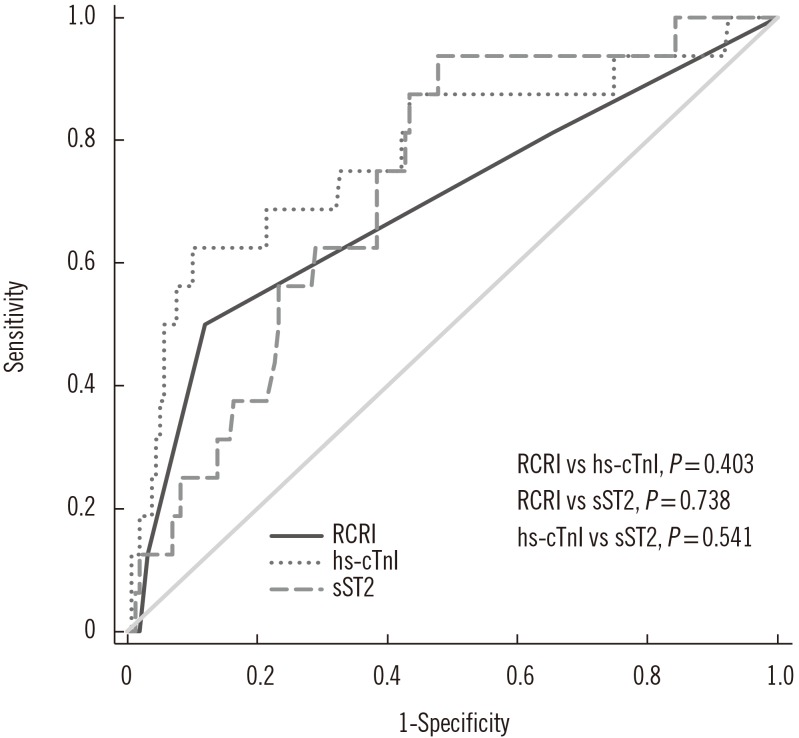
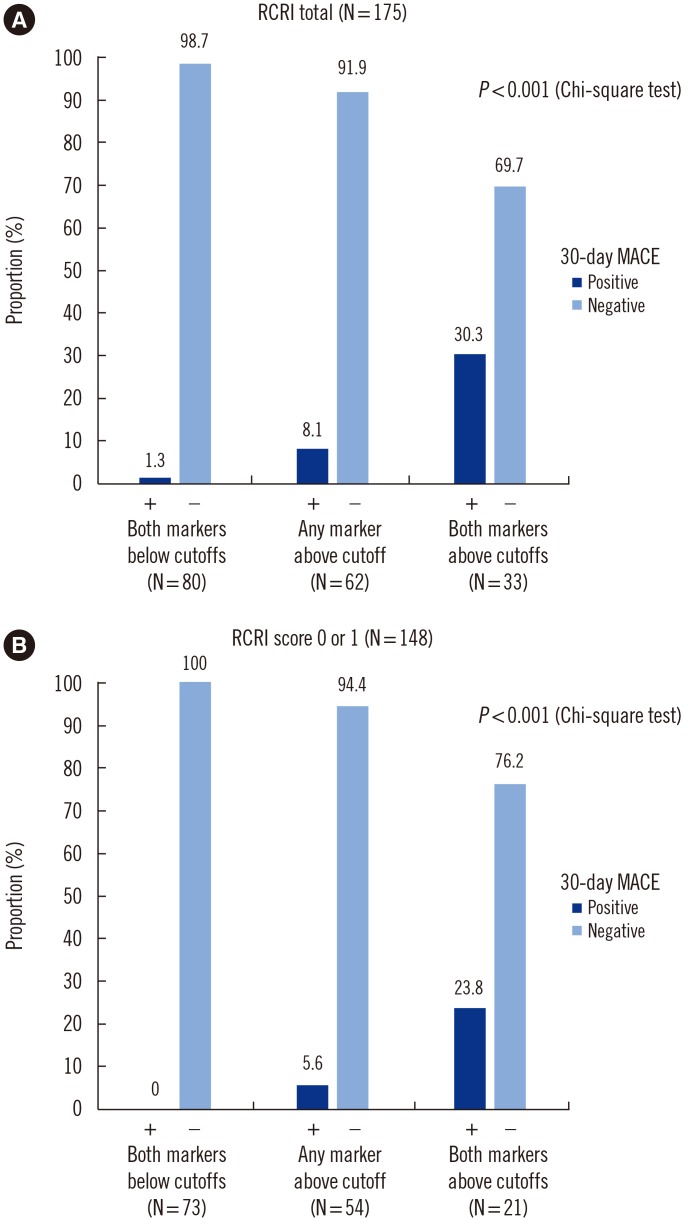
Overall, 30-day MACE was observed in 16 (9.1%) patients. hs-cTnI and sST2 concentrations differed significantly between the two groups with and without 30-day MACE (P<0.05). The maximum concentration of sST2 was an independent predictor of 30-day MACE (odds ratio=1.016, P=0.008). The optimal cut-off values of hs-cTnI and sST2 for predicting 30-day MACE were 53.0 ng/L and 182.5 ng/mL, respectively. A combination of hs-cTnI and sST2 predicted 30-day MACE better than the RCRI score. Moreover, 30-day MACE was observed more frequently with increasing numbers of above-optimal cut-off hs-cTnI and sST2 values (P<0.0001). Reclassification analyses indicated that the addition of biomarkers to RCRI scores improved the prediction of 30-day MACE.
This study demonstrates the utility of hs-cTnI and sST2 in predicting 30-day MACE following non-cardiac surgery. Cardiac biomarkers would provide enhanced risk stratification in addition to clinical RCRI scores for patients undergoing major non-cardiac surgery.
心脏标志物,高敏心肌肌钙蛋白 I(hs-cTnI)和可溶性肿瘤抑制物 2(sST2)在非心脏手术中的预后价值尚不清楚。我们评估了 hs-cTnI 和 sST2 在接受非心脏手术后入住外科重症监护病房(SICU)的患者中预测 30 天主要不良心脏事件(MACE)的作用。
在手术后立即以及术后三天测量了 175 例 SICU 患者的 hs-cTnI 和 sST2 浓度。将结果与 30 天 MACE 相关联进行分析,并与修订的 Goldman 心脏风险指数(RCRI)评分进行比较。
总体而言,有 16 例(9.1%)患者在 30 天内发生了 MACE。有和无 30 天 MACE 的两组之间 hs-cTnI 和 sST2 浓度差异有统计学意义(P<0.05)。sST2 的最大浓度是 30 天 MACE 的独立预测因子(优势比=1.016,P=0.008)。预测 30 天 MACE 的 hs-cTnI 和 sST2 的最佳截断值分别为 53.0ng/L 和 182.5ng/mL。hs-cTnI 和 sST2 的组合比 RCRI 评分预测 30 天 MACE 更好。此外,随着超过最佳截断值的 hs-cTnI 和 sST2 值的数量增加,观察到 30 天 MACE 的频率更高(P<0.0001)。重新分类分析表明,将生物标志物添加到 RCRI 评分中可改善 30 天 MACE 的预测。
这项研究表明 hs-cTnI 和 sST2 可用于预测非心脏手术后 30 天 MACE。心脏标志物除了临床 RCRI 评分外,还可为接受非心脏大手术的患者提供增强的风险分层。