Buck Institute for Research on Aging, 8001 Redwood Boulevard, Novato, CA, 94945, USA.
Institute for Stem Cell Biology and Regenerative Medicine, Stanford University, School of Medicine, 1265 Welch Road, Stanford, CA, 94305, USA.
Sci Rep. 2018 Feb 5;8(1):2410. doi: 10.1038/s41598-018-20000-4.
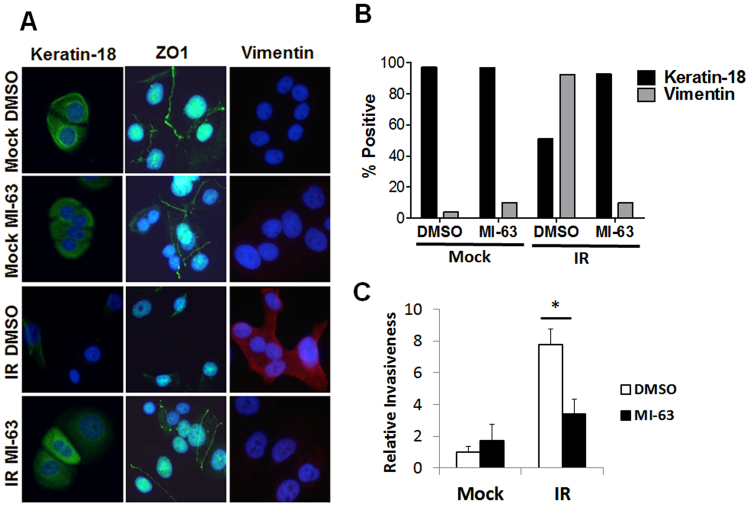
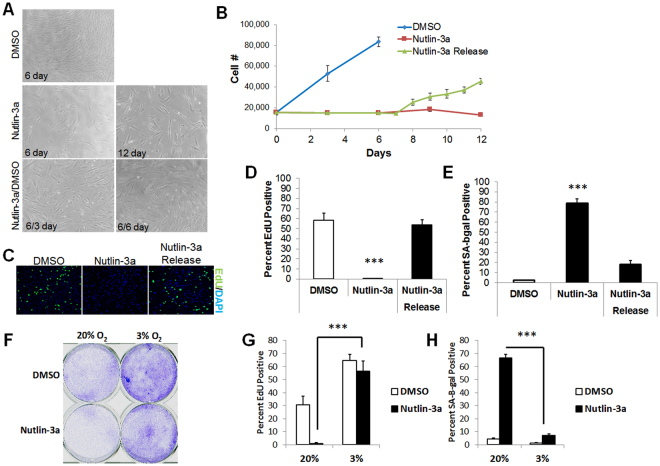
Processes that have been linked to aging and cancer include an inflammatory milieu driven by senescent cells. Senescent cells lose the ability to divide, essentially irreversibly, and secrete numerous proteases, cytokines and growth factors, termed the senescence-associated secretory phenotype (SASP). Senescent cells that lack p53 tumor suppressor function show an exaggerated SASP, suggesting the SASP is negatively controlled by p53. Here, we show that increased p53 activity caused by small molecule inhibitors of MDM2, which promotes p53 degradation, reduces inflammatory cytokine production by senescent cells. Upon treatment with the MDM2 inhibitors nutlin-3a or MI-63, human cells acquired a senescence-like growth arrest, but the arrest was reversible. Importantly, the inhibitors reduced expression of the signature SASP factors IL-6 and IL-1α by cells made senescent by genotoxic stimuli, and suppressed the ability of senescent fibroblasts to stimulate breast cancer cell aggressiveness. Our findings suggest that MDM2 inhibitors could reduce cancer progression in part by reducing the pro-inflammatory environment created by senescent cells.
与衰老和癌症相关的过程包括由衰老细胞驱动的炎症微环境。衰老细胞失去分裂的能力,基本上是不可逆的,并分泌许多蛋白酶、细胞因子和生长因子,称为衰老相关分泌表型 (SASP)。缺乏 p53 肿瘤抑制功能的衰老细胞表现出过度的 SASP,表明 SASP 受到 p53 的负调控。在这里,我们表明,MDM2 的小分子抑制剂可增加 MDM2,促进 p53 降解,从而降低衰老细胞中炎症细胞因子的产生。用 MDM2 抑制剂 nutlin-3a 或 MI-63 处理后,人细胞获得了类似于衰老的生长停滞,但这种停滞是可逆的。重要的是,抑制剂降低了由遗传毒性刺激诱导衰老的细胞中 SASP 特征因子 IL-6 和 IL-1α 的表达,并抑制了衰老成纤维细胞刺激乳腺癌细胞侵袭的能力。我们的研究结果表明,MDM2 抑制剂通过减少衰老细胞产生的促炎环境,可能在一定程度上减少癌症的进展。