Zhang Shuai, Wang Zhecheng, Zhu Jie, Xu Ting, Zhao Yan, Zhao Huanyu, Tang Fan, Li Zhenlu, Zhou Junjun, Gao Dongyan, Tian Xiaofeng, Yao Jihong
Department of Pharmacology, Dalian Medical University, Dalian, China.
Department of General Surgery, Second Affiliated Hospital of Dalian Medical University, Dalian, China.
Front Pharmacol. 2018 Jan 19;8:976. doi: 10.3389/fphar.2017.00976. eCollection 2017.
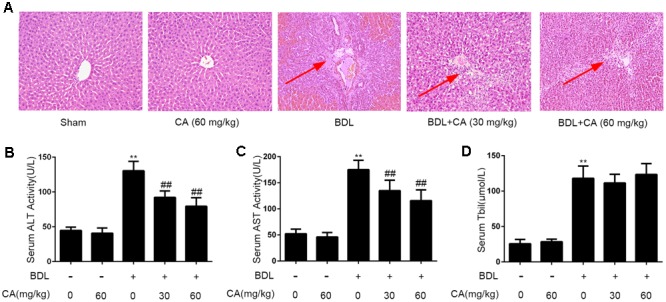
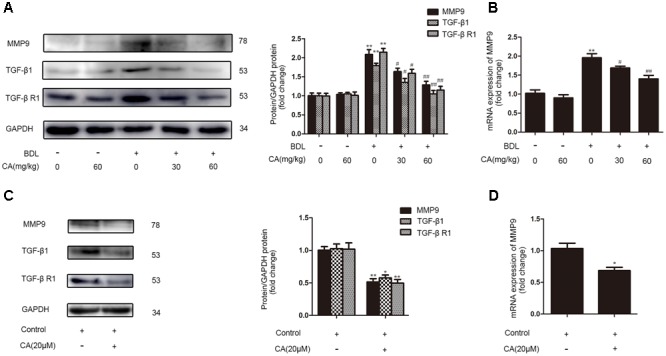
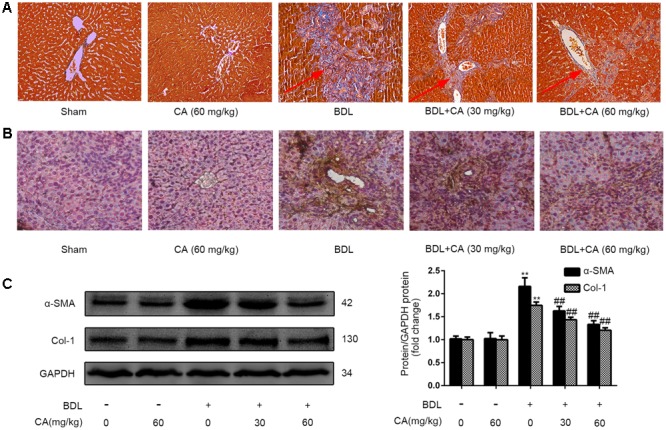
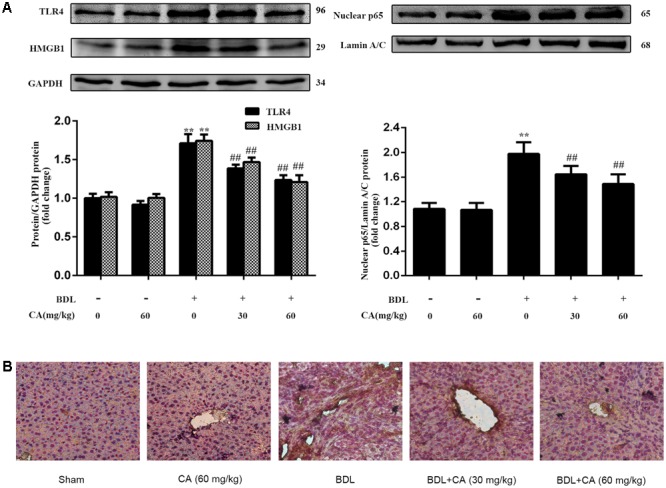
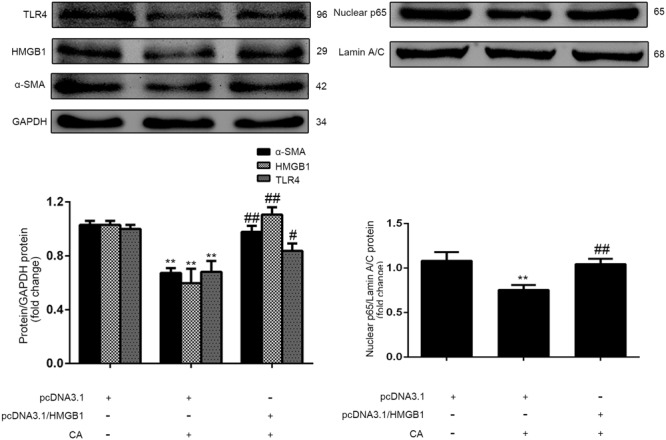
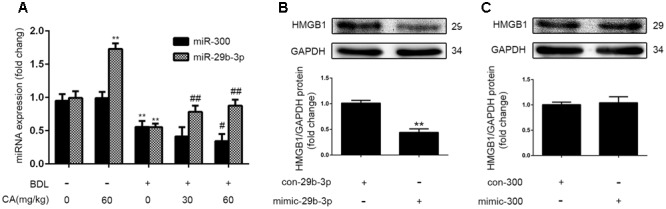
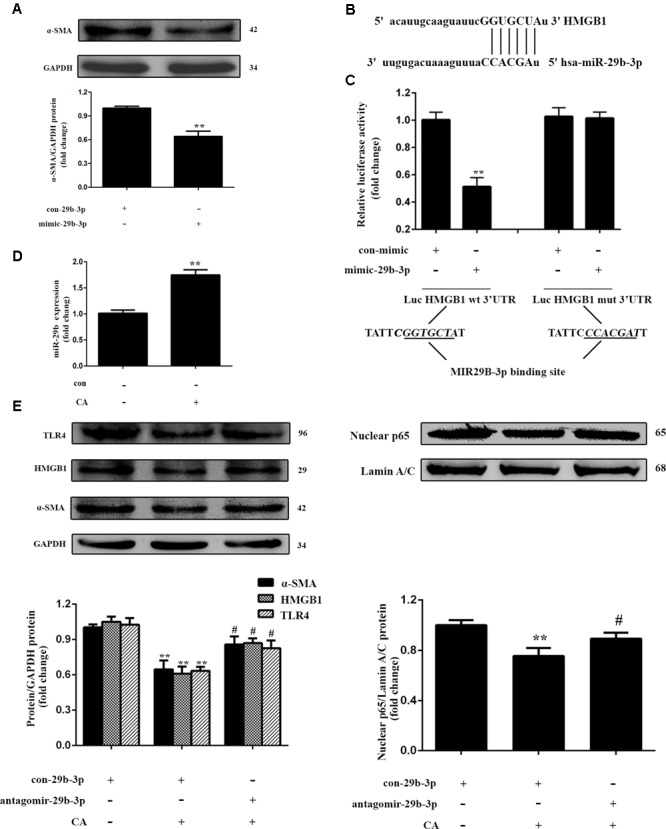
Fibrosis reflects a progression to liver cancer or cirrhosis of the liver. Recent studies have shown that high-mobility group box-1 (HMGB1) plays a major role in hepatic injury and fibrosis. Carnosic acid (CA), a compound extracted from rosemary, has been reported to alleviate alcoholic and non-alcoholic fatty liver injury. CA can also alleviate renal fibrosis. We hypothesized that CA might exert anti-liver fibrosis properties through an HMGB1-related pathway, and the results of the present study showed that CA treatment significantly protected against hepatic fibrosis in a bile duct ligation (BDL) rat model. CA reduced the liver expression of α-smooth muscle actin (α-SMA) and collagen 1 (Col-1). Importantly, we found that CA ameliorated the increase in HMGB1 and Toll-like receptor 4 (TLR4) caused by BDL, and inhibited NF-κB p65 nuclear translocation in fibrotic livers. , CA inhibited LX2 cell activation by inhibiting HMGB1/TLR4 signaling pathway. Furthermore, miR-29b-3p decreased HMGB1 expression, and a dual-luciferase assay validated these results. Moreover, CA down-regulated HMGB1 and inhibited LX2 cell activation, and these effects were significantly counteracted by antago-miR-29b-3p, indicating that the CA-mediated inhibition of HMGB1 expression might be miR-29b-3p dependent. Collectively, the results demonstrate that a miR-29b-3p/HMGB1/TLR4/NF-κB signaling pathway, which can be modulated by CA, is important in liver fibrosis, and indicate that CA might be a prospective therapeutic drug for liver fibrosis.
肝纤维化反映了向肝癌或肝硬化的进展。最近的研究表明,高迁移率族蛋白B1(HMGB1)在肝损伤和肝纤维化中起主要作用。迷迭香酸(CA)是一种从迷迭香中提取的化合物,据报道可减轻酒精性和非酒精性脂肪肝损伤。CA还可减轻肾纤维化。我们推测CA可能通过与HMGB1相关的途径发挥抗肝纤维化作用,本研究结果表明,在胆管结扎(BDL)大鼠模型中,CA治疗可显著预防肝纤维化。CA降低了肝脏中α-平滑肌肌动蛋白(α-SMA)和胶原蛋白1(Col-1)的表达。重要的是,我们发现CA改善了BDL引起的HMGB1和Toll样受体4(TLR4)的增加,并抑制了纤维化肝脏中NF-κB p65的核转位。此外,CA通过抑制HMGB1/TLR4信号通路抑制LX2细胞活化。此外,miR-29b-3p降低了HMGB1的表达,双荧光素酶报告基因实验验证了这些结果。此外,CA下调HMGB1并抑制LX2细胞活化,而抗miR-29b-3p可显著抵消这些作用,表明CA介导的对HMGB1表达的抑制可能依赖于miR-29b-3p。总的来说,结果表明,可被CA调节的miR-29b-3p/HMGB1/TLR4/NF-κB信号通路在肝纤维化中很重要,并表明CA可能是一种有前景的肝纤维化治疗药物。