Mitani Keita, Kashino Makio
Department of Information Processing, Interdisciplinary Graduate School of Science and Engineering, Tokyo Institute of Technology, Yokohama, Japan.
Japan Society for the Promotion of Science, Tokyo, Japan.
Front Psychol. 2018 Jan 19;8:2325. doi: 10.3389/fpsyg.2017.02325. eCollection 2017.
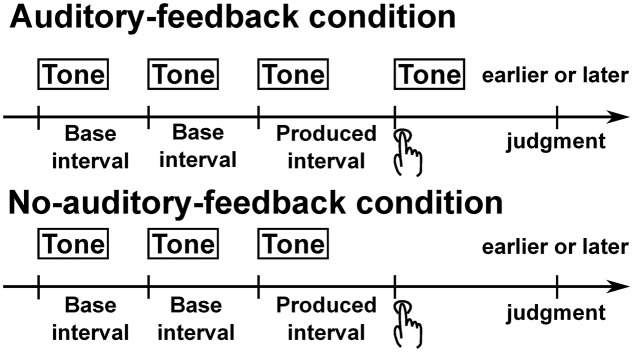
We examined whether auditory feedback assists the error correction of temporal reproduction, and the perception of self-produced time intervals in the subsecond and suprasecond ranges. Here, we employed a temporal reproduction task with a single motor response at a point in time with and without auditory feedback. This task limits participants to reducing errors by employing auditory feedback in a manner. Additionally, the participants were asked to judge the self-produced timing in this task. The results showed that, in the presence of auditory feedback, the participants exhibited smaller variability and bias in terms of temporal reproduction and the perception of self-produced time intervals in the subsecond range but not in the suprasecond range. Furthermore, in the presence of auditory feedback, the positive serial dependency of temporal reproduction, which is the tendency of reproduced intervals to be similar to those in adjacent trials, was reduced in the subsecond range but not in the suprasecond range. These results suggest that auditory feedback assists the error correction of temporal reproduction, and the perception of self-produced time intervals in the subsecond range.
我们研究了听觉反馈是否有助于时间再现的错误校正,以及对自我产生的亚秒级和超秒级时间间隔的感知。在此,我们采用了一种时间再现任务,在有和没有听觉反馈的情况下,在某一时刻进行单一的运动反应。该任务限制参与者以某种方式利用听觉反馈来减少误差。此外,要求参与者在该任务中判断自我产生的时间。结果表明,在有听觉反馈的情况下,参与者在亚秒级范围内的时间再现和自我产生的时间间隔感知方面表现出较小的变异性和偏差,但在超秒级范围内则没有。此外,在有听觉反馈的情况下,时间再现的正序列依赖性(即再现间隔与相邻试验中的间隔相似的趋势)在亚秒级范围内降低,但在超秒级范围内没有。这些结果表明,听觉反馈有助于时间再现的错误校正,以及亚秒级范围内自我产生的时间间隔的感知。