Pagliaccia Deborah, Shi Jinxia, Pang Zhiqian, Hawara Eva, Clark Kelley, Thapa Shree P, De Francesco Agustina D, Liu Jianfeng, Tran Thien-Toan, Bodaghi Sohrab, Folimonova Svetlana Y, Ancona Veronica, Mulchandani Ashok, Coaker Gitta, Wang Nian, Vidalakis Georgios, Ma Wenbo
Department of Microbiology and Plant Pathology, University of California, Riverside, Riverside, CA, United States.
Center for Plant Cell Biology, University of California, Riverside, Riverside, CA, United States.
Front Microbiol. 2017 Oct 23;8:2041. doi: 10.3389/fmicb.2017.02041. eCollection 2017.
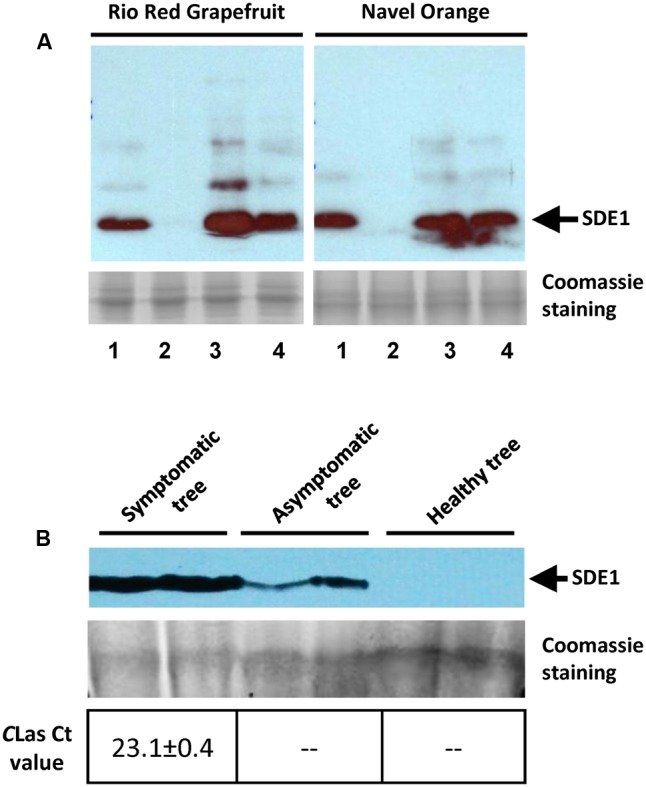
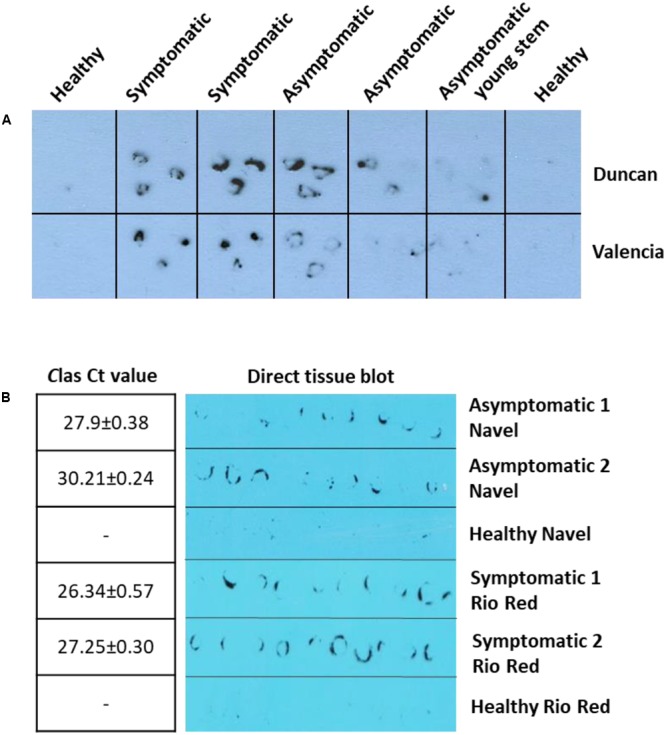
The citrus industry is facing an unprecedented crisis due to Huanglongbing (HLB, aka citrus greening disease), a bacterial disease associated with the pathogen Liberibacter asiaticus (Las) that affects all commercial varieties. Transmitted by the Asian citrus psyllid (ACP), Las colonizes citrus phloem, leading to reduced yield and fruit quality, and eventually tree decline and death. Since adequate curative measures are not available, a key step in HLB management is to restrict the spread of the disease by identifying infected trees and removing them in a timely manner. However, uneven distribution of Las cells in infected trees and the long latency for disease symptom development makes sampling of trees for Las detection challenging. Here, we report that a Las secreted protein can be used as a biomarker for detecting HLB infected citrus. Proteins secreted from Las cells can presumably move along the phloem, beyond the site of ACP inoculation and Las colonized plant cells, thereby increasing the chance of detecting infected trees. We generated a polyclonal antibody that effectively binds to the secreted protein and developed serological assays that can successfully detect Las infection. This work demonstrates that antibody-based diagnosis using a Las secreted protein as the detection marker for infected trees offers a high-throughput and economic approach that complements the approved quantitative polymerase chain reaction-based methods to enhance HLB management programs.
柑橘产业正面临着一场前所未有的危机,这是由黄龙病(HLB,又称柑橘绿变病)引起的,黄龙病是一种由亚洲韧皮杆菌(Las)引发的细菌性疾病,会影响所有商业品种。Las通过亚洲柑橘木虱(ACP)传播,它在柑橘韧皮部定殖,导致产量和果实品质下降,最终使树木衰退直至死亡。由于尚无足够的治愈措施,黄龙病管理的关键一步是通过识别受感染的树木并及时将其移除,来限制疾病的传播。然而,Las细胞在受感染树木中的分布不均以及疾病症状出现的潜伏期较长,使得对树木进行采样以检测Las具有挑战性。在此,我们报告一种Las分泌蛋白可作为检测感染黄龙病柑橘的生物标志物。Las细胞分泌的蛋白质可能会沿着韧皮部移动,超出ACP接种部位和Las定殖的植物细胞,从而增加检测到受感染树木的机会。我们制备了一种能有效结合该分泌蛋白的多克隆抗体,并开发了能够成功检测Las感染的血清学检测方法。这项工作表明,以Las分泌蛋白作为受感染树木的检测标志物进行基于抗体的诊断,提供了一种高通量且经济的方法,可补充已获批的基于定量聚合酶链反应的方法,以加强黄龙病管理计划。