INSERM UMR 1186, Integrative Tumor Immunology and Genetic Oncology, Gustave Roussy, EPHE, Fac. de Médecine - Univ. Paris-Sud, Université Paris-Saclay, Villejuif, France.
ElyssaMed, Paris Biotech Santé, Paris, France.
Front Immunol. 2018 Jan 22;9:14. doi: 10.3389/fimmu.2018.00014. eCollection 2018.
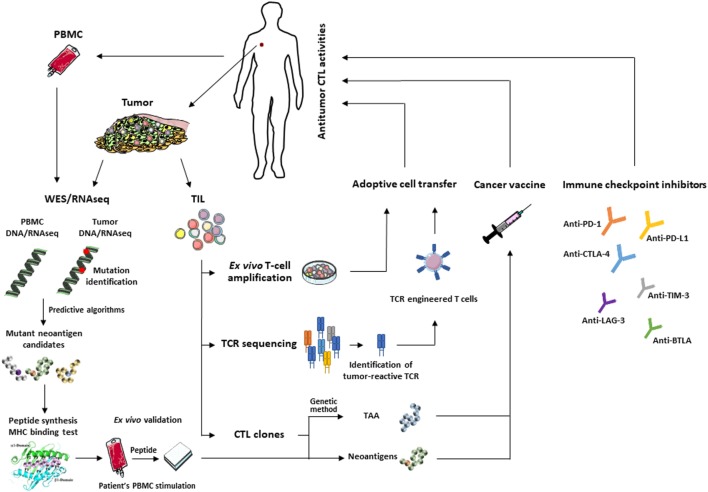
Recent advances in cancer treatment have emerged from new immunotherapies targeting T-cell inhibitory receptors, including cytotoxic T-lymphocyte associated antigen (CTLA)-4 and programmed cell death (PD)-1. In this context, anti-CTLA-4 and anti-PD-1 monoclonal antibodies have demonstrated survival benefits in numerous cancers, including melanoma and non-small-cell lung carcinoma. PD-1-expressing CD8 T lymphocytes appear to play a major role in the response to these immune checkpoint inhibitors (ICI). Cytotoxic T lymphocytes (CTL) eliminate malignant cells through recognition by the T-cell receptor (TCR) of specific antigenic peptides presented on the surface of cancer cells by major histocompatibility complex class I/beta-2-microglobulin complexes, and through killing of target cells, mainly by releasing the content of secretory lysosomes containing perforin and granzyme B. T-cell adhesion molecules and, in particular, lymphocyte-function-associated antigen-1 and CD103 integrins, and their cognate ligands, respectively, intercellular adhesion molecule 1 and E-cadherin, on target cells, are involved in strengthening the interaction between CTL and tumor cells. Tumor-specific CTL have been isolated from tumor-infiltrating lymphocytes and peripheral blood lymphocytes (PBL) of patients with varied cancers. TCRβ-chain gene usage indicated that CTL identified selectively expanded at the tumor site compared to autologous PBL. Moreover, functional studies indicated that these CTL mediate human leukocyte antigen class I-restricted cytotoxic activity toward autologous tumor cells. Several of them recognize truly tumor-specific antigens encoded by mutated genes, also known as neoantigens, which likely play a key role in antitumor CD8 T-cell immunity. Accordingly, it has been shown that the presence of T lymphocytes directed toward tumor neoantigens is associated with patient response to immunotherapies, including ICI, adoptive cell transfer, and dendritic cell-based vaccines. These tumor-specific mutation-derived antigens open up new perspectives for development of effective second-generation therapeutic cancer vaccines.
近年来,针对 T 细胞抑制性受体的新型免疫疗法在癌症治疗方面取得了进展,其中包括细胞毒性 T 淋巴细胞相关抗原 (CTLA)-4 和程序性细胞死亡 (PD)-1。在这种情况下,抗 CTLA-4 和抗 PD-1 单克隆抗体在多种癌症中显示出了生存获益,包括黑色素瘤和非小细胞肺癌。表达 PD-1 的 CD8 T 淋巴细胞似乎在这些免疫检查点抑制剂(ICI)的反应中发挥了主要作用。细胞毒性 T 淋巴细胞(CTL)通过 T 细胞受体(TCR)识别癌细胞表面由主要组织相容性复合体 I/β-2-微球蛋白复合物呈递的特定抗原肽,以及通过杀伤靶细胞,主要通过释放含有穿孔素和颗粒酶 B 的分泌溶酶体的内容物,从而消除恶性细胞。T 细胞黏附分子,特别是淋巴细胞功能相关抗原-1 和 CD103 整合素,以及它们各自的配体,即细胞间黏附分子 1 和 E-钙黏蛋白,在靶细胞上参与增强 CTL 与肿瘤细胞之间的相互作用。已经从肿瘤浸润淋巴细胞和患有各种癌症的患者的外周血淋巴细胞(PBL)中分离出肿瘤特异性 CTL。TCRβ 链基因的使用表明,与自体 PBL 相比,CTL 在肿瘤部位选择性扩增。此外,功能研究表明,这些 CTL 介导针对自体肿瘤细胞的人类白细胞抗原 I 类限制性细胞毒性活性。其中一些识别真正的肿瘤特异性抗原,这些抗原由突变基因编码,也称为新抗原,它们可能在抗肿瘤 CD8 T 细胞免疫中发挥关键作用。因此,已经表明针对肿瘤新抗原的 T 淋巴细胞的存在与患者对免疫疗法的反应相关,包括 ICI、过继细胞转移和基于树突状细胞的疫苗。这些肿瘤特异性突变衍生抗原为开发有效的第二代治疗性癌症疫苗开辟了新的前景。