Headache Center of Southern California, The Neurology Center, 6010 Hidden Valley Road, Carlsbad, CA, 92024, USA.
Monash University and Alfred Hospital, Melbourne, VIC, Australia.
J Headache Pain. 2018 Feb 5;19(1):13. doi: 10.1186/s10194-018-0840-8.
OnabotulinumtoxinA is approved for the prevention of headache in those with chronic migraine (CM); however, more clinical data on the risk-benefit profile for treatment beyond one year is desirable.
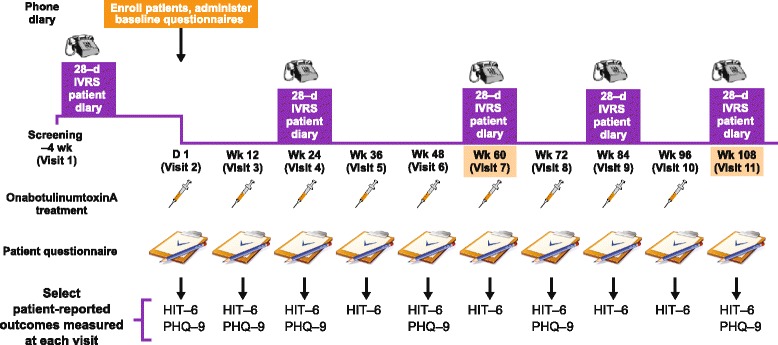
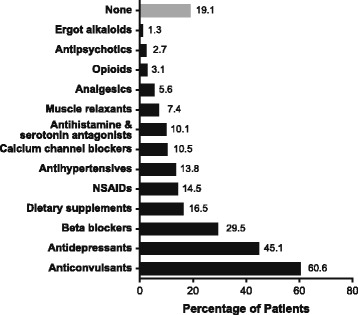
The Chronic Migraine OnabotulinuMtoxinA Prolonged Efficacy open Label (COMPEL) Study ( ClinicalTrials.gov , NCT01516892) is an international, multicenter, open-label long-term prospective study. Adults with CM received 155 U of onabotulinumtoxinA (31 sites in a fixed-site, fixed-dose paradigm across 7 head/neck muscles) every 12 weeks (±7 days) for 9 treatment cycles (108 weeks). The primary outcome was headache day reductions at 108 weeks; secondary outcomes were headache day reductions at 60 weeks and change in the 6-item Headache Impact Test (HIT-6) score. Safety and tolerability were assessed by reviewing the frequency and nature of adverse events (AEs). AEs were determined at each visit through patient self-report, general non-directed and, for specific AEs, directed questioning, and physical examination. Subgroup analyses for safety and efficacy included, but were not limited to, patients with/without concomitant oral preventive treatment and acute medication overuse at baseline.
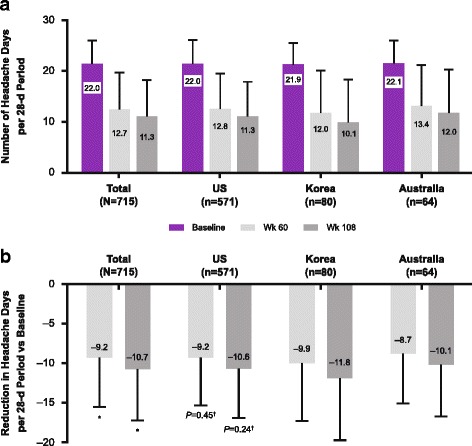
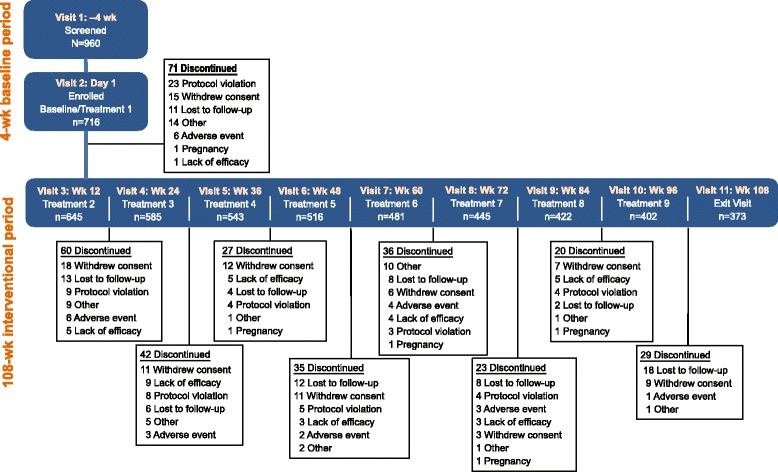
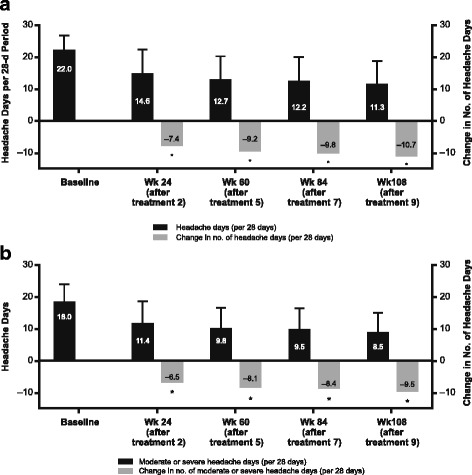
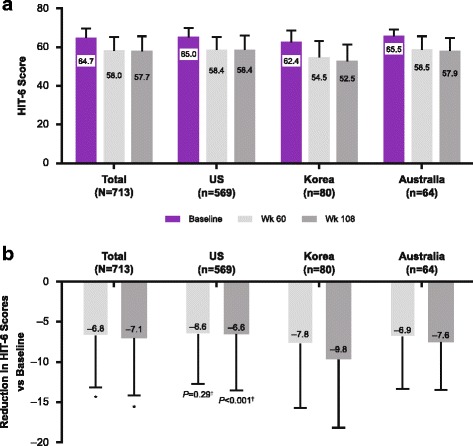
Enrolled patients (N = 716) were 18-73 years old and most were female (n = 607, 84.8%). At baseline, patients reported an average 22.0 (SD = 4.8) headache days per month. 52.1% of patients (n = 373) completed the study. By 60 and 108 weeks, a significant reduction in headache days (- 9.2 days and - 10.7 days, respectively, P < 0.0001) was observed. Significant improvements (P < 0.0001) in HIT-6 scores (- 7.1 point change at week 108) were also demonstrated. 131 patients (18.3%) reported ≥1 treatment-emergent adverse events; most frequently reported was neck pain (n = 29, 4.1%). One patient reported a serious treatment-related adverse event (rash). No deaths were reported.
The COMPEL Study provides additional clinical evidence for the consistency of the efficacy and for the long-term safety and tolerability of onabotulinumtoxinA for the prevention of headache in those with CM who have been treated with onabotulinumtoxinA every 12 weeks over 2 years (9 treatments) with the fixed-site, fixed-dose injection paradigm.
Trial registration number: NCT01516892 . Name of registry: clinicaltrials.gov . Date of registration: January 20 2012. Date of enrollment of first patient: December 2011.
肉毒毒素 A 已获批准用于预防慢性偏头痛(CM)患者的头痛;然而,需要更多的临床数据来证明其在一年以上的治疗中的风险-效益情况。
慢性偏头痛肉毒毒素 A 延长疗效开放标签(COMPEL)研究(ClinicalTrials.gov,NCT01516892)是一项国际性、多中心、开放标签的长期前瞻性研究。患有 CM 的成年人每 12 周(±7 天)接受 155U 肉毒毒素 A(7 块头颈部肌肉上的 31 个固定部位和固定剂量),共进行 9 个治疗周期(108 周)。主要终点是 108 周时头痛天数的减少;次要终点是 60 周时头痛天数的减少和 6 项头痛影响测试(HIT-6)评分的变化。通过回顾不良事件(AE)的频率和性质来评估安全性和耐受性。通过患者自我报告、一般非定向以及针对特定 AE 的定向询问和体格检查,在每次就诊时确定 AE。安全性和疗效的亚组分析包括但不限于伴有/不伴有口服预防性治疗和基线时急性药物过度使用的患者。
入组患者(n=716)年龄为 18-73 岁,大多数为女性(n=607,84.8%)。基线时,患者报告平均每月有 22.0(SD=4.8)天头痛。52.1%的患者(n=373)完成了研究。在 60 和 108 周时,观察到头痛天数显著减少(分别为-9.2 天和-10.7 天,P<0.0001)。HIT-6 评分也显著改善(P<0.0001)(第 108 周时的变化为-7.1 分)。131 名患者(18.3%)报告了≥1 次治疗后出现的不良事件;最常报告的是颈部疼痛(n=29,4.1%)。1 名患者报告了 1 例严重的与治疗相关的不良事件(皮疹)。没有死亡报告。
COMPEL 研究提供了更多的临床证据,证明了在 2 年内(9 次治疗)每 12 周接受肉毒毒素 A 治疗的 CM 患者中,肉毒毒素 A 的疗效一致性以及长期安全性和耐受性。该研究采用固定部位、固定剂量的注射方案。
试验注册号:NCT01516892。注册机构名称:clinicaltrials.gov。注册日期:2012 年 1 月 20 日。首例患者入组日期:2011 年 12 月。