From the MAXIMUS Federal, Contracting Agency to the Division of Viral Diseases.
National Center for Immunizations and Respiratory Diseases, Centers for Disease Control & Prevention, Atlanta, Georgia.
Pediatr Infect Dis J. 2018 Aug;37(8):817-822. doi: 10.1097/INF.0000000000001930.
The effectiveness of rotavirus vaccines in low and very low birth weight infants (LBW and VLBW) weighing <2500 and <1500 g at birth, respectively, a high-risk population for severe rotavirus gastroenteritis, has not been well examined.
We analyzed inpatient commercial claims data for US children <5 years of age from July 2001 to June 2015. Claims for acute gastroenteritis (AGE) and rotavirus-coded hospitalizations and LBW, VLBW and normal birth weight (NBW) infants were identified. Receipt of rotavirus vaccine was defined using Current Procedural Terminology. Rate reductions were calculated using prevaccine (2001-2006) and postvaccine (2007-2015) annual AGE and rotavirus hospitalization rates.
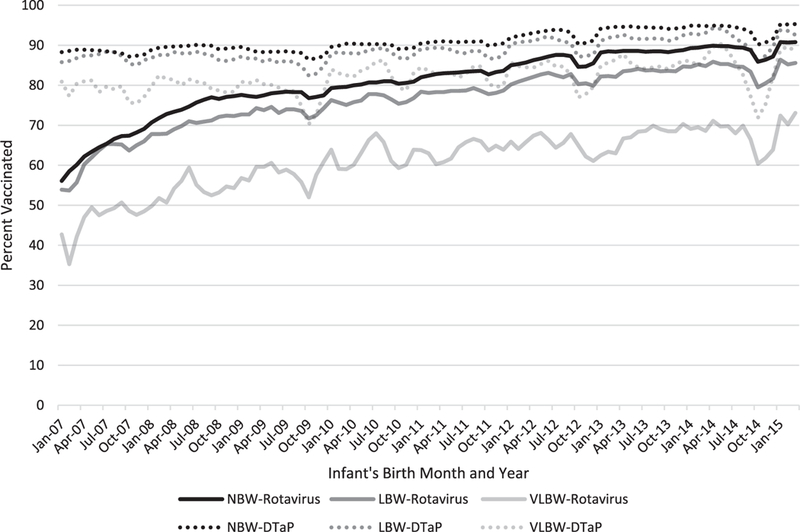
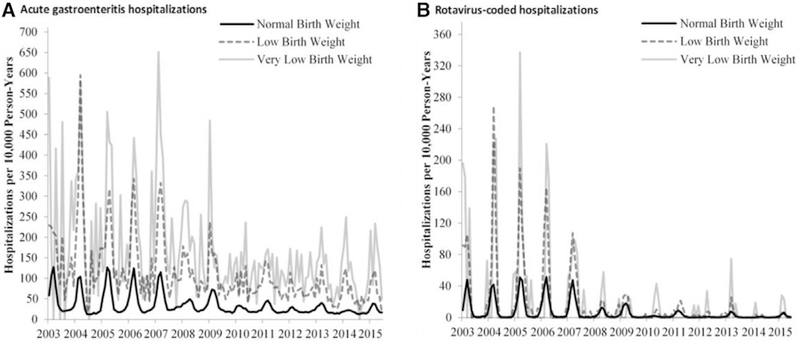
As of December 2014, rotavirus vaccine coverage was 87%, 82% and 64%, for NBW, LBW and VLBW infants, respectively. For 2014-2015, among NBW, LBW and VLBW children <5 years of age, AGE hospitalization rate reductions relative to the prevaccine introduction period were 60% [95% confidence interval (CI): 58%-61%], 64% (95% CI: 57%-70%) and 55% (95% CI: 39%-67%), respectively. Rotavirus hospitalization rate reductions were 91% (95% CI: 90%-92%), 98% (95% CI: 93%-100%) and 93% (95% CI: 70%-98%). Rotavirus vaccines resulted in a 62% (95% CI: 51%-71%), 72% (95% CI: 44%-86%) and 71% (95% CI: 7%-91%) reduction in AGE hospitalization rates comparing vaccinated versus unvaccinated NBW, LBW and VLBW children 3-23 months of age, respectively.
Rotavirus vaccines have substantially reduced AGE hospitalizations and are highly effective in LBW and VLBW infants, similar to NBW infants. Efforts to improve vaccination coverage, particularly in LBW and VLBW infants, should continue.
在分别出生体重小于 2500 克和 1500 克的极低出生体重(LBW 和 VLBW)婴儿(患严重轮状病毒胃肠炎的高危人群)中,轮状病毒疫苗的有效性尚未得到很好的研究。
我们分析了 2001 年 7 月至 2015 年 6 月期间美国<5 岁儿童的住院商业索赔数据。确定了急性胃肠炎(AGE)和轮状病毒编码住院以及 LBW、VLBW 和正常出生体重(NBW)婴儿的索赔。轮状病毒疫苗的使用是根据当前程序术语来定义的。使用疫苗前(2001-2006 年)和疫苗后(2007-2015 年)的每年 AGE 和轮状病毒住院率来计算发病率降低率。
截至 2014 年 12 月,NBW、LBW 和 VLBW 婴儿的轮状病毒疫苗覆盖率分别为 87%、82%和 64%。对于 2014-2015 年,在<5 岁的 NBW、LBW 和 VLBW 儿童中,与疫苗引入前相比,AGE 住院率降低了 60%(95%CI:58%-61%)、64%(95%CI:57%-70%)和 55%(95%CI:39%-67%)。轮状病毒住院率降低了 91%(95%CI:90%-92%)、98%(95%CI:93%-100%)和 93%(95%CI:70%-98%)。轮状病毒疫苗使接种疫苗的 NBW、LBW 和 VLBW 3-23 个月龄儿童的 AGE 住院率分别降低了 62%(95%CI:51%-71%)、72%(95%CI:44%-86%)和 71%(95%CI:7%-91%)。
轮状病毒疫苗大大降低了 AGE 住院率,对 LBW 和 VLBW 婴儿非常有效,与 NBW 婴儿相似。应继续努力提高疫苗接种覆盖率,特别是在 LBW 和 VLBW 婴儿中。