Stringfield Sierra J, Boettiger Charlotte A, Robinson Donita L
Bowles Center for Alcohol Studies, University of North Carolina, Chapel Hill, NC, USA; Neuroscience Curriculum, University of North Carolina, Chapel Hill, NC, USA.
Bowles Center for Alcohol Studies, University of North Carolina, Chapel Hill, NC, USA; Neuroscience Curriculum, University of North Carolina, Chapel Hill, NC, USA; Department of Psychology and Neuroscience, University of North Carolina, Chapel Hill, NC, USA.
Behav Brain Res. 2018 May 2;343:16-20. doi: 10.1016/j.bbr.2018.01.023. Epub 2018 Feb 3.
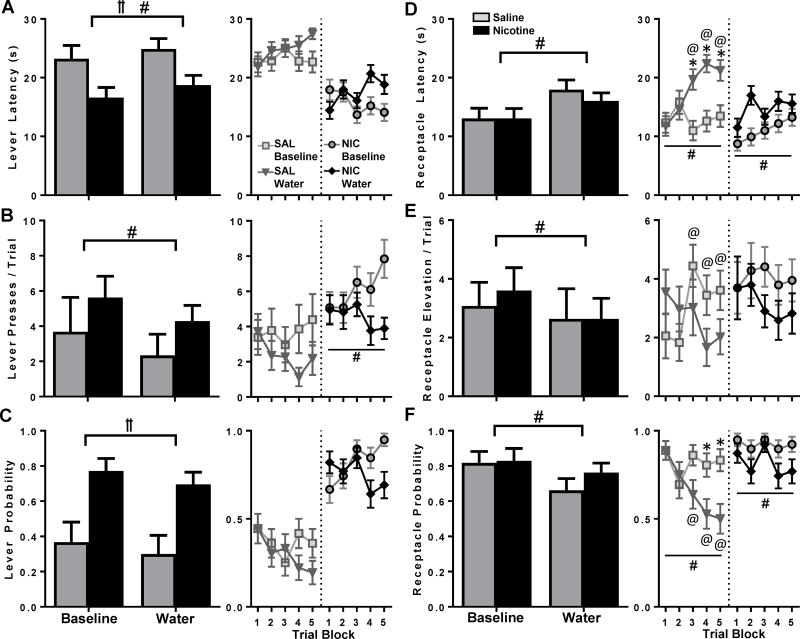
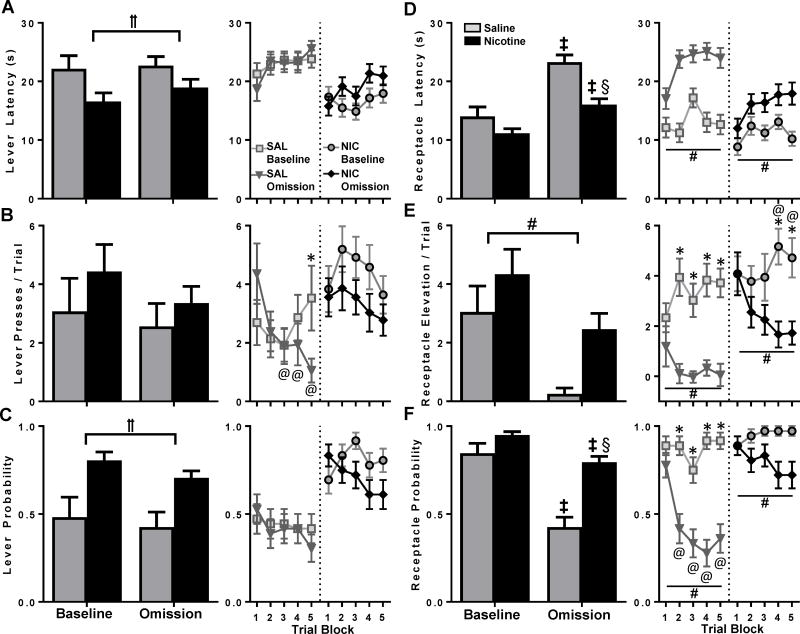
Conditioned stimuli contribute to the resilience of nicotine addiction in that nicotine-associated cues can influence smokers and promote relapse. These stimuli are thought to acquire incentive motivational properties through a Pavlovian mechanism, and this phenomenon can be measured in animals by observing conditioned approach to the conditioned stimulus (sign-tracking) or to the location of unconditioned stimulus delivery (goal-tracking). Goal-tracking is thought to be more flexible than sign-tracking in response to changes in expected outcome. Nicotine exposure can increase the expression of conditioned responses, and we hypothesized that animals exposed to nicotine would also exhibit less flexible conditioned responses after a change in the expected unconditioned stimulus. Adult male rats were exposed to nicotine (0.4mg/kg, s.c.) or saline before Pavlovian conditioned approach training sessions. After training, animals underwent test sessions that reduced (water substitution) or withheld (omission) the unconditioned stimulus (US, 20% sucrose). As expected, nicotine enhanced sign- and goal-tracking. Water substitution moderately and nonspecifically reduced both sign- and goal-tracking in all rats. In contrast, US omission only reduced goal-tracking, with robust effects in saline-exposed rats and smaller effects in nicotine-exposed rats. These data support the hypothesis that both sign-tracking and nicotine exposure confer behavioral inflexibility under US omission.
条件刺激有助于尼古丁成瘾的恢复力,因为与尼古丁相关的线索会影响吸烟者并促使复发。这些刺激被认为通过巴甫洛夫机制获得激励动机属性,并且这种现象可以在动物中通过观察对条件刺激的条件性接近(信号追踪)或对无条件刺激给予位置的条件性接近(目标追踪)来测量。在应对预期结果变化时,目标追踪被认为比信号追踪更具灵活性。尼古丁暴露可增加条件反应的表达,并且我们假设暴露于尼古丁的动物在预期无条件刺激发生变化后也会表现出灵活性较低的条件反应。成年雄性大鼠在进行巴甫洛夫条件性接近训练前接受尼古丁(0.4mg/kg,皮下注射)或生理盐水注射。训练后,动物接受测试,其中减少(用水替代)或不给予(省略)无条件刺激(US,20%蔗糖)。正如预期的那样,尼古丁增强了信号追踪和目标追踪。用水替代适度且非特异性地降低了所有大鼠的信号追踪和目标追踪。相比之下,省略无条件刺激仅降低了目标追踪,对接受生理盐水注射的大鼠影响较大,对接受尼古丁注射的大鼠影响较小。这些数据支持了信号追踪和尼古丁暴露在省略无条件刺激时都会导致行为灵活性降低的假设。