Department of Ecology and Genetics/Limnology, Uppsala University, Uppsala, Sweden.
Department of Chemistry and Molecular Biology, University of Gothenburg, Gothenburg, Sweden.
Microbiome. 2018 Feb 6;6(1):28. doi: 10.1186/s40168-018-0400-0.
Gut microbiota provide functions of importance to influence hosts' food digestion, metabolism, and protection against pathogens. Factors that affect the composition and functions of gut microbial communities are well studied in humans and other animals; however, we have limited knowledge of how natural food web factors such as stress from predators and food resource rations could affect hosts' gut microbiota and how it interacts with host sex. In this study, we designed a two-factorial experiment exposing perch (Perca fluviatilis) to a predator (pike, Esox lucius), and different food ratios, to examine the compositional and functional changes of perch gut microbiota based on 16S rRNA amplicon sequencing. We also investigated if those changes are host sex dependent.
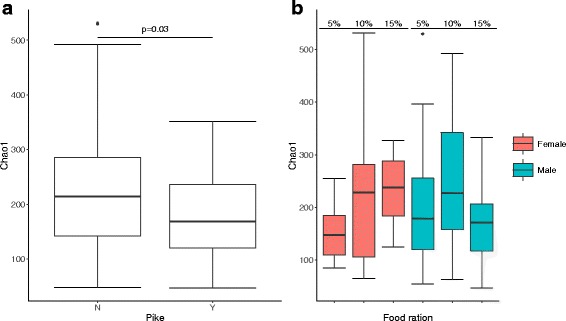
We showed that overall gut microbiota composition among individual perch significantly responded to food ration and predator presence. We found that species richness decreased with predator presence, and we identified 23 taxa from a diverse set of phyla that were over-represented when a predator was present. For example, Fusobacteria increased both at the lowest food ration and at predation stress conditions, suggesting that Fusobacteria are favored by stressful situations for the host. In concordance, both food ration and predation stress seemed to influence the metabolic repertoire of the gut microbiota, such as biosynthesis of other secondary metabolites, metabolism of cofactors, and vitamins. In addition, the identified interaction between food ration and sex emphasizes sex-specific responses to diet quantity in gut microbiota.
Collectively, our findings emphasize an alternative state in gut microbiota with responses to changes in natural food webs depending on host sex. The obtained knowledge from this study provided us with an important perspective on gut microbiota in a food web context.
肠道微生物群为宿主提供了重要的功能,影响宿主的食物消化、代谢和抵御病原体的能力。影响肠道微生物群落组成和功能的因素在人类和其他动物中已经得到了很好的研究;然而,我们对自然食物网因素(如捕食者的压力和食物资源配给)如何影响宿主的肠道微生物群,以及它如何与宿主性别相互作用知之甚少。在这项研究中,我们设计了一个两因素实验,使鲈鱼(Perca fluviatilis)暴露于捕食者(梭子鱼,Esox lucius)和不同的食物比例下,以检查基于 16S rRNA 扩增子测序的鲈鱼肠道微生物群落的组成和功能变化。我们还研究了这些变化是否与宿主性别有关。
我们表明,个体鲈鱼的整体肠道微生物群落组成明显对食物比例和捕食者存在有反应。我们发现,当存在捕食者时,物种丰富度下降,我们从一个多样化的门中鉴定出 23 个分类群,这些分类群在存在捕食者时被过度代表。例如,梭菌属在最低食物比例和捕食压力条件下都增加了,这表明梭菌属在宿主面临压力的情况下更受欢迎。与此一致,食物比例和捕食压力似乎都影响了肠道微生物群的代谢谱,如其他次生代谢物的生物合成、辅因子和维生素的代谢。此外,确定的食物比例和性别之间的相互作用强调了肠道微生物群对饮食量的性别特异性反应。
总的来说,我们的研究结果强调了肠道微生物群的一种替代状态,它对自然食物网的变化有反应,取决于宿主的性别。从这项研究中获得的知识使我们对食物网背景下的肠道微生物群有了一个重要的认识。