Division of Chemistry, Graduate School of Science, Kyoto University, Kitashirakawa-Oiwakecho, Sakyo-ku, Kyoto, 606-8502, Japan.
Department of Applied Quantum Physics and Nuclear Engineering, Kyushu University, 744 Motooka, Nishi-ku, Fukuoka, 819-0395, Japan.
Nat Commun. 2018 Feb 6;9(1):510. doi: 10.1038/s41467-018-02933-6.
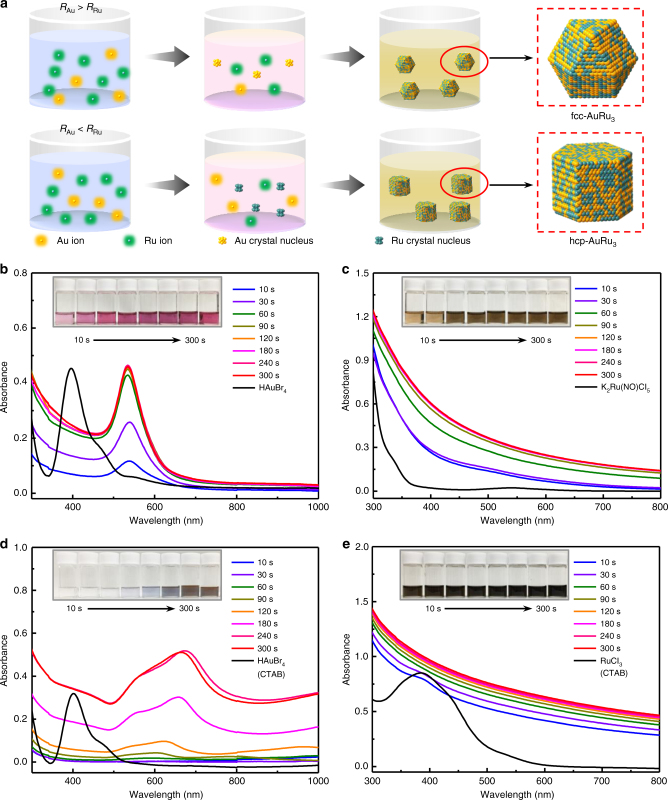
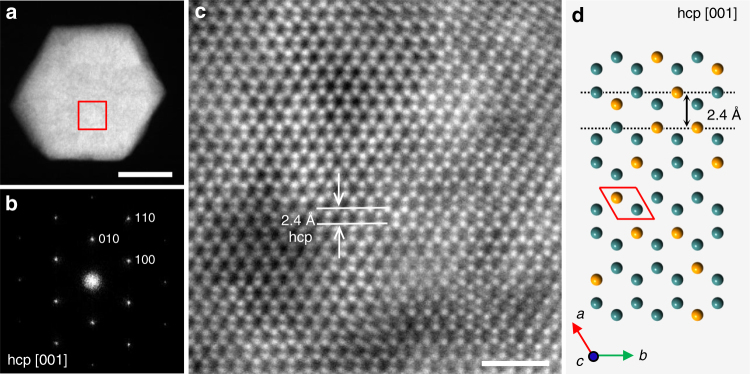
Binary solid-solution alloys generally adopt one of three principal crystal lattices-body-centred cubic (bcc), hexagonal close-packed (hcp) or face-centred cubic (fcc) structures-in which the structure is dominated by constituent elements and compositions. Therefore, it is a significant challenge to selectively control the crystal structure in alloys with a certain composition. Here, we propose an approach for the selective control of the crystal structure in solid-solution alloys by using a chemical reduction method. By precisely tuning the reduction speed of the metal precursors, we selectively control the crystal structure of alloy nanoparticles, and are able to selectively synthesize fcc and hcp AuRu alloy nanoparticles at ambient conditions. This approach enables us to design alloy nanomaterials with the desired crystal structures to create innovative chemical and physical properties.
二元固溶合金通常采用三种主要晶格结构之一——体心立方(bcc)、六方密排(hcp)或面心立方(fcc)——其中结构由组成元素和成分决定。因此,选择性控制具有特定成分的合金的晶体结构是一项重大挑战。在这里,我们提出了一种通过化学还原法选择性控制固溶合金晶体结构的方法。通过精确调整金属前体的还原速度,我们选择性地控制了合金纳米粒子的晶体结构,能够在环境条件下选择性地合成 fcc 和 hcp AuRu 合金纳米粒子。该方法使我们能够设计具有所需晶体结构的合金纳米材料,从而创造出创新的化学和物理性质。