van Dijke Annemiek, Hopman Juliette A B, Ford Julian D
Yulius Academy/Yulius/COLK Centre for Psychosomatics Yulius, Dordrecht - Zaandam, the Netherlands.
Department of Clinical Psychology, VU University Amsterdam, Rotterdam, the Netherlands.
Eur J Psychotraumatol. 2018 Jan 23;9(1):1400878. doi: 10.1080/20008198.2017.1400878. eCollection 2018.
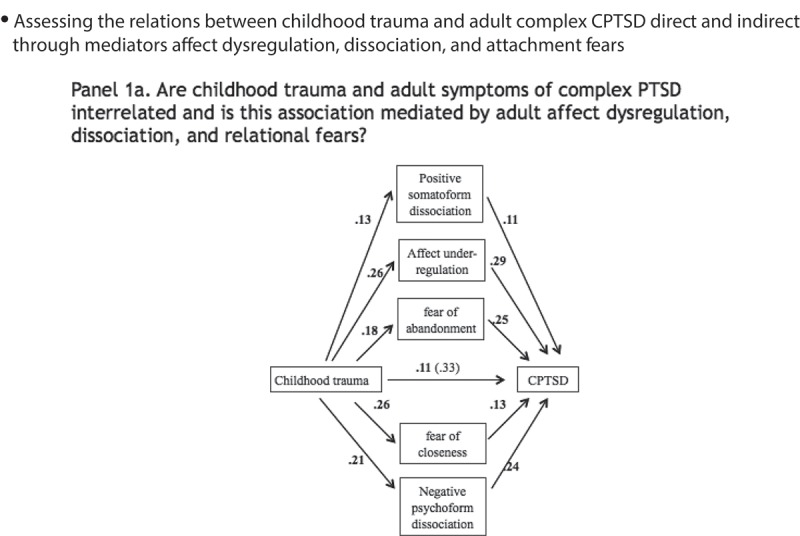
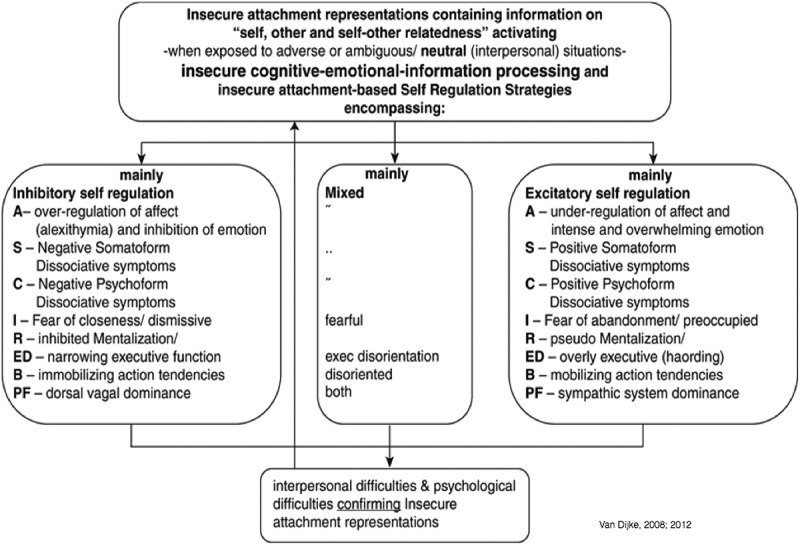
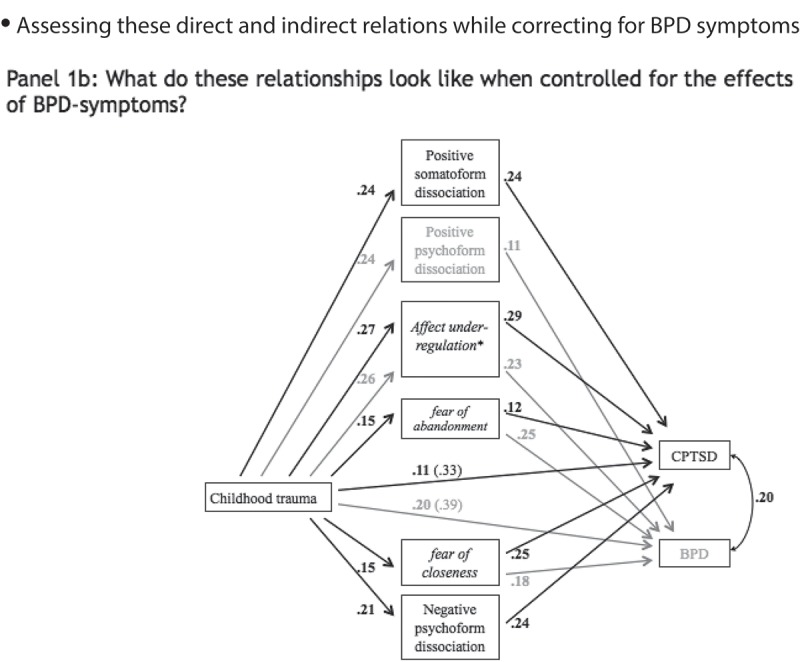
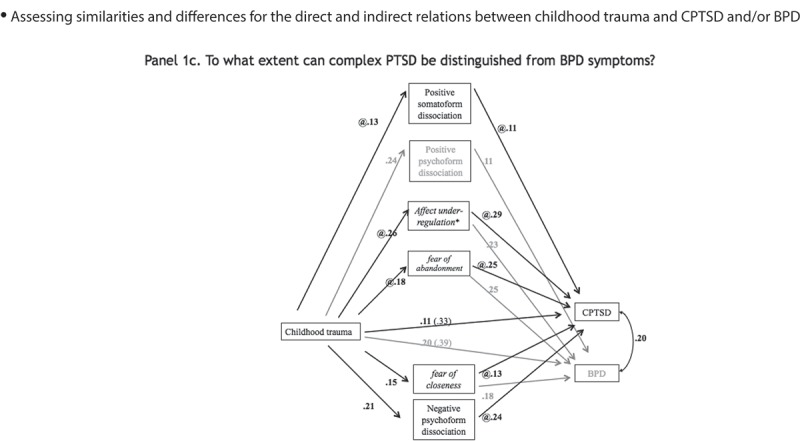
: Complex posttraumatic stress disorder (CPTSD) as defined by the Disorders of Extreme Stress Not Otherwise Specified (DESNOS) formulation is associated with childhood relational trauma and involves relational impairment, affect dysregulation, and identity alterations. However, the distinct contributions of relational impairment (operationalized in the form fears of closeness or abandonment), affect dysregulation (operationalized in the form of overregulation and under-regulation of affect), and identity alterations (operationalized in the form of positive or negative psychoform or somatoform dissociation) to the relationship between childhood trauma and CPTSD/DESNOS have not been systematically tested. : In a clinical sample of adults diagnosed with severe and chronic psychiatric and personality disorders ( = 472; = 34.7 years, = 10.1), structural equation modelling with bootstrap 95% confidence intervals demonstrated that the association between childhood trauma and CPTSD/DESNOS symptoms in adulthood was partially mediated by under-regulation of affect, negative psychoform dissociation, and adult relational fears of closeness and of abandonment. These results also were independent of the effects of borderline personality disorder (BPD) symptoms. : Some, but not all, hypothesized components of the DESNOS formulation of CPTSD statistically mediate the relationship between childhood trauma and adult CPTSD/DESNOS. These relationships appear specific to CPTSD/DESNOS and not to the effects of another potential sequelae of childhood trauma BPD. Replication with prospective longitudinal studies is needed.
极端应激未另作规定的障碍(DESNOS)所定义的复杂性创伤后应激障碍(CPTSD)与童年期关系性创伤相关,涉及关系损害、情感失调和身份改变。然而,关系损害(以对亲密或被抛弃的恐惧形式体现)、情感失调(以情感的过度调节和调节不足形式体现)以及身份改变(以积极或消极的心理形式或躯体形式解离形式体现)对童年创伤与CPTSD/DESNOS之间关系的独特作用尚未得到系统检验。
在一个诊断为严重慢性精神和人格障碍的成年临床样本(n = 472;平均年龄 = 34.7岁,标准差 = 10.1)中,采用自抽样95%置信区间的结构方程模型表明,童年创伤与成年期CPTSD/DESNOS症状之间的关联部分由情感调节不足、消极心理形式解离以及成年人对亲密和被抛弃的关系性恐惧所介导。这些结果也独立于边缘型人格障碍(BPD)症状的影响。
CPTSD的DESNOS表述中一些(但并非全部)假设成分在统计学上介导了童年创伤与成年期CPTSD/DESNOS之间的关系。这些关系似乎特定于CPTSD/DESNOS,而非童年创伤的另一个潜在后果BPD的影响。需要通过前瞻性纵向研究进行重复验证。