Peláez-Jaramillo Maria J, Cárdenas-Mojica Allison A, Gaete Paula V, Mendivil Carlos O
Universidad de los Andes School of Medicine, Bogotá, Colombia.
Endocrinology Section, Department of Internal Medicine, Fundación Santa Fe de Bogotá, Bogotá, Colombia.
Diabetes Ther. 2018 Apr;9(2):521-543. doi: 10.1007/s13300-018-0374-8. Epub 2018 Feb 6.
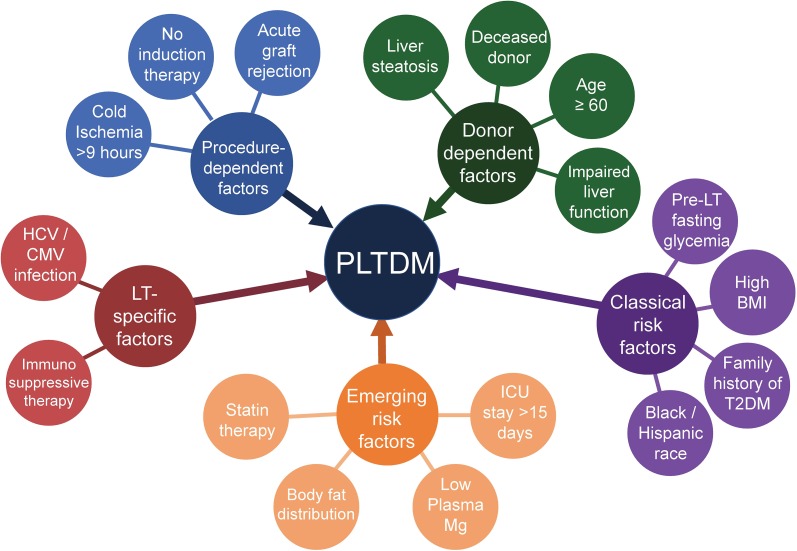
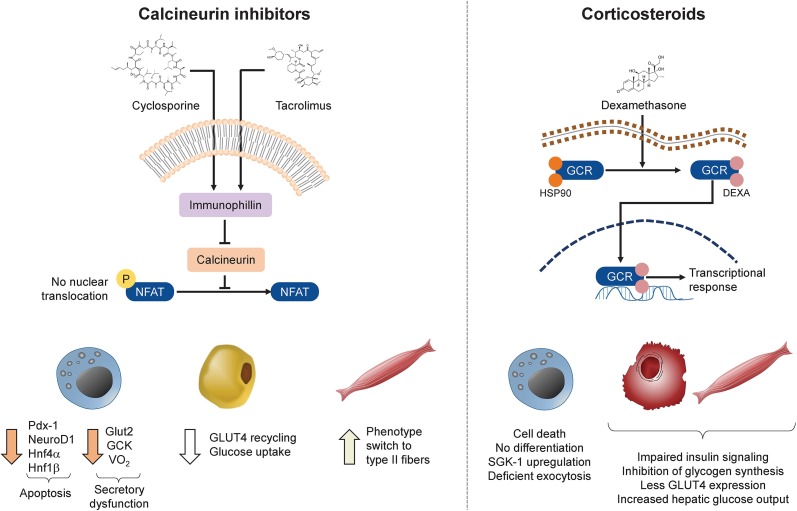
Post-liver transplantation diabetes mellitus (PLTDM) develops in up to 30% of liver transplant recipients and is associated with increased risk of mortality and multiple morbid outcomes. PLTDM is a multicausal disorder, but the main risk factor is the use of immunosuppressive agents of the calcineurin inhibitor (CNI) family (tacrolimus and cyclosporine). Additional factors, such as pre-transplant overweight, nonalcoholic steatohepatitis and hepatitis C virus infection, may further increase risk of developing PLTDM. A diagnosis of PLTDM should be established only after doses of CNI and steroids are stable and the post-operative stress has been overcome. The predominant defect induced by CNI is insulin secretory dysfunction. Plasma glucose control must start immediately after the transplant procedure in order to improve long-term results for both patient and transplant. Among the better known antidiabetics, metformin and DPP-4 inhibitors have a particularly benign profile in the PLTDM context and are the preferred oral agents for long-term management. Insulin therapy is also an effective approach that addresses the prevailing pathophysiological defect of the disorder. There is still insufficient evidence about the impact of newer families of antidiabetics (GLP-1 agonists, SGLT-2 inhibitors) on PLTDM. In this review, we summarize current knowledge on the epidemiology, pathogenesis, course of disease and medical management of PLTDM.
肝移植后糖尿病(PLTDM)在高达30%的肝移植受者中发生,并且与死亡率增加及多种不良结局相关。PLTDM是一种多因素疾病,但其主要危险因素是使用钙调神经磷酸酶抑制剂(CNI)家族的免疫抑制剂(他克莫司和环孢素)。其他因素,如移植前超重、非酒精性脂肪性肝炎和丙型肝炎病毒感染,可能会进一步增加发生PLTDM的风险。只有在CNI和类固醇剂量稳定且术后应激已消除后,才能确诊PLTDM。CNI引起的主要缺陷是胰岛素分泌功能障碍。移植手术后必须立即开始控制血糖,以改善患者和移植的长期结局。在较为知名的抗糖尿病药物中,二甲双胍和二肽基肽酶-4(DPP-4)抑制剂在PLTDM情况下具有特别良好的安全性,是长期管理的首选口服药物。胰岛素治疗也是一种有效的方法,可解决该疾病普遍存在的病理生理缺陷。关于新型抗糖尿病药物家族(胰高血糖素样肽-1(GLP-1)激动剂、钠-葡萄糖协同转运蛋白2(SGLT-2)抑制剂)对PLTDM的影响,目前仍证据不足。在本综述中,我们总结了关于PLTDM的流行病学、发病机制、病程及药物治疗的现有知识。